header 1500

.
  • Home
  • I Learn the Truth
    • 1 Lincoln’s Secret Weapon
    • 2 Of the People, by the People, for the People
    • 3 The Meaning and History of our Constitution
      • 29 Second Inaugural Address March 4 1865
    • 4 Explaining Lincoln’s Biggest Mistake
    • 5 How Story helped Lincoln find his calling in life
    • 6 Lincoln Lyceum Speech January 27 1838
    • 7 Lincoln Peoria Speech October 16 1854
    • 8 Republican Party Platform June 17 1856
    • 9 Dred Scott 1857 Dissent Opinions
    • 10 House Divided Speech June 16 1858
  • II Tell the Truth
    • 11 Second Campaign Speech Chicago July 10 1858
    • 12 First Debate Ottawa Illinois August 21 1858
    • 13 Second Debate Freeport Doctrine August 27 1858
    • 14 Third Debate Jonesboro September 15 1858
    • 15 Fifth Debate Galesburg October 7 1858
    • 16 Douglas Popular Sovereignty September 7 1859
    • 17 Lincoln Cincinnati Speech September 17 1859
    • 18 Lincoln Indianapolis Speech September 19 1859
    • 19 Lincoln Cooper Union Address February 27 1860
    • 20 Lincoln’s Chicago Miracle
  • III Defend the Constitution
    • 21 First Inaugural Address March 4 1861
    • 22 Message to Congress July 4 1861
    • 23 First Annual Message December 2 1861
    • 24 Second Annual Message December 1 1862
    • 25 Emancipation Proclamation January 1 1863
    • 26 Gettysburg Address November 19 1863
    • 27 Third Annual Message December 8 1863
    • 28 Fourth Annual Message December 6 1864
  • Lincoln Republicans
  • American Patriots
  • Contact Us

Part III Lincoln’s Commitment to Defend the Constitution

The third 10 chapters occur after Lincoln is elected President. By honoring his Oath of Office to Preserve, Protect and Defent our Constitution, Lincoln saved our nation and our civil rights.

3.00

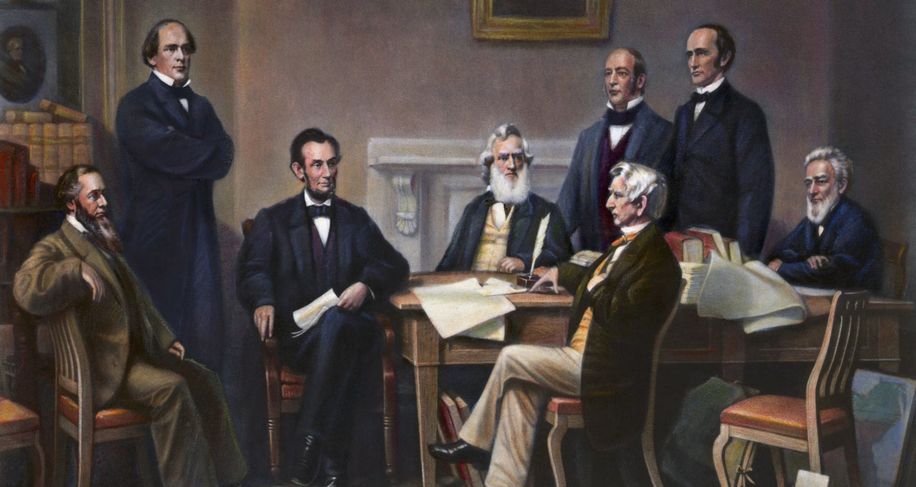
An image of Lincoln meeting with his cabinet.

21 First Inaugural Address March 4 1861

By the time Lincoln gave this speech, several Southern states, shown in blue, had already ceded from the Union. Four more would leave the Union after Fort Sumter was taken.
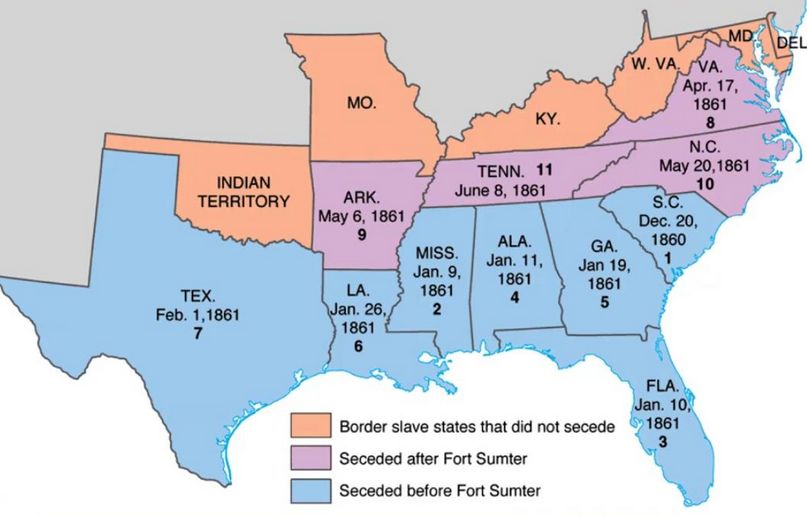
21.01a

******************************************************************************

Fellow-Citizens of the United States:

Apprehension seems to exist among the people of the Southern States that, by the accession of a Republican Administration, their property and their peace and personal security are to be endangered. There has never been any reasonable cause for such apprehension. Indeed, the most ample evidence to the contrary has all the while existed. It is found in nearly all the published speeches of him who now addresses you. I do but quote from one of those speeches when I declare that I have no purpose, directly or indirectly, to interfere with the institution of slavery in the States where it exists. I believe I have no lawful right to do so, and I have no inclination to do so.

Those who nominated and elected me did so with full knowledge that I had made this and many similar declarations and had never recanted them; and more than this, they placed in the platform for my acceptance, and as a law to themselves and to me, the clear and emphatic resolution which I now read:
Read more: 21 First Inaugural Address March 4 1861

22 Message to Congress July 4 1861

The message to Congress on July 4, 1861—which is not nearly so well known as it deserves to be—illustrates several of Lincoln’s traits as a thinker and communicator. One of Lincoln’s traits was the slow, gradual development of an idea. Lincoln had long supported the Constitution and long opposed slavery as a moral, political and social wrong. What changed over time was his ability to use simple logic to persuade others to support the Constitution and oppose slavery. His many debates with Douglas allowed him to develop analogies which resonated with the public – culminating in his Cooper Union speech in February 1860. This speech led to his nomination and election.

His July 4 1861 message to Congress came only a year later with many questioning the wisdom of opposing the Southern Rebellion. Lincoln’s first sentence goes directly to the reason… defending the Constitution of the United States.

Read more: 22 Message to Congress July 4 1861

23 First Annual Message December 2 1861

Between July 4, 1861 and December 2 1861, there were several battles and other events – most of which did not go well for Lincoln and his Union supporters.

On July 21, 1861, Confederate forces won the First Battle of Bull Run in Virginia, the first major land battle of the war, forcing a Union retreat toward Washington, D.C. Six days later, Lincoln appointed McClellan to command the Army of the Potomac.

On August 10, 1861, Confederate forces won the Battle of Wilson's Creek near Springfield, Missouri, the first major battle west of the Mississippi River.

On September 20, 1861, Confederate forces won the the First Battle of Lexington – capturing Lexington Missouri.

On October 21, 1861, Confederate forces won the Battle of Ball's Bluff in Virginia.

It was therefore not certain that the Union would win the Civil War. The first problem was a lack of training for the Union Army. They were basically raw recruits. But the biggest problem seemed to be a lack of leadership of the Union Army. The Generals were reluctant to engage the rebels and when they did engage the rebels, they were nearly always out smarter by rebel tactics.

Read more: 23 First Annual Message December 2 1861

24 Second Annual Message December 1 1862

In the year between December 1861 and December 1862, the Civil War slowly began to turn in the Union’s favor.

In February, 1862, Union forces under Grant captured Fort Henry and Fort Donelson, opening the Tennessee and Cumberland rivers.

In March, 1862, Union forces won the Battle of Pea Ridge in Arkansas, securing Union control over much of Missouri.

In April, 1862, Grant won the deadly Battle of Shiloh in Tennessee. Also in April, 1862 the Union fleet captured New Orleans.

In June, 1862, Lee assumed control over the Confederate Army and defeated the Union Army in the Battle for Richmond.

In August, 1862, Confederate forces won a major victory at the Second Battle of Bull Run in Virginia.

On September 17, 1862, Union forces “won” the Battle of Antietam in Maryland, marking the single bloodiest day in American military history and halting Lee's first northern invasion. As a result of this dubious victory, on September 22, 1862, Lincoln issued the Emancipation Proclamation – freeing all the slaves in states engaged in Rebellion.

On October 8, 1862 Union forces “won” the Battle of Kentucky

On November 7, 1862, Lincoln gave up on McClellan and replaced him with Burnside

Read more: 24 Second Annual Message December 1 1862

25 Emancipation Proclamation January 1 1863

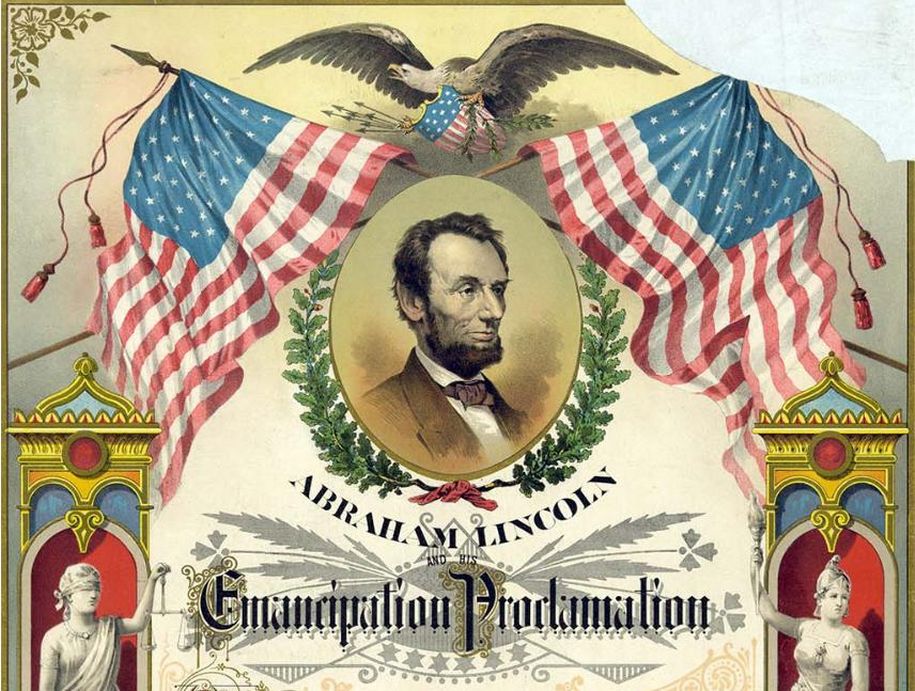
The Proclamation ordered the freedom of all slaves in 10 states. Because it was issued under the President's authority to suppress rebellion (war powers), it necessarily excluded areas not in rebellion, but still applied to more than 3.5 million of the 4 million slaves. The Proclamation was based on the President's constitutional authority as commander in chief of the armed forces. Slaves in the north were not freed until passage of the 13th Amendment in December 1865.

25.01

************************************************************************

January 1, 1863

By the President of the United States of America: A Proclamation.

Read more: 25 Emancipation Proclamation January 1 1863

26 Gettysburg Address November 19 1863

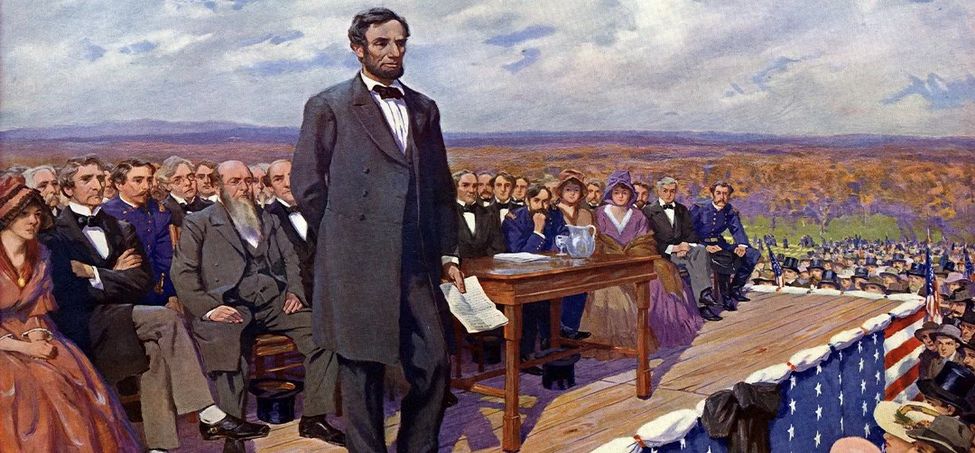
In November 1863, President Abraham Lincoln was invited to deliver remarks at the dedication of a cemetery on the site of the Battle of Gettysburg, which had raged in the Pennsylvania countryside for three days during the previous July.

In the famous opening words, "Four score and seven years ago," Lincoln does not refer to the United States Constitution, but to the Declaration of Independence. That is important as Lincoln was invoking Jefferson's phrase that "all men are created equal" as being central to the American government.

26.01

Read more: 26 Gettysburg Address November 19 1863

27 Third Annual Message December 8 1863

In the first part of 1863, Southern forces had several major victories. But on July 4, 1863, two major Union victories dramatically changed the course of the war in favor of the Union.

December 1862, Lee defeated Burnside in the Battle of Frederickburg.

May 1863, Lee defeated Hooker in the Battle of Chancellorsville.

June 20, 1863, West Virginia was admitted to the union as the 35th State.

July 4, 1863 Union forces under Grant won the Battle of Vicksburg – taking full control of the Mississippi River

July 4, 1863 Union forces under Meade won the Battle of Gettysburg – ending Lee’s Second Invasion of the North.

November 19, 1863 Lincoln delivers the Gettysburg Address

November 25, 1863 Union forces under Grant defeated Confederate forces in the Battle for Tennessee.

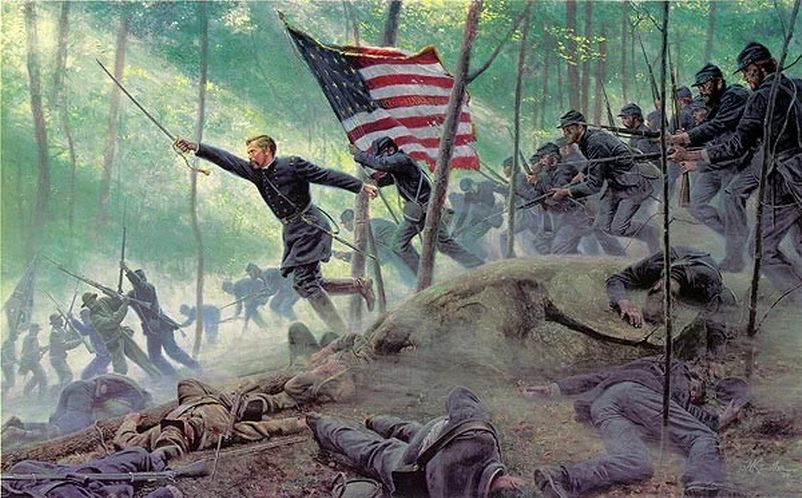
Defense of Little Round Top Bayonet Charge –
the turning point in the Battle of Gettysburg

27.01

Below is Lincoln’s Third Annual Message to Congress

Read more: 27 Third Annual Message December 8 1863

28 Fourth Annual Message December 6 1864

1864 saw Lincoln replace Meade with Grant - who then began the assault that led eventually to Union victory. Equally important, Lincoln overcame all odds to win the 1864 election over McClellan.

March 10, 1864 Lincoln places Grant in charge of all Union Armies.

May 1864 Grant launches the Overland Campaign in Virginia and has several costly victories in Virginia including the Wilderness, Spotsylvania, and Cold Harbor.

June 1864 Grant begins the Siege of Vicksburg trapping Lee and his forces.

September 1, 1864 Sherman wins the Battle of Atlanta providing a huge moral boost for the Union just weeks before the 1864 election.

November 8, 1864 Lincoln wins re-election.

November 30, 1864 Union forces defeat Hood in the Battle of Franklin Tennessee.

Read more: 28 Fourth Annual Message December 6 1864

29 Second Inaugural Address March 4 1865

The Civil War ended in 1865 with several major union victories.

On January 31, 1865, Congress passed the 13th Amendment abolishing slavery.

On March 4 1865 Lincoln delivered his Second Inaugural Address (See image below)

On April 9, 1865 Lee surrendered to Grant at Appomattox Court House

Lincoln reading his Second Inaugural Address. Look for him below and to the left of the American Flag just above the small white table with a glass of water on it. Some have claimed this short speech was his finest speech.

Read more: 29 Second Inaugural Address March 4 1865

30 Honoring Lincoln’s Legacy

Following President Abraham Lincoln's assassination on April 14, 1865, his funeral train carried his remains and the casket of his son Willie roughly 1,654 to 1,700 miles from Washington, D.C., to Springfield, Illinois. Departing Washington on April 21, 1865, the journey generally reversed Lincoln's 1861 pre-inaugural rail route and concluded with his burial in Springfield on May 4, 1865.

The train took 3 weeks to travel across 7 states and hundreds of cities and towns at speeds never exceeding 20 miles per hour. The train made stops and public viewings in major cities—including Baltimore, Harrisburg, Philadelphia, New York City, Albany, Buffalo, Cleveland, Columbus, Indianapolis, and Chicago—before reaching Springfield. Over seven million people viewed the train along the route, with millions more participating in formal ceremonies in cities and towns all across the United States.

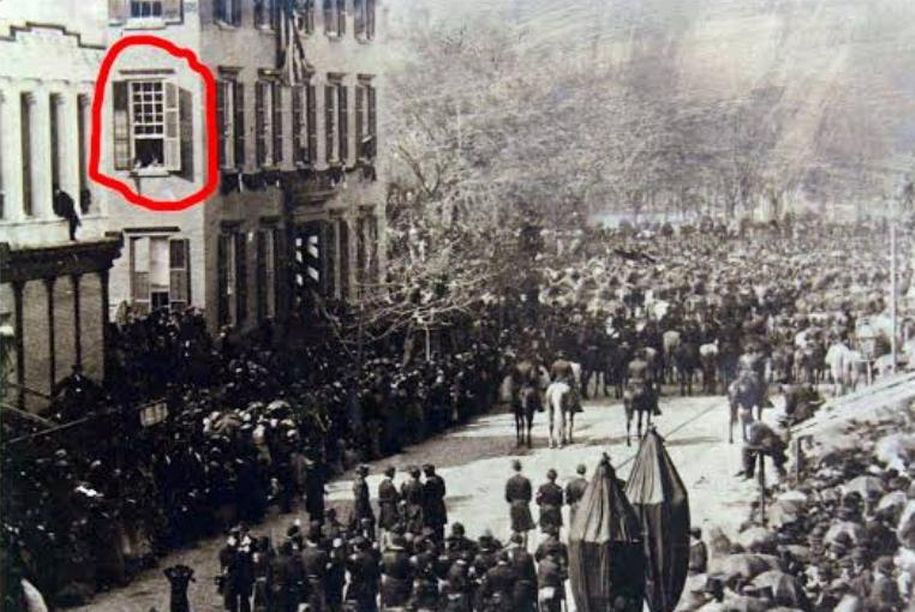
In New York City, on April 25, 1865, tens of thousands of people marched in the largest funeral procession in the city’s history -witnessed by over a half million people. One of those people was 6 year old Teddy Roosevelt – who later became President after another Presidential Assasination (see red circle):

30.01

Lincoln gave his last full measure of devotion that our government of the People, by the People, for the People shall not perish. We all owe him a debt that can never be fully paid. Still, it is up to us, the living to continue in his footsteps – to honor, protect and defend our precious Constitution – and work together to win this Second Civil War and thereby restore our essential civil rights by learning from Lincoln.

One simple way to honor the memory of Lincoln would be to share this book with your friends and neighbors.

Read more: 30 Honoring Lincoln’s Legacy
  • Home
  • I Learn the Truth
    • 1 Lincoln’s Secret Weapon
    • 2 Of the People, by the People, for the People
    • 3 The Meaning and History of our Constitution
      • 29 Second Inaugural Address March 4 1865
    • 4 Explaining Lincoln’s Biggest Mistake
    • 5 How Story helped Lincoln find his calling in life
    • 6 Lincoln Lyceum Speech January 27 1838
    • 7 Lincoln Peoria Speech October 16 1854
    • 8 Republican Party Platform June 17 1856
    • 9 Dred Scott 1857 Dissent Opinions
    • 10 House Divided Speech June 16 1858
  • II Tell the Truth
    • 11 Second Campaign Speech Chicago July 10 1858
    • 12 First Debate Ottawa Illinois August 21 1858
    • 13 Second Debate Freeport Doctrine August 27 1858
    • 14 Third Debate Jonesboro September 15 1858
    • 15 Fifth Debate Galesburg October 7 1858
    • 16 Douglas Popular Sovereignty September 7 1859
    • 17 Lincoln Cincinnati Speech September 17 1859
    • 18 Lincoln Indianapolis Speech September 19 1859
    • 19 Lincoln Cooper Union Address February 27 1860
    • 20 Lincoln’s Chicago Miracle
  • III Defend the Constitution
    • 21 First Inaugural Address March 4 1861
    • 22 Message to Congress July 4 1861
    • 23 First Annual Message December 2 1861
    • 24 Second Annual Message December 1 1862
    • 25 Emancipation Proclamation January 1 1863
    • 26 Gettysburg Address November 19 1863
    • 27 Third Annual Message December 8 1863
    • 28 Fourth Annual Message December 6 1864
  • Lincoln Republicans
  • American Patriots
  • Contact Us