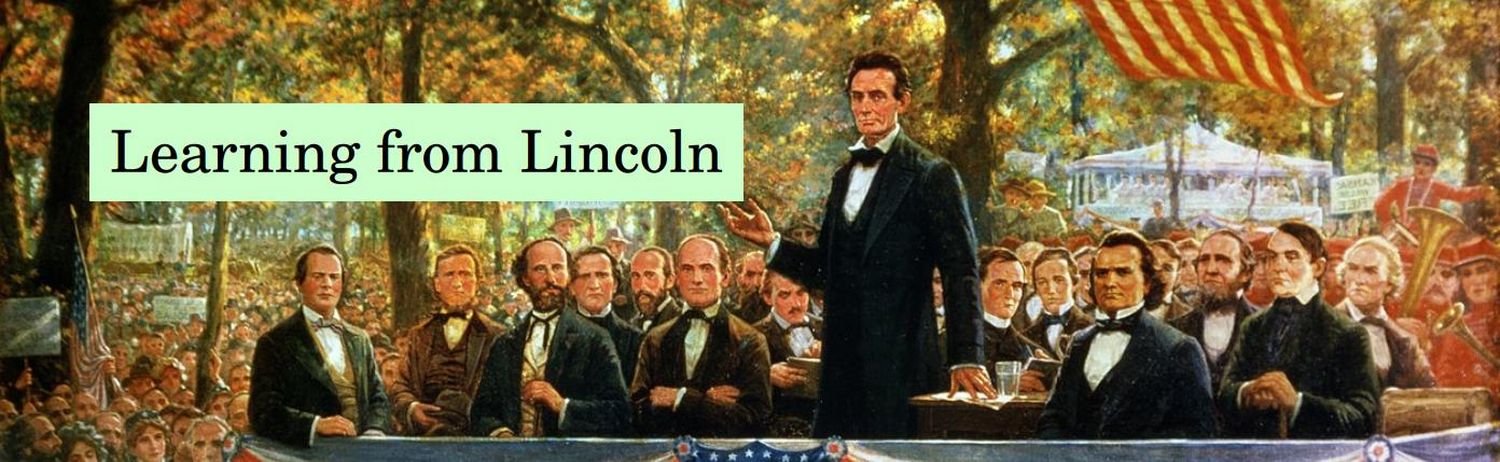
Some have claimed that the last Civil War was a battle over slavery while others claim it was a battle over States Rights versus Federal Rights. After reading Story’s Commentaries, you will hopefully come to see that neither of these claims is entirely accurate. Instead, the true meaning of Lincoln’s speeches leads to the conclusion that the Civil War was actually about preserving our Constitutional Republic.
When Lincoln said that the Civil War was about “preserving the Union,” what he meant by “Union” was the “more perfect union” described in the Preamble to the Constitution which states that:
“We the People of the United States, in order to form a more perfect Union, establish Justice, insure domestic Tranquility, provide for the common defense, promote the general Welfare, and secure the Blessings of Liberty to ourselves and our Posterity, do ordain and establish this Constitution for the United States of America.”
In short, the foundation of our more perfect Union is the Constitution. Prior to the creation of our Constitution, in 1787, We, the People, had spent several harsh years enduring a LESS PERFECT UNION due to the Articles of Confederation that left each State to make its own way. The result was economic warfare that divided the States - and no way to resolve conflicts between the States. By 1786, other than New York, nearly every State was near economic collapse and political chaos.
In his book, Commentaries on the Constitution, Joseph Story has an entire chapter on the drawbacks of the Articles of Confederation and another chapter on the meaning and history of the Preamble. For example, the words “We the People” means ALL of the People of the United States.
A major misunderstanding that led to the last Civil War was the false belief that the States had ratified the Constitution and therefore that any State could leave the Union whenever it’s State legislature wished. Instead, what really happened was that the People in each State held Constitutional Conventions open not merely to state legislatures but to the People. Once ratified by the People, a new group was created called We, the People of the United States.
Thus, the Constitution was created in a radically different way than the Articles of Confederation. To avoid this misunderstanding about who created the Constitution in the future and because this misunderstanding (about “States Rights” versus the rights of We, the People) is a part of our current Constitutional Crisis, we should begin with a review of the meaning of a few important words.
The word “sovereign” was used to claim that each state was “sovereign” or independent from the other states. Each State being independent from the other States may have been true under the Articles of Confederation. But it was not true and is not true under the US Constitution – for reasons we will explain throughout this book.
The word “sovereign” is also used by individuals to claim they are independent from other people and need not comply with the Constitution because they personally have not given their “Consent” to abide by the Constitution. This also leads down a dangerous and even deadly path whereby we would all lose our liberties – because the Constitution together with the Bill of Rights is designed to protect our rights and liberties. Without the Constitution, and the Union based on that Constitution, tyranny and or anarchy are just around the corner.
In truth, the word “sovereign” means possessing supreme or ultimate power. Historically, it referred to a King. In modern democracies, some claim that each person is sovereign meaning that, in theory, each of us is independent and ruled by no one. But while in theory, there is no difference between theory and reality, in reality, there is often a major difference between theory and reality.
In reality, no single person is actually independent from others - or has ever been or ever will be completely free. We begin as children entirely dependent on our parents for food and guidance. As we grow, we marry and create a family which is part of an extended family of grandparents, aunts and uncles.
Extended families in turn live in communities with other extended families. None of us could thrive or even survive without the support and help of our family and our community.
Communities in turn require communication – the sharing of knowledge and creation of a common shared vision.
As relationships grow more complex, social rules are needed. Communities form tribes of people who speak the same language and share the same customs. Tribes might unite with other tribes in order to trade and for defense. When they unite with other tribes, at least initially, each tribe might retain their own local control. When tribes first join forces they form what can be called a “Confederation.”
Confederation versus Federation
The word “Confederation” comes from the Latin word “confoedertio” which means to unite several groups or tribes into a league. The Latin word “Con” means together and the Latin word “Foedus” means a league. But not just any league. Instead a confederation is a political union which consists of a number of independent (or sovereign) groups forming a loose alliance with no centralized control. In contrast to Confederation, the word “Federation” means combining several states or groups or tribes into a single group with at least some centralized control. The difference between the two terms is that the first word includes “con” while the second word does not. From the word Federation comes the word, Federal as in the “federalists” who supported our Constitution versus Anti-federalists who opposed our Constitution.
Conflict versus Consensus
Con means together and flict comes from fligere which means to strike. So “Conflict” means a battle between two opposing groups. It also means disagreement as in two groups of people with conflicting opinions. Another English word for Conflict is “War” which comes from the old Saxon word “werran” which in Old English and Old French was “werre.”
Consensus comes from con which means together and “sentire” which means to feel. So “Consensus” means to feel like you are together or in agreement.
But just as English can have one word with more than one meaning, so Latin words can have more than one meaning. Another meaning of “Con” is as an abbreviation for “contra” which means being against something. The opposite of Con in Latin is Pro which means to be in favor of something.
It is useful to think of a Confederation as being “against federation” – or against any central authority or not trusting any central authority while a federation is in favor of at least some federal authority.
This lack of trust between the colonies was common when they first formed the United States in 1776. Each state had their own legislature and their own laws which often were in conflict with the laws of other states. The main reason they came together under the Articles of Confederation was to fight against the British. Once the British were defeated, the leaders of each State mistakenly thought they did not need the other States any more. They failed to understand that the War with Britain was not over yet. In fact, Britain just changed the War from a political war to an economic War. And the British were winning.
By 1786, several of the States, with the exception of New York, were on the brink of economic collapse. Riots were breaking out in several states. People were losing their homes and their jobs. Some came to think that the our experiment of living without a King had been a mistake. This was just what Britain wanted.
The First Constitutional Crisis
After winning the final battle at Yorktown, each State took back their returning soldiers with the promise to pay them for their service. But States like Massachusetts quickly forgot this promise. Soldiers, if paid at all, were paid with worthless “script” – which were just pieces of paper. Meanwhile, they were requires to pay State taxes in hard currency like gold and silver that was much harder to come by. Being unable to pay their taxes, many soldiers returned only to see their farms and shops being sold to pay their back taxes.
The resentment from this injustice led to a Tax Payer Rebellion, led in part by a former Revolutionary War officer named Daniel Shays. Initially, these former soldiers were able to stop the court proceedings which had caused so many of their homes to be foreclosed and sold off for back taxes. But in January 1787, Shays and his followers were driven out of Massachusetts by a group of mercenary thugs hired by wealthy Boston merchants. Shays died thinking he was a failure. But in fact, he played a little known but extremely crucial role towards establishing our Constitution.
In 1876, ten years after the Declaration of Independence, James Madison, was fully aware that many of the States were on the edge of collapse. The Articles of Confederation were not working. Something needed to be done and done quickly. Madison had carefully studied the history of governments from Greece to Rome to Britain. Based on this study, Madison developed a plan for a new Constitutional Republic which he called the Virginia Plan.
Madison knew there was only one person that everyone in the States trusted and respected. That person was George Washington. Three times in 1876, Madison begged Washington to come to a Constitutional Convention. All three times, Washington declined. Washington was just too old and too tired. His health was failing. Washington agreed that the Confederation was failing, but the nation would have to find a solution without him.
George Washington and Daniel Shays
Then in January 1787, something happened that changed Washington’s mind. He received a letter about Shays Rebellion. Washington was deeply disturbed not just by the Rebellion, but by the person who was leading it – Daniel Shays. By a coincidence of history, in 1781, Captain Daniel Shays had played a direct role in exposing Benedict Arnold as a traitor. Washington called Shays one of his “most trusted officers” and gave Shays the task of overseeing the execution of Arnold’s co-conspirator, Major John Andre.
In January 1787, Washington was alarmed that one of his most trusted officers had been forced into such hard times that he was now leading an open rebellion against the nation he had helped to create. At the last minute, without even telling Madison, and despite his poor health - and likely out of respect to Daniel Shays, Washington decided to go to the Constitutional Convention in Philadelphia.
At the Constitutional Convention, Washington was unanimously elected to lead the Convention. There is no doubt that without Washington to keep the warring delegates from 12 radically different States in line, there would have been no Constitution and likely no United States. But without Shays Rebellion, there would have likely been no Washington at the 1787 Constitutional Convention in Philadelphia. This is yet another miracle of our nation’s founding.
American Republicanism
Republicanism is a belief that people should elect their own Representatives. It is the opposite of a Monarchy or a Dictatorship. This belief in Republicanism gained popularity in England among a group of politicians called Whigs who were a dominant political faction during the Glorious Revolution of 1688–89 in Britain. These Whig Republicans played a central role in shaping the English Bill of Rights in 1689. They advocated for parliamentary authority over royal power. British Republicanism became very popular in the American colonies in the decades before the Declaration of Independence. British Republicanism was central to James Madison in his 1787 Virginia plan. His idea was to replace the House of Commons with a House of Representatives, replace the House of Lords with a US Senate and replace the King with a President who would be elected by all of the People of the new 13 States.
However, when Madison got to Philadelphia, he found that many delegates did not like his plan. Small States liked the fact that under the Articles of Confederation, each small State had as much power as each big State. After a month of arguing, Madison was forced to agree to the Connecticut Compromise whereby the US Senate would have equal representation for each State while the House of Representatives would be based on population. Passage of any bill would require the agreement of both groups.
There were numerous other compromises including Checks and Balances to limit the power of the President as well as Checks and Balances to share power between the State and Federal governments.
The most difficult compromise was with southern states over slavery. The Constitution that was finally agreed to in September 1787 was radically different from Madison’s original Virginia Plan and radically different from any other form of Government that had ever existed.
This new form of government based on a Constitution that was the result of several compromises was called American Republicanism because it had literally been invented by 55 delegates from 12 states arguing with and attempting to convince each other for four months. In September 1787, only 39 delegates were willing to sign the new Constitution.
But this radical new Constitution was approved by the Constitutional Conventions in 1788 – likely because it had the one signature that every person in the nation trusted and respected. That person was George Washington. To drive the point home that George Washington approved of this Constitution, a small committee wrote a cover letter to the Constitution, called a Letter from George Washington. It is only four paragraphs and this is what it said (with my underlines):
Letter from George Washington September 17 1787
“We have now the Honor to submit to the Consideration of the United States in Congress assembled that Constitution which has appeared to us the most advisable. The Friends of our Country have long seen and desired that the Power of making War Peace and Treaties, that of levying Money & regulating Commerce and the correspondent executive and judicial Authorities should be fully and effectually vested in the general Government of the Union. But the Impropriety of delegating such extensive Trust to one Body of Men is evident—Hence results the Necessity of a different Organization.”
“It is obviously impracticable in the federal Government of these States to secure all Rights of independent Sovereignty to each and yet provide for the Interest and Safety of all—Individuals entering into Society must give up a Share of Liberty to preserve the Rest. The Magnitude of the Sacrifice must depend as well on Situations and Circumstances as on the Object to be obtained. It is at all Times difficult to draw with Precision the Lines between those Rights which must be surrendered and those which may be reserved. And on the present Occasion this Difficulty was increased by a Difference among the several States as to their Situation and Interests.”
“In all our Deliberations on this Subject we kept steadily in our View that which appears to us the greatest Interest of every true American the Consolidation of our Union in which is involved our Prosperity Felicity Safety perhaps our national Existence. This important Consideration, deeply impressed on our Minds, led each State in the Convention to be less rigid on Points of inferior Magnitude than might have been otherwise expected.”
“And thus the Constitution we now present is the Result of a Spirit of Amity and of that mutual Deference & Concession which the Peculiarity of our political Situation rendered indispensable. That it will meet the full Approbation of every State is not perhaps to be expected. But each will doubtless consider that had her Interests been alone consulted, the Consequences might have been disagreeable or injurious to others. That it is liable to as few Exceptions as could reasonably have been expected we hope and believe it may promote the lasting Welfare of that Country so dear to us all and secure her Freedom and Happiness is our most ardent wish.”
Did the Constitution form a new government?
The Constitution was not approved by the various State legislatures. Instead, Constitutional Conventions were held. Some of them only agreed on the condition that a Bill of Rights also be approved by the first Congress. Nevertheless, the above letter by Washington (which was actually written by Madison and signed by Washington), made it clear that the addition of a more functional federal government was essential for the “national Existence” of the United States. In addition, Article VI, Section 2 of the new Constitution established that the Constitution, federal laws made pursuant to it, and treaties are the "supreme Law of the Land". It mandates that federal law takes precedence over conflicting state constitutions or laws.
Despite these facts, some continued to assert that the rights of each State government continued to be greater than that of the national government and that the nation was still a “confederation.”
Federalists and Anti Federalists
Those who favored the Constitution were called Federalists. Three of them (Madison, Jay and Hamilton) wrote the Federalist Papers to explain the benefits of the new Constitution.
Those who opposed the Constitution, including Patrick Henry and George Mason, were called Anti-federalists. Their problem was that the Articles of Confederation – which gave almost no power to the central government, were universally acknowledged to be a complete economic and political failure. As a result, eventually, the Constitutional Conventions of all 13 States approved the new Constitution and the first Congress passed both a Bill of Rights and the Judiciary Act of 1789 – both of which are currently being ignored by every wing of our state and national governments.
The alignment of political parties from 1780 to Present
It is important to note that all early political parties expressed a belief in Republicanism. The difference was between Pro-federal Republicans and Anti-federal Republicans. So there is no doubt, that the Federalists could have called themselves Federal Republicans. But as the following table shows, there was a constant debate between those who favored a functional federal government and those who opposed a functional federal government – and instead supported “State Supremacy” as existed in the Articles of Confederation.
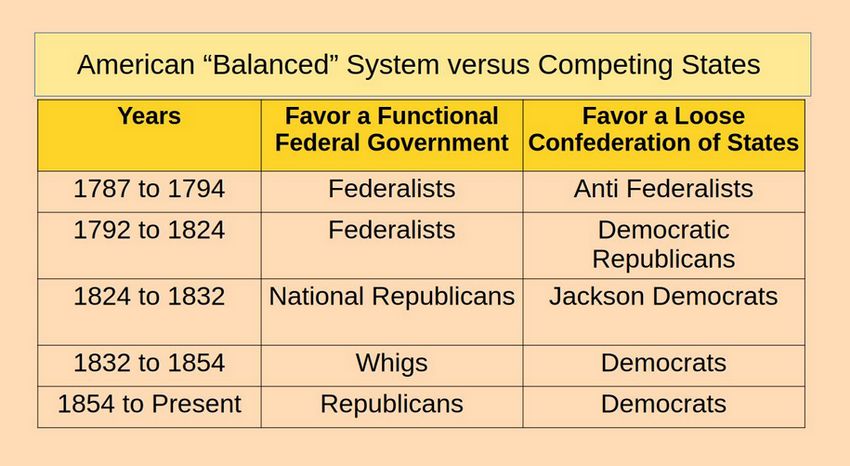
The confusion many still suffer from today was created by Jefferson who called his party the “Democratic Republicans” despite the fact that he was actually opposed to a functional federal government.
Another reason for our modern confusion is that while James Madison was a federalist, he was also with Jefferson, one of the founders of the Democratic Republican Party. But as Jackson, Van Buren and Calhoun radicalized the Democratic Republican party forming a new Jackson Democrats party, Madison rejoined the National Republicans as he still favored a functional federal government.
The founders of both the National Republican Party and the Whig Party included Daniel Webster and Henry Clay. They supported the “American System” of using tariffs to create funds for public works projects like railroads and canals. But regardless of the name, and whether it was called the American System or American Republicanism, they supported the Constitution and the Union.
Abe Lincoln joins the Pro-Constitution, Pro-Union Party
It is commonly claimed that Lincoln joined the Whig Party in Illinois in 1832 because he agreed with the need for these public projects. But this does not mean that Lincoln or any other Whigs opposed State rights. Instead, it means they saw themselves as Americans first and as a member of their States second. I have a problem with the term “Nationalists” which is used to describe Joseph Story, Daniel Webster and Abe Lincoln. My view is they simply supported the Constitution.
Our Constitution is not a nationalist constitution. Instead, it tries to strike a balance between the rights of the state and federal governments. Madison believed that the best way to protect the rights of the People was to set up competing groups he called “factions” each of which would naturally want to limit the power of the other groups. And both groups, State and Federal, would have as their primary mission to protect the rights of the People. Thus, the more accurate term for these federalists or National Republicans would be to call them Constitutionalists in that they supported a balance of power between State and Federal governments – and most crucially – they supported the Supreme Court as the final arbiter whenever conflicts rose between States and the Federal government.
Lincoln learned the meaning of the Constitution from Joseph Story
In addition to his work on the Supreme Court, Story took an active interest in politics, serving as an advisor to Daniel Webster. From 1819 to his death, Story was also a trustee of Harvard College. Story also served as an officer for several banks. On the eve of Andrew Jackson's inaugural as President in 1829 on a “States Rights” platform, Story embarked on a career as a law professor, accepting the Dane Professorship at Harvard Law School, where he trained a generation of new lawyers.
Under Story's guidance, Harvard became the preeminent law school in the nation, growing from one student in 1828 to 7 students in 1830 and 156 students in 1844. As we mentioned previously, one of Story’s seven students at Harvard in 1830 moved to Springfield Illinois where he became Abe Lincoln’s legal mentor in 1834.
Story also became a profilic author, writing numerous commentaries on the law and the Constitution. Illness caused Story to miss the Supreme Court term in 1843; he returned a year later, but remained ill. Story planned to resign once a replacement was chosen, but he died before a replacement received nomination and confirmation.
Story argued that the Constitution was a creation of a single national people, not an "assemblage of nations". Lincoln adopted Story’s view that the Constitution created a permanent, inseparable Union. Also like Story, while personally opposing slavery, Lincoln understood that the Constitution left it untouched in states where it already existed.
The reason Lincoln was so confident that State Succession and State Nullification were both unconstitutional is because Story explained in detail why they were both unconstitutional. In fact, nearly every one of Lincoln’s political views was identical to the views of Joseph Story as described in his “Commentaries on the Constitution.”
The problem with the Dred Scott decision was not that it supported slavery. The problem was that it tried to force slavery on the northern states. Lincoln was opposed to the expansion of slavery.
The question is not about exactly what is decided on the boundary between state and federal rights. The question is who has the authority under the Constitution to make that decision. It is the Supreme Court – not each state. The States can appeal any federal decision – as can the federal government. Then they both can go to the Supreme Court who, if they decide to accept the case, each side will get one hour to explain their position. Plus everyone in America can submit Amicus briefs which the Justices will likely have their assistants read and summarize. Then the hard part. The Justices will try to find and write a majority opinion while other Justices write dissenting opinions explaining why they think the majority is wrong – to make it easier for some future Supreme Court to overturn whatever the current Supreme Court decided. This is a very inefficient system because it take years to resolve a conflict. But it is way better that a Civil War that would cost a million lives and destroy the Nation.
Under the Articles of Confederation, the States retained most of their sovereignty, like independent nations bound together only by treaties. But the new Constitution rejected the notion that the Nation was simply a collection of States, and instead created a direct link between the National Government and the people of the United States.
What is a sanctuary state?
Despite the First Civil War having decided the Supremacy of the Federal Constitution over States Rights, in the past 10 years, 12 states have declared themselves to be “sanctuary states.” This means that they refuse to comply with federal laws and federal Supreme Court rulings they disagree with.
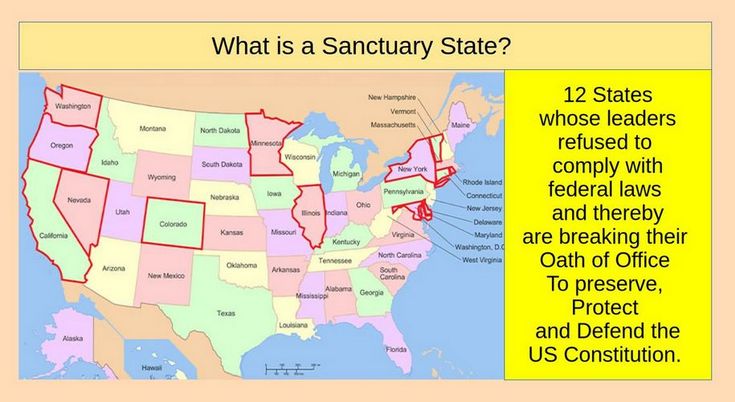
In short, they refuse to comply with the US Constitution despite their leaders having taken an Oath to uphold the US Constitution. The concept of Sanctuary States is a major cause of our current but hidden civil war.