Here we will take a closer look on how Joseph Story’s commentaries influenced the evolution of Lincoln’s early convictions.
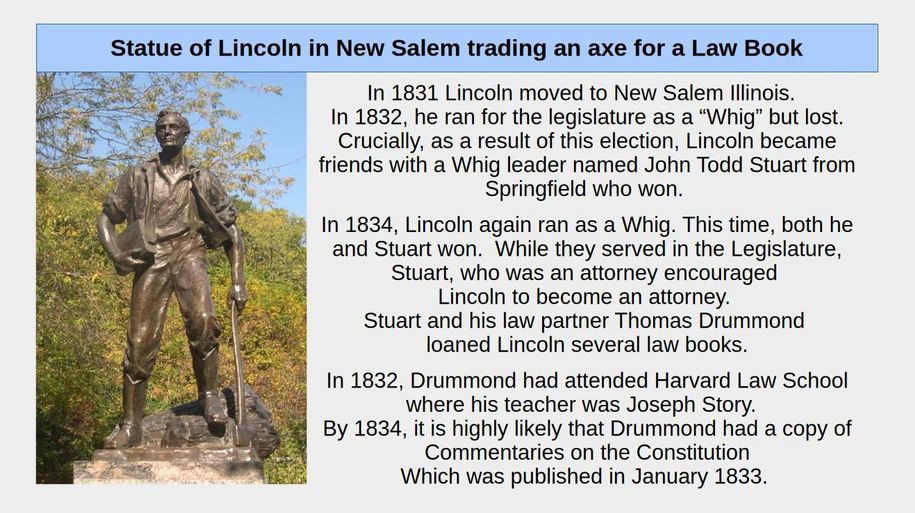
In 1831, at the age of 22, Lincoln settled in New Salem, Illinois. Lincoln became fond of hanging out at the courtroom of Judge Bowling Green. The two bonded over a mutual love of jokes and funny stories. Judge Green encouraged Lincoln’s interest in the law and allowed him to develop his speaking skills by trying small cases.
In 1832, Lincoln ran as a National Republican for the State legislature coming in 8th in a field of 13. It is odd that Lincoln chose to run as a National Republican in 1832. Jackson Democrats were in the majority in Illinois in 1828. Andrew Jackson won the national Presidential Election with over 55% of the vote. His National Republican opponent, the current President, John Quincy Adams only got 44% of the vote. In 1832, Jackson won again with 54% of the vote. His National Republican opponent, Henry Clay, only got 37% of the vote.
Democrats were the party of the people, whereas the National Republicans advocated for a strong federal government, the rule of law and protections for minority interests against majority tyranny.
So why did Lincoln decide to join the National Republicans in 1932 instead of going for the more popular Democratic Party?
The answer was that Lincoln wanted an expansion of the federal government including public investments in schools, roads, canals and railroads which were a key component of Henry Clay’s "American System" which proposed to generate revenue from high protective tariffs and a national bank. They favored national development over states rights.
By contrast, Jackson Democrats advocated for limited federal government, low taxes, and states rights.
The National Republicans, including Clay and Daniel Webster, changed the name of their Party to the Whig Party in 1833.
John Todd Stuart had also ran as a National Republican in 1832 and was elected in his first attempt at office, finishing second among the 13 candidates. Stuart was the only Clay supporter among the four Sangamon County representatives—the other three were Jackson Democrats.
Stuart was 24, and Lincoln was 23—the two youngest among 13 candidates in 1832. Stuart and Lincoln discovered their political affinity from their mutual support for Clay and for the American System.
Despite losing in 1832, Lincoln ran again, this time as a Whig in 1834. This time he won a seat in the Illinois House of Representatives.
In 1834, again there were 13 candidates for 4 positions from Sangamon County. The Sangamon Democrats understood Stuart’s strength as a leader of the new Whig Party and were concerned that he would aspire to higher office, perhaps in Congress, with his continued success. Therefore, they developed a strategy to defeat Stuart by elevating Lincoln in the voting above him, hoping Stuart would fall out of the top 4 candidates, and thus cripple his standing in any future election. They approached Lincoln with an offer to give him their support, knowing Lincoln already had the backing of the Whigs.
Stuart said years later: “Lincoln acted fairly and honorably about it by coming and submitting the proposition to me. . . . I told Lincoln to go ahead and tell them he would take their votes—that I would risk it.” Stuart’s strategy succeeded, as Lincoln finished second and Stuart squeaked by in fourth place.
In 1834, Stuart formed a law partnership with Henry Dummer. A recent arrival in Springfield, Dummer had attended Harvard Law School in 1832 where he took classes from Joseph Story – who was on the Supreme Court and a good friend of Daniel Webster – supporting many of the goals of the Whig Party.
While serving as postmaster in New Salem, Illinois and following his loss for a seat in the Illinois House of Representatives, in 1834, Lincoln decided to study law. Rather than apprentice under an established attorney, Lincoln borrowed law books from Judge Thomas Drummond, John Todd Stuart (with whom he served with in the Black Hawk War) and Henry Dummer. All three loaned Lincoln law books. Lincoln regularly walked or rode twenty miles each way to Springfield to borrow them. Henry Dummer remembered that “Lincoln used to come to our office in Springfield and borrow books.”
So of Lincoln’s first three legal teachers, one was a judge, one was a Whig and one was a student of Joseph Story.
Lincoln applied for the bar in 1836 in New Salem, Illinois. On September 9, 1836, Lincoln obtained his law license. It was not difficult to become an attorney in Illinois in the 1830’s. At the time there were no written exams or formal tests required for certification. The bar exam was oral in nature. A judge or lawyer appointed by the court would merely attest the person requesting admittance to the bar possessed sufficient “moral character.
The clerk of the court, William Butler, was a supporter of Lincoln, and simply entered Lincoln’s name onto the court record and he was admitted to the bar. Because Lincoln had few cases and little money, Butler often brought Lincoln home to have meals with his family.
Then, on April 15, 1837, with New Salem no longer a viable place to expand a law practice, Lincoln moved to Springfield, the new state capital. Lincoln, as an Illinois state representative, had been a major force in making Springfield the capital. Also in April 1837, Dummer left the Stuart Law firm to move to Beardstown to start a law practice there. Lincoln was the obvious choice to replace him. The previous October, 1836, Stuart had Lincoln prepare important legal documents for three related lawsuits, serving as a confirmation of his skills.
Lincoln’s mentor and first law partner, John Todd Stuart, was a cousin of Mary Todd, who would later become Lincoln’s wife.
In 1838, John Todd Stuart defeated Stephen Douglas and became a member of the U.S. Congress. This meant that he was gone much of the time and the legal practice was effectively left in Lincoln’s hands.
Stuart was engrossed in politics for the six months he was engaged in his race for Congress against Stephen Douglas, and he was not able to make many contributions to the law practice during that time or when he was in Congress. Between 1839 to 1855, Lincoln appeared in 29 cases in federal court. Lincoln won 19, lost 6 and settled in 4 ties.
One of Lincoln’s first know speeches where he explained his position on the Constitution and on the importance of law and order was on January 27, 1838. We will take a close look at this early speech.