header 1500

.
  • Home
  • I Learn the Truth
    • 1 Lincoln’s Secret Weapon
    • 2 Of the People, by the People, for the People
    • 3 The Meaning and History of our Constitution
      • 29 Second Inaugural Address March 4 1865
    • 4 Explaining Lincoln’s Biggest Mistake
    • 5 How Story helped Lincoln find his calling in life
    • 6 Lincoln Lyceum Speech January 27 1838
    • 7 Lincoln Peoria Speech October 16 1854
    • 8 Republican Party Platform June 17 1856
    • 9 Dred Scott 1857 Dissent Opinions
    • 10 House Divided Speech June 16 1858
  • II Tell the Truth
    • 11 Second Campaign Speech Chicago July 10 1858
    • 12 First Debate Ottawa Illinois August 21 1858
    • 13 Second Debate Freeport Doctrine August 27 1858
    • 14 Third Debate Jonesboro September 15 1858
    • 15 Fifth Debate Galesburg October 7 1858
    • 16 Douglas Popular Sovereignty September 7 1859
    • 17 Lincoln Cincinnati Speech September 17 1859
    • 18 Lincoln Indianapolis Speech September 19 1859
    • 19 Lincoln Cooper Union Address February 27 1860
    • 20 Lincoln’s Chicago Miracle
  • III Defend the Constitution
    • 21 First Inaugural Address March 4 1861
    • 22 Message to Congress July 4 1861
    • 23 First Annual Message December 2 1861
    • 24 Second Annual Message December 1 1862
    • 25 Emancipation Proclamation January 1 1863
    • 26 Gettysburg Address November 19 1863
    • 27 Third Annual Message December 8 1863
    • 28 Fourth Annual Message December 6 1864
  • Lincoln Republicans
  • American Patriots
  • Contact Us

Part II Lincoln’s Courage to Tell the Truth

The second 10 chapters occur before Lincoln is elected President. By telling the Truth, Lincoln is given the name “Honest Abe.”

2.00

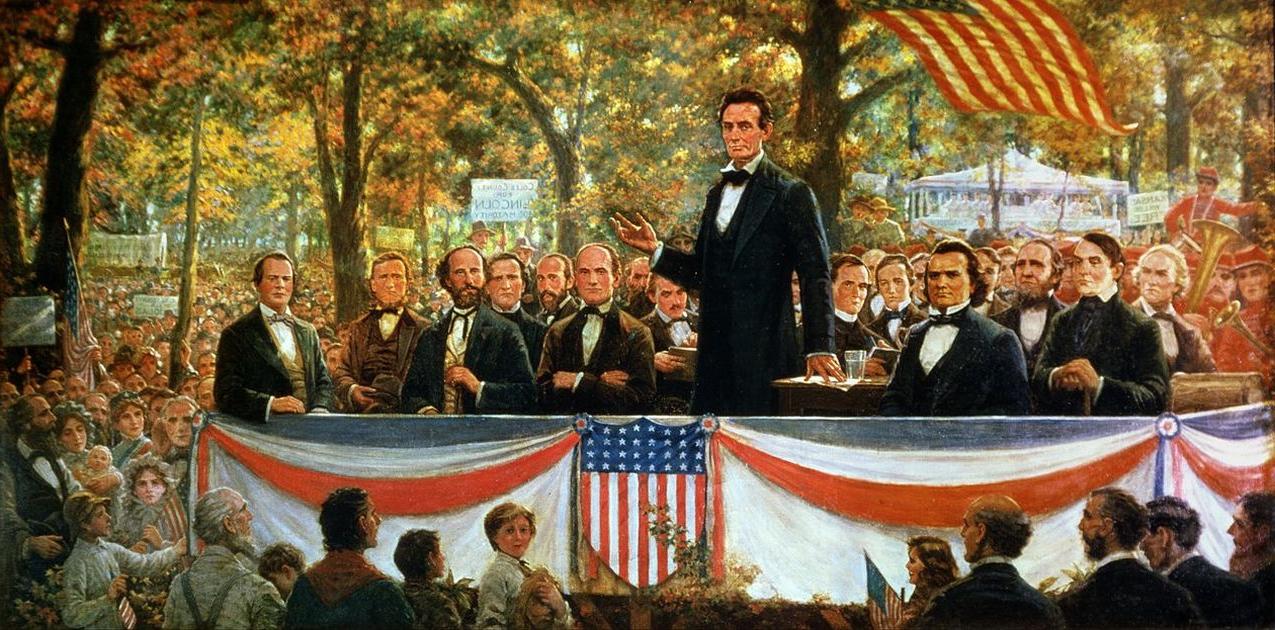
A drawing of a Lincoln Douglas Debate

11 Second Campaign Speech Chicago July 10 1858

The following speech was given 3 weeks after the House Divided speech and 3 days after his first campaign speech in Springfield. Lincoln had ended his first speech by accusing Douglas with being part of a conspiracy to hide a secret plan to impose slavery on the Northern States from the voters until after the 1956 election, a charge which led to a standing ovation from his supporters in Springfield:

“I charged that the people had been deceived into carrying the last Presidential election, by the impression that the people of the Territories might exclude slavery if they chose, when it was known in advance by the conspirators, that the Court was to decide that neither Congress nor the people could so exclude slavery. These charges are more distinctly made than any thing else in the speech.”

“Judge Douglas has carefully read and re-read that speech. He has not, so far as I know, contradicted those charges. In the two speeches which I heard he certainly did not. On his own tacit admission I renew that charge. I charge him with having been a party to that conspiracy and to that deception for the sole purpose of nationalizing slavery.”

In his second campaign speech, Lincoln refines his position that the Dred Scott decision will force the evil of slavery on Northern states.
Read more: 11 Second Campaign Speech Chicago July 10 1858

12 First Debate Ottawa Illinois August 21 1858

In August through October 1858, there were a total of seven debates between Lincoln and Douglas. Each of the Lincoln–Douglas debates lasted about three hours, divided into a 60-minute opening speech, a 90-minute response, and a 30-minute closing rebuttal. Abraham Lincoln and Stephen Douglas alternated who spoke first, with Douglas opening four of the seven debates.

We will only cover four of the debates in order to show how Lincoln’s arguments on the moral, social, economic and political immorality of slavery grew stronger over time. The other three debates did not introduce any new arguments not raised in the four we will cover. We have slightly edited Lincoln’s comments for space reasons.

We will not cover Douglas’s comments due to the fact that nearly everything he said was simply not true. The only Douglas speech which we will cover is his September 7, 1859 speech where we explain in detail why every one of his claims is not supported by the actual historical evidence.

Douglas was extremely confident that he would win the 1858 Senate Race for three important reasons. First, in 1856, the Democratic Presidential Candidate Buchanan had defeated the Republican candidate Fremont in Illinios by 12,000 votes (172,000 to 160,000).

In addition, the actual selection of the Senate Candidate would be made by the Illinois State legislature in January 1859 – not by the people in November of 1858. Democrats had stacked the districts in their favor to give them an unfair advantage.

Finally, Douglas was a nationally famous politician for having written the 1854 Nebraska Kansas Act – the Act that voided the Compromise of 1820 and allowed slavery to be introduced to Territories where it had been banned by the Compromise of 1820. By contrast, Lincoln was a relative unknown who had not won an election in a decade.

Lincoln did so well in these debates that the Republican Party slate defeated the Democratic Party slate in the 1858 election – getting 190,000 votes to 166,000 (53% to 45%). But due to the “stacked deck” in the Illinois legislature, Douglas won their votes by 54 to 46.

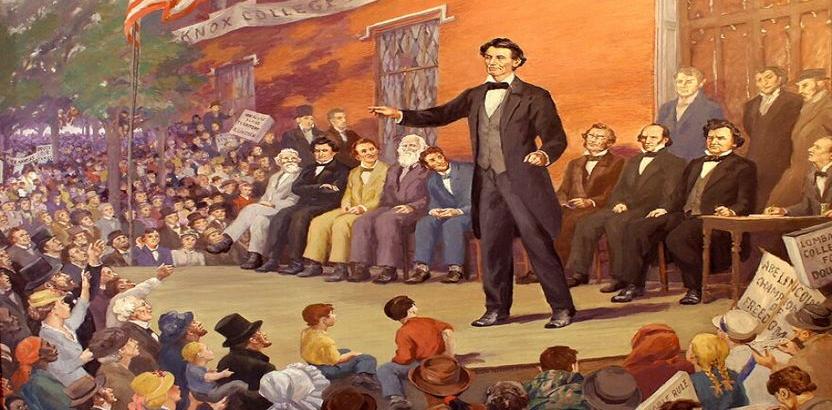
Below is a somewhat glamorized image of one of the debates:

12.01

On August 21, 1858, about 12,000 people were in attendance when the first Lincoln-Douglas debate began at 2 pm. There were no seats or bleachers. So the audience either stood or sat on blankets.

Read more: 12 First Debate Ottawa Illinois August 21 1858

13 Second Debate Freeport Doctrine August 27 1858

August 27, 1858 stands as one of the most important days in American history. Many claim it was the day that Lincoln won the 1860 election. Special trains brought people from Galena, Chicago, Rockford, and other cities in northern Illinois. Estimates as high as 15,000 were reported in various newspapers. Lincoln answered the 7 questions Douglas posed at Ottawa and then asked 4 of his own. Douglas' response became known as the Freeport Doctrine which split the Democratic Party at the 1860 Democratic National Convention. Lincoln asked Douglas a simple innocent question: Did Popular Sovereignty still applies despite the Dred Scott decision? Douglas replied that the people could still vote to ban slavery. This became known in the South as the hated Freeport Doctrine. Thus, this statement by Douglas split the Democratic Party in their 1860 South Carolina Convention – which led to the election of Lincoln – which in turn saved the Constitution and the Union.

Read more: 13 Second Debate Freeport Doctrine August 27 1858

14 Third Debate Jonesboro September 15 1858

At Freeport I answered several interrogatories that had been propounded to me by Judge Douglas at the Ottawa meeting. The Judge has yet not seen fit to find any fault with the position that I took in regard to those seven interrogatories, which were certainly broad enough, in all conscience, to cover the entire ground. In my answers, which have been printed, and all have had the opportunity of seeing, I take the ground that those who elect me must expect that I will do nothing which will not be in accordance with those answers. I have some right to assert that Judge Douglas has no fault to find with them.

But he chooses to still try to thrust me upon different ground without paying any attention to my answers. At the same time, I propounded four interrogatories to him, claiming it as a right that he should answer as many interrogatories for me as I did for him, and I would reserve myself for a future installment when I got them ready. The Judge in answering me upon that occasion, put in what I suppose he intends as answers to all four of my interrogatories.

Read more: 14 Third Debate Jonesboro September 15 1858

15 Fifth Debate Galesburg October 7 1858

So far in this controversy I can get no answer at all from Judge Douglas upon these subjects. Not one can I get from him, except that he swells himself up and says, "All of us who stand by the decision of the Supreme Court are the friends of the Constitution; all you fellows that dare question it in any way, are the enemies of the Constitution."

Now, in this very devoted adherence to this decision, in opposition to all the great political leaders whom he has recognized as leaders- there is something very marked. And the manner in which he adheres to it-not as being right upon the merits, as he conceives (because he did not discuss that at all), but as being absolutely obligatory upon every one simply because of the source from whence it comes-as that which no man can gainsay, whatever it may be-this is another marked feature of his adherence to that decision. It marks it in this respect, that it commits him to the next decision, whenever it comes, as being as obligatory as this one, since he does not investigate it, and won't inquire whether this opinion is right or wrong. So he takes the next one without inquiring whether it is right or wrong.

He teaches men this doctrine, and in so doing prepares the public mind to take the next decision when it comes, without any inquiry. In this I think I argue fairly (without questioning motives at all), that Judge Douglas is more ingeniously and powerfully preparing the public mind to take that decision when it comes; and not only so, but he is doing it in various other ways. In these general maxims about liberty-in his assertions that he "don't care whether slavery is voted up or voted down;" that "whoever wants slavery has a right to have it;" that "upon principles of equality it should be allowed to go every where;" that "there is no inconsistency between free and slave institutions."

In this he is also preparing (whether purposely or not) the way for making the institution of slavery national! I repeat again, for I wish no misunderstanding, that I do not charge that he means it so; but I call upon your minds to inquire, if you were going to get the best instrument you could, and then set it to work in the most ingenious way, to prepare the public mind for this movement, operating in the free States, where there is now an abhorrence of the institution of slavery, could you find an instrument so capable of doing it as Judge Douglas? or one employed in so apt a way to do it?

Read more: 15 Fifth Debate Galesburg October 7 1858

16 Douglas Popular Sovereignty September 7 1859

While Republicans who supported Lincoln won the popular vote in the 1858 Illinois Senate race with 53% of the vote, he lost in the Illinois State legislature on January 5, 1859 by a vote of 54 to 46 – which was the group who actually chose the Senator. This result was due to “apportionment” problems as well as “hold over” Democrats in the State Senate. Lincoln therefore entered 1859 buried in debt from his 1858 campaign and with little hope of reviving his political career.

However, an opportunity rose around September 1, 1859, when Harpers Magazine published a lengthy article written by Stephen Douglas explaining his “popular sovereignty” solution to the Slavery question. Douglas claimed that allowing or disallowing slavery to extend into the territories based on the vote of its local citizens—his popular sovereignty—was a concept that matched the intent of the Founding Fathers. Democrats in Ohio used this article to schedule a series of speeches by Douglas in Ohio to promote his Popular Sovereignty claim and help Democrats win the 1859 Ohio Governor’s election to be held on October 11, 1859. His speeches would also help Douglas in his run for the Democratic Presidential nomination in 1860.

The Republican Party started in Ohio on July 13, 1854, at a convention in Columbus and they were the first state to elect a Republican governor (Salmon Chase) in 1855 by only 11,000 votes out of 400,000 voters. They also won in 1857 – this time by only 1,000 votes. The 1859 Ohio election was seen across the country by both sides as an early indicator of the 1860 Presidential election.

Both sides needed Ohio to win the 1860 Presidential election. Surprisingly, incumbent Ohio Governor Simon Chase did not campaign for the Republican candidate William Dennison in the 1859 Ohio Governors race. The reason was that the Ohio Republican party was divided into factions who had strong disagreements with each other. An outsider was needed to appeal to the Ohio voters and refute Douglas. So the Ohio State party leaders reached out to Lincoln as being the most well known and well spoken opponent of Douglas.

Read more: 16 Douglas Popular Sovereignty September 7 1859

17 Lincoln Cincinnati Speech September 17 1859

This is the Cincinnati speech that led to the Cooper Union Speech, that led to the Republican Nomination that saved the Union. Lincoln used Story’s Commentaries during both speeches to refute Douglas.

My Fellow Citizens of the State of Ohio:

I understand that you have had recently with you my very distinguished friend, Judge Douglas, of Illinois; and I understand that he did me the honor to mention my humble name. I suppose that he did so for the purpose of making some objection to some sentiment at some time expressed by me. I should expect, it is true, that judge Douglas had reminded you, or informed you, if you had never before heard it, that I had once in my life declared it as my opinion that this government cannot endure permanently, half slave and half free; that a house divided against itself cannot stand, and, as I had expressed it, I did not expect the house to fall, that I did not expect the Union to be dissolved, but that I did expect that it would cease to be divided, that it would become all one thing, or all the other; that either the opponents of slavery would arrest the further spread of it, and place it where the public mind would rest in the belief that it was in the course of ultimate extinction, or the friends of slavery will push it forward until it becomes alike lawful in all the States, old or new, free as well as slave. I did, 15 months ago, express that opinion, and upon many occasions Judge Douglas has denounced it, and has greatly, intentionally or unintentionally, misrepresented my purpose in the expression of that opinion.


Read more: 17 Lincoln Cincinnati Speech September 17 1859

18 Lincoln Indianapolis Speech September 19 1859

On September 19, 1859, Lincoln traveled to Indianapolis by train from Cincinnati, Ohio to Indianapolis, Indiana. He then addressed a full house at the Masonic Lodge that evening. He began his speech by described his childhood memories of growing up in Indiana. In the fall of 1816, when he was only 8 years old, his father brought him over from Kentucky, and settled in Indiana where he lived for 12 years until he was 20 and left his father’s home for Illinois.

While this speech is rarely discussed in books about Lincoln, it was one of the most important speeches he ever gave. This speech endeared him to Republicans in Indiana. Nine 9 months later, these Indiana Republicans would give Lincoln the crucial First Round votes he needed to be the leading challenger to Seward for the Republican Party Presidential Nomination. Together with Illinois, Indiana would cast a block of 48 votes for Lincoln on the First Round in May 1860.

Read more: 18 Lincoln Indianapolis Speech September 19 1859

19 Lincoln Cooper Union Address February 27 1860

Never before and never since has a single speech so clearly launched a dark horse candidate towards a Presidential victory. Lincoln’s speech in Cincinnati on September 17th and the Ohio victory on October 11th convinced the New York Young Mens’ Central Republican Club, led in part by Horace Greeley, on October 12, 1859 to invite Lincoln to speak in New York on November 29th 1859 in the same subject as his informative speech in Cincinnati a few weeks earlier. Despite the fact that this was his first invitation to speak on the East Coast, Lincoln asked that the date be postponed to February 1860.

At the beginning of 1860, Lincoln was not even on lists of potential candidates for the 1860 Republican nomination. The leading candidates were William Seward, Senator of New York, Simon Cameron of Pennsylvania, Salmon Chase, Governor of Ohio, and Edward Bates of Missouri. Among the leading candidates, Seward was the favorite.

But many thought Seward was too radical to win in the “swing” states in the Midwest due to his 1850 speech in which claimed that slavery in the territories violated a “higher law than the Constitution” – a moral and divine law and not just a legal law. In October 1858, Seward also gave a speech stating that there was an “irrepressible conflict” between the Northern and Southern States. While his speech sounded similar to Lincoln’s House Divided speech, there was a crucial difference. Lincoln made it clear that he only wanted to honor the current US Constitution, which limited slavery to the existing southern states and opposed it only in the new states and territories under his theory that slavery would eventually die a slow death.

Read more: 19 Lincoln Cooper Union Address February 27 1860

20 Lincoln’s Chicago Miracle

Change requires believing that change is possible. Too often, people fail to act because they do not believe that they will succeed. But if we do not act, then we are certain to not succeed. If we have the courage to act, then even if we lose, we can still win by learning from our failures how to do better next time.

Such was the case of Lincoln. He failed in not just one, but two Senate races. But still he continued on to correct what he saw as a moral, social, political and economic wrong – the issue of slavery, or more precisely, the expansion of slavery into the western and northern states. To help others understand the dangers of slavery, Lincoln traveled thousands of miles and gave more than 100 speeches. He gradually perfected his arguments against slavery and slowly built a hidden national group of supporters. It was through his speeches and with the help of his supporters that he was able to win the 1860 Republican Party Presidential nomination in Chicago. Here we will take a closer look at Lincoln’s Chicago Miracle.

Can a person with no money defeat a wealthy political machine?

The leading candidate for the 1860 Republican nomination was William Seward – a wealthy corporate lawyer and a somewhat corrupt politician who may not have even been elected President due to his ties to Thurlow Weed – who promised “oceans of money” to Republican delegates to secure the nomination for Seward. Horace Greeley’s New York Tribune said that when Seward was governor, the New York legislature was “not merely corrupt but shameless.”

Read more: 20 Lincoln’s Chicago Miracle
  • Home
  • I Learn the Truth
    • 1 Lincoln’s Secret Weapon
    • 2 Of the People, by the People, for the People
    • 3 The Meaning and History of our Constitution
      • 29 Second Inaugural Address March 4 1865
    • 4 Explaining Lincoln’s Biggest Mistake
    • 5 How Story helped Lincoln find his calling in life
    • 6 Lincoln Lyceum Speech January 27 1838
    • 7 Lincoln Peoria Speech October 16 1854
    • 8 Republican Party Platform June 17 1856
    • 9 Dred Scott 1857 Dissent Opinions
    • 10 House Divided Speech June 16 1858
  • II Tell the Truth
    • 11 Second Campaign Speech Chicago July 10 1858
    • 12 First Debate Ottawa Illinois August 21 1858
    • 13 Second Debate Freeport Doctrine August 27 1858
    • 14 Third Debate Jonesboro September 15 1858
    • 15 Fifth Debate Galesburg October 7 1858
    • 16 Douglas Popular Sovereignty September 7 1859
    • 17 Lincoln Cincinnati Speech September 17 1859
    • 18 Lincoln Indianapolis Speech September 19 1859
    • 19 Lincoln Cooper Union Address February 27 1860
    • 20 Lincoln’s Chicago Miracle
  • III Defend the Constitution
    • 21 First Inaugural Address March 4 1861
    • 22 Message to Congress July 4 1861
    • 23 First Annual Message December 2 1861
    • 24 Second Annual Message December 1 1862
    • 25 Emancipation Proclamation January 1 1863
    • 26 Gettysburg Address November 19 1863
    • 27 Third Annual Message December 8 1863
    • 28 Fourth Annual Message December 6 1864
  • Lincoln Republicans
  • American Patriots
  • Contact Us