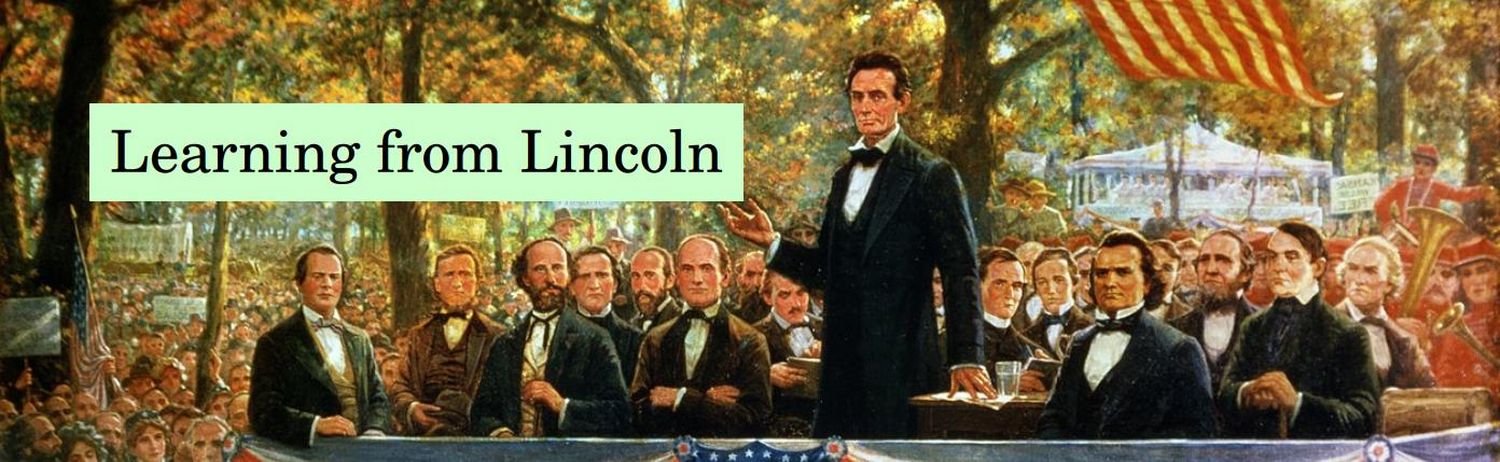
The most famous phrase in Lincoln's Gettysburg Address is in the final sentence where he described the unfinished business that we should all be dedicated to: "that government of the people, by the people, for the people, shall not perish from the earth."
Because Lincoln was a man of the People, it is possible that he thought up this phrase himself as his entire Address naturally led to this conclusion - as if the conclusion was written first and the rest of the Address was written to stress the importance of this goal. But in most of his speeches, Lincoln usually talks of "saving the Union." So there is the possibility that Lincoln took this line from someone else.
Lincoln's third and last law partner, Billy Herndon, wrote a biography of Lincoln in which he claimed that he was the one who gave the idea to Lincoln. Herndon claimed that in 1858, he traveled to Boston and on July 4th, he heard a rather lengthy sermon by abolitionist Theodore Parker called "The Effect of Slavery on the American People." Here is a link to a PDF of this sermon.
Herndon claims that this sermon was then printed and he brought a copy of the speech back to Springfield with him and gave it to Lincoln to read. He further claims that when Lincoln returned the pamphlet to him, Herndon found underscored in pencil the lines: Democracy is direct self-government, over all the people, for all the people, by all the people.
Thus, according to Herndon the final line of the Gettysburg Address was due to a trip that Herndon took to Boston in the summer of 1858
There are however several problems with Billy Herndon's account. This line does occur near the bottom of Page 5 of this 14 page sermon. But the first problem is that Lincoln, like most Republicans, had a pretty strong dislike for Abolitionists like Theodore Parker - mainly because Abolitionists were advocating rebellion while Lincoln was strongly in favor of preserving the Union and following the Constitution.
Unlike Lincoln, Herndon agreed with the Abolitionists. He may have given Lincoln the pamphlet, but the first four pages of the pamphlet was filled with radical claims that I am certain Lincoln strongly disagreed with. I doubt that Lincoln ever read even the first page of the pamphlet - much less making it all the way to page 5. Even had Lincoln made it to page 5, the manner in which the sentence appears is not very meaningful. Read the first 5 pages of the sermon and see for yourself if you can even spot the sentence.
But I have other reasons for doubting Herndon's account. Several researchers have concluded that important parts of Herndon's biography of Lincoln turned out to be false. Most famous is Herndon's claim that Lincoln's only true love was Ann Rutledge. Herndon also botched the story of Lincoln's courtship of Mary Todd and described, down to the bridal flowers, an aborted wedding ceremony that never actually happened. There are at least a dozen other incidents in Billy Herndon's biography of Lincoln that scholars have since concluded were either exaggerated or never happened at all. In particular, Mary Todd, Lincoln’s widow, and her eldest son Robert Todd condemned Herndon's Biography of Lincoln as being filled with falsehoods.
But my most important reason for doubting Herndon is that he was known to have a serious problem with alcoholism. Herndon himself stated that Lincoln “picked me out of the gutter and made a man of me. I was a drunkard till he took me in hand and kept me straight.”
I have studied the causes and effects of Alcoholism and there are two scientific facts that are beyond dispute. The first is that Alcohol kills brain cells - especially heavy and frequent drinking. Brain cells sadly do not grow back. The second problem is that folks suffering from this problem tend to be ashamed and often try to hide this problem from others. In hiding this problem, they often develop a bad habit of exaggerating or even lying.
I am sure that a lot of what Herndon said about Lincoln was true and it was certainly true that Lincoln loved Herndon and nursed Herndon through episodes of his drinking "sickness."
So I think this claim by Herndon that Lincoln's famous line was due to him is just not likely to be true.
There is a second possibility source for Lincoln's most famous phrase. On January 26, 1830, in a rather famous speech delivered in Congress on the history and meaning of the Constitution, Daniel Webster, who was one of the leaders of the Whig Party that Lincoln joined in 1932, said: “It is, sir, the People’s Constitution, the People’s Government; made for the People; made by the People; and answerable to the People. The People of the United States have declared that this Constitution shall be the Supreme Law.”
Theodore Parker was an admirer of Daniel Webster. It is likely that this was where Parker got the phrase from. Since Lincoln was also an admirer of Daniel Webster, it is possible that Lincoln also got this phrase from Daniel Webster. But I think this is unlikely. Webster had betrayed Lincoln's view of the Constitution in 1850 by supporting the Compromise of 1850 - a compromise that not only led to the Civil War, but equally important to Lincoln, a compromise which violated Lincoln's understanding of the US Constitution.
Lincoln opposed the Compromise of 1850 in several of his later speeches because it allowed the expansion of slavery into territories where slavery did not yet exist. Lincoln understood that the only reason slavery was initially allowed at the Constitutional Convention of 1787 was because the alternative was the complete end of the United States. The delegates in 1787 had a gun to their head in the form of economic blackmail by the British Empire. But slavery was only to be allowed "where it already existed." Nowhere else. Lincoln knew that if slavery was allowed in the Territories, eventually, slave holders would gain so much power in Congress that the entire nation would fall victim to this monstrous evil.
Lincoln gave his Gettysburg Address in 1863. It is highly unlikely that Lincoln would use anything from a Daniel Webster speech in his dedication to those who died at Gettysburg - because Lincoln felt that Webster's betrayal on the issue of slavery was a factor that led to the Civil War.
In fact, since they did not have the Internet back in the 1800s to look up speeches, it is just as likely that Lincoln never read Webster's January 26, 1830 speech. Webster buried that single sentence on Page 47 of a 66 page speech!
But I am certain that there was a book which Lincoln did read - a book that Lincoln likely owned and referred to often - a book which did include the phrase he made famous at the end of his Gettysburg Address. That book was called Commentaries on the Constitution, published by Joseph Story in January 1833.
In later chapters, we will provide several examples of how Lincoln often used information that could only have come from this incredible book - with its 900 pages of information on the history and meaning of the Constitution.
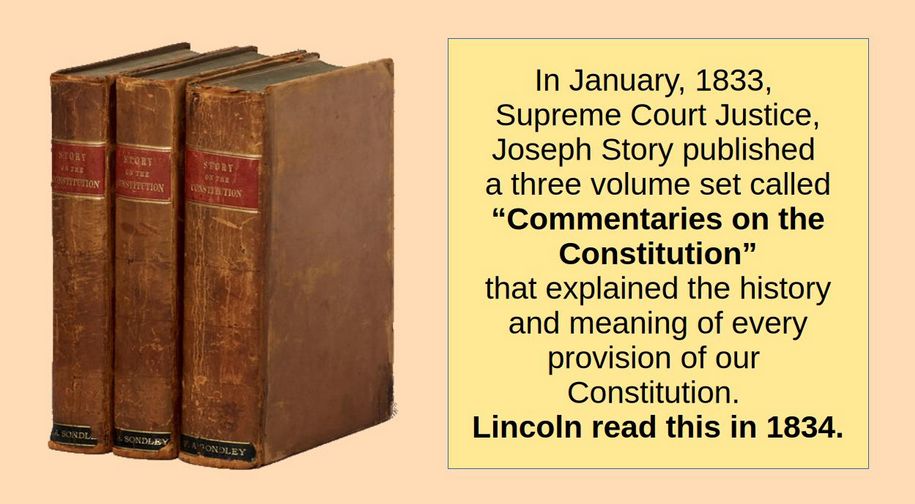
The reason I am certain that Lincoln read this book in 1834 is that while he still lived in New Salem, Illinois, he had been befriended by John Todd Stuart who had an established law practice 20 miles away in Springfield Illinois. It is well known that Stuart loaned Lincoln several law books in 1834 from which Lincoln taught himself law.
What is less well known is that in 1834, John Todd Stuart had a junior partner named Henry Dummer. Dummer was Stuart's law partner from 1832 to 1837. More important, Dummer had studied at Harvard Law School in 1829 to 1830 where his instructor was none other than Joseph Story.
In 1829, Story started teaching at Harvard Law School where it was estimated that he had only 7 students. In an amazing miracle, Dummer was one of Story’s first 7 students.
Story's book, Commentaries on the Constitution, published in 1833 was taken from and based on the lectures he taught at Harvard Law School. So it is likely Drummer had copies of Story's lectures because that was the curriculum of the Harvard Law School.
It is certain that Dummer loaned Lincoln what he felt were the most important law books. Commentaries was published in a three book volume that cost a lot of money. But Dummer was from a wealthy family and it is certain that Joseph Story was his hero and mentor. It is therefore likely that Dummer bought Story's Commentaries in 1833 and a year later loaned the book to Lincoln.
In 1855, Lincoln wrote this to a person interested in learning how to be a lawyer: Mr. Dummer is a clever man and an excellent lawyer (much better than I, in law-learning); I have no doubt he will cheerfully tell you what books to read, and also loan you the books.
In 1856, Lincoln and Dummer exchanged a series of letters regarding the position of the new Republican Party in regards to the issue of slavery. Dummer clarified that the Constitution required respecting the existence of slavery in the States where it existed – but did not support the expansion of slavery into territories where it did not exist.
A group called the Friends of the Lincoln Collection stated: "In Lincoln's time, students who learned on the own or in law apprenticeships studied Blackstone's Commentaries, James Kent's Commentaries on American Law and Joseph Story's Commentaries on the Constitution."
It is likely that Joseph Story also influenced where Lincoln sent his son to college. In 1859, Lincoln sent his son Robert to Harvard University. This was likely over the objection of Mary Todd Lincoln as Harvard was about as far away from Springfield Illinois as a school can get. No historian has ever investigated how or why this important decision was made. Robert did not have much sense of ambition as a young man and it is highly likely that Abe Lincoln chose the school Robert was to attend. Lincoln had more than one hundred colleges to choose from.So why did Lincoln choose to send his son to Harvard?
Either consciously or unconsciously, I think it was because that was where Joseph Story had taught. Robert graduated from Harvard in 1864 and then attended Harvard Law School - where Joseph Story's curriculum was still in use.
There is much more to the connection between Abe Lincoln, Joseph Story and Commentaries on the Constitution. Throughout this book, in looking at several of Lincoln’s most famous speeches and most important decisions, we will show that Lincoln’s position on Constitutional issues were exactly identical to Story’s positions as explained in Commentaries. But for now, let’s get back to Lincoln’s final line in the Gettysburg Address.
Story, stated in Commentaries Paragraph 397 that the government created by the US Constitution was a government “made by the People, made for the People and is responsible to the People.”
This phrase is not merely a catchy jingle. Not is it a single isolated sentence. Instead, it is the central idea of Joseph Story's book, Commentaries on the Constitution. This crucial sentence appears in the first paragraph of Chapter Five, which is the chapter titled “Rules of Interpretation of the Constitution.”
In his book, Story goes into detail to explain the meaning of each of the three parts of this phrase. The reason the Constitution (and the government created by the Constitution) is made “by the People” is that it says right in the Preamble that “We, the People of the United States of America do ordain this Constitution.” In 1788, the People held Constitutional Ratifying Conventions in every State including delegates from nearly every town in every State. Over 1,700 delegates – elected in over 1000 town hall meetings – attended these conventions. In Massachusetts alone, there was 360 delegates at their ratifying convention.
There were likely two main reasons the new Constitution was approved. The first was that everyone knew the Articles of Confederation were a disaster. But the main reason folks voted in favor of the new Constitution was because it had the support of George Washington – who was trusted and supported and loved by everyone in the nation.
The reason the new government was made “for the People” was that as the primary purpose of the Constitution and of the new federal government was to protect the rights of the People through a new form of government that relied on a series of checks and balances to prevent any one person or group of people to threaten those rights.
The reason the new government was “responsible to the People” is that federal elections are held every two years. If the People do not like how things are going, they can vote to “kick the bums out.”
In short, the “government” Lincoln was referring to in his Gettysburg Address was the government described in Story’s Commentaries and the government created by the US Constitution. Without preserving protecting and defending the US Constitution, we would no longer have a government of the People, by the People and for the People.
Anyone who read Story’s Commentaries even once, even years earlier, would have these essential facts buried in their head. After Lincoln read Story’s Commentaries in 1834, he appeared to become a changed man. He was much more dedicated and confident than he had been before. Suddenly, the meaning and history of the Constitution was clear to him. It was a clarity and confidence that can be see in every speech he gave from that point forward.
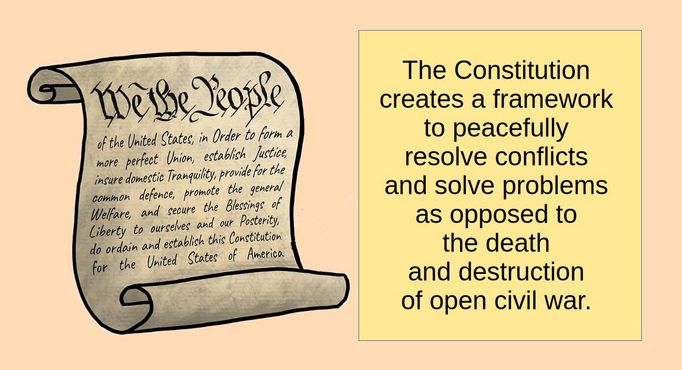
The phrase “Of the People, By the People, For the People” is also the central idea of our book. It is a book with a new view about the ideas that shaped Lincoln. But it is also a book about the importance of the Constitution – a document that is just as important today as it was in the days leading up to the last Civil War.
It is our hope that those who loved Lincoln, and the sacrifices he made to preserve the Union, will gain a new appreciate for the importance of our Constitution.
While our Constitution is today being largely ignored by our political leaders, the symbols of its importance are still all around us. For example, our flag still have 50 stars on a field of blue – representing that we are one nation – not merely 50 separate States.
The Pledge of Allegiance is another hidden reminder of the importance of our Constitution: "I pledge allegiance to the Flag of the United States of America, and to the Republic for which it stands, one Nation under God, indivisible, with liberty and justice for all"
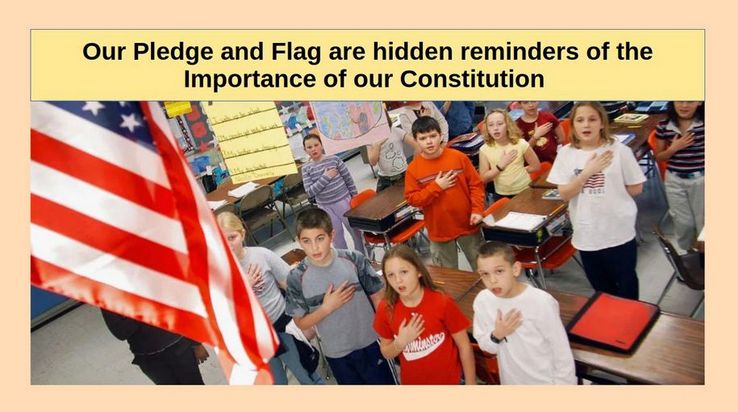
Hopefully, reading this book and reading Story’s Commentaries will give more Americans a new understanding about the meaning of our flag and the meaning of our Pledge of Allegiance. The Republic we pledge allegiance to is the American Republic created by our Constitution.
This Constitution creates one Nation, under God. Our nation is indivisible because we are not merely individual states but we are one nation – and the purpose of this nation is to protect liberty and justice for all. Joseph Story lit a fire in Abe Lincoln – a fire that never went out. Our hope is to relight the fire in the hearts of a new generation of American Patriots. With this in mind, let’s take a few moments to review the meaning and history of our Constitution as Joseph Story explained it.