Change requires believing that change is possible. Too often, people fail to act because they do not believe that they will succeed. But if we do not act, then we are certain to not succeed. If we have the courage to act, then even if we lose, we can still win by learning from our failures how to do better next time.
Such was the case of Lincoln. He failed in not just one, but two Senate races. But still he continued on to correct what he saw as a moral, social, political and economic wrong – the issue of slavery, or more precisely, the expansion of slavery into the western and northern states. To help others understand the dangers of slavery, Lincoln traveled thousands of miles and gave more than 100 speeches. He gradually perfected his arguments against slavery and slowly built a hidden national group of supporters. It was through his speeches and with the help of his supporters that he was able to win the 1860 Republican Party Presidential nomination in Chicago. Here we will take a closer look at Lincoln’s Chicago Miracle.
Can a person with no money defeat a wealthy political machine?
The leading candidate for the 1860 Republican nomination was William Seward – a wealthy corporate lawyer and a somewhat corrupt politician who may not have even been elected President due to his ties to Thurlow Weed – who promised “oceans of money” to Republican delegates to secure the nomination for Seward. Horace Greeley’s New York Tribune said that when Seward was governor, the New York legislature was “not merely corrupt but shameless.”
Weed arrived at the May 1860 Chicago Republican Party Convention with 70 committed delegates from New York as well as 13 railroad cars of supporters. At 60 people per car, this came to 780 people. Weed, nicknamed “Lord Thurlow,” set up headquarters with an abundant supply of cigars and 300 bottles of champagne, and a willingness to promise anything to secure the remaining 63 votes Seward needed.
Before and at the Republican Party Convention, Weed spread vast sums of money around. To secure the nomination, Seward would need 233 delegates.
He had 170 committed delegates weeks before the Convention. 70 were from his home state of New York. A survey taken a month earlier concluded that no other candidate had more than 50 committed delegates.
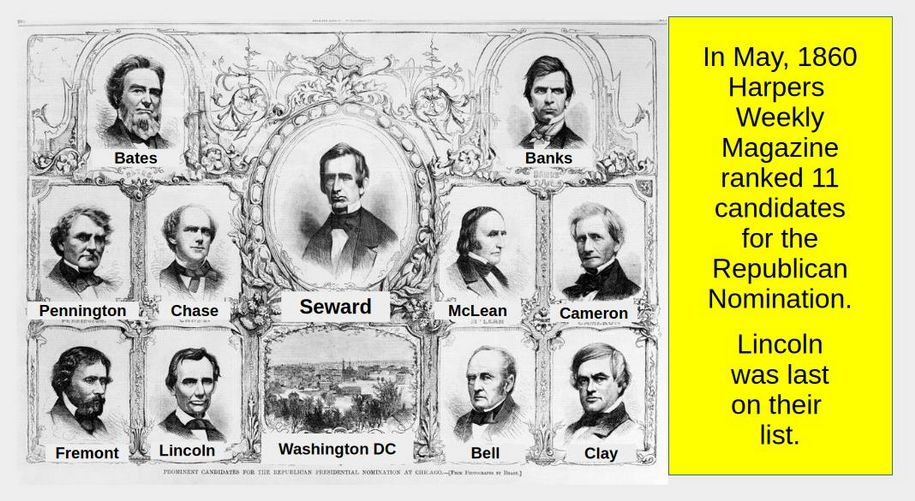
By contrast, Lincoln not only lacked national name recognition, but he had little experience in Washington – having only won a single 2 year term in Congress 12 years earlier. Since then, Lincoln had lost two elections to the US Senate. The first loss was in early 1855 where he withdrew his name to help elect an anti-slavery candidate over a pro-slavery candidate. The second loss was his 1858 campaign against Stephen Douglas. A national magazine ranked Lincoln 11th out of the 11 candidates at the Chicago Convention:
In November 1858, after Lincoln’s slate lost to the Douglas slate, an Illinois paper wrote: "Lincoln is undoubtedly the most unfortunate politician that ever attempted to rise in Illinois. In everything he undertakes politically, he seems doomed to failure.”
Worst of all, Lincoln had no money at all to finance his campaign. In fact, he was in debt from the expenses he had incurred two years earlier running for the Illinois Senate against Stephen Douglas. It would take a miracle for Lincoln to get the nomination. The first miracle was that the convention just happened to be in Chicago.
The First Miracle – How, Why and When Chicago was chosen
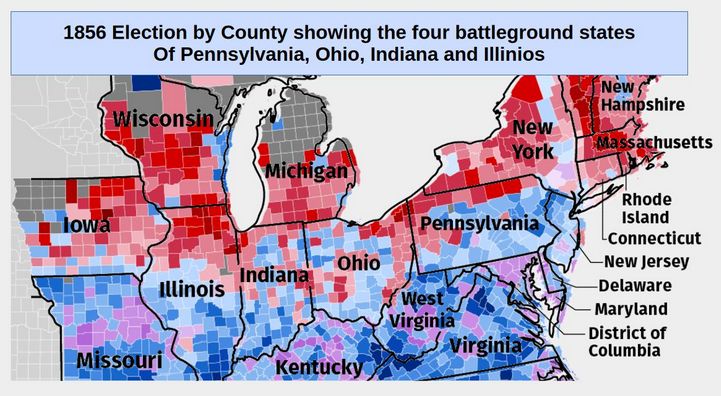
There were several reasons the Republican 1860 Convention was held in Chicago. The first was that Illinois was one of four important Midwest swing states the Republican Party would need to win the 1860 Presidential election. The other crucial Midwest Swing states were Pennsylvania, Indiana and Ohio.
In the 1856 election, the Democratic Party had won three of these four of these “battleground” states:
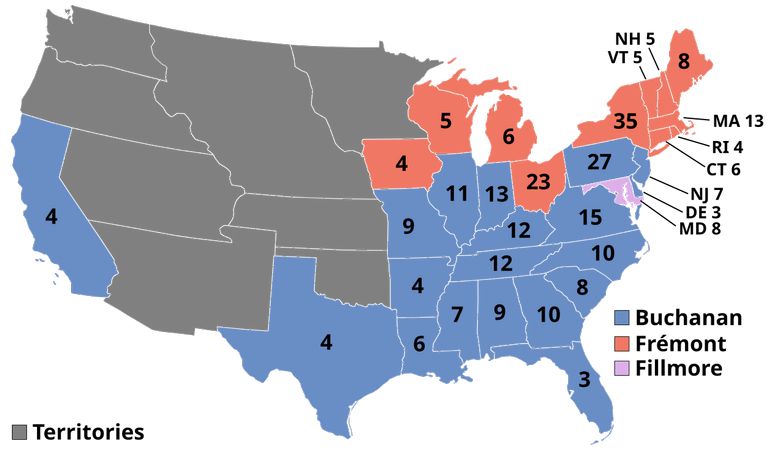
The Democratic candidate, Buchanan had 174 Electoral votes while the Republican candidate, Fremont had only 114 Electorial votes. Republicans needed a swing of 30 or more additional Electoral votes to win in 1860. The additional swing states they needed were Pennsylvania, Indiana and Illinois. Together these 3 swing states had 51 electoral votes.
Illinois had no strong Presidential Candidate?
Chicago was selected for the May 1860 Republican National Convention in mid-December 1859 by the Republican National Committee after Illinois party chairman Norman Judd lobbied for it as a "compromise" choice and won approval by a single vote. (This was the miracle part).
As Illinois's representative on the Republican National Committee, Judd traveled to New York City and persuaded the committee to pick Chicago.
The meeting was held at the Astor House. Seward supporters argued that the convention should be held in New York City. Ohio’s Chase supporters pressured the committee to choose Cleveland or Columbus, Ohio. Bates supporters were certain that holding the convention in St. Louis would guarantee a Republican victory. Initially, no one mentioned Chicago.
City after city was turned down because it would give an unfair advantage to one of the leading candidates - or because it was a slave state, in Missouri’s case. Finally, almost as an afterthought (a carefully calculated afterthought) Norman Judd suggested Chicago as a “compromise.”
After all, since Illinois had “no prominent presidential candidate,” it would be a neutral site for the contest among Seward, Chase, and Bates. In addition, Chicago would increase their chances of carrying it as a “battleground” state. Besides Chicago would even offer to build a temporary convention center, and the railroads would give delegates special travel rates. Judd even assured the group that there would be equally special lodging rates, So . . . why not Chicago? Frontrunner Seward's camp went along with the choice, viewing Illinois as neutral ground without a dominant rival candidate and giving them a chance to stage Pro-Seward parades in Chicago during the Convention. Weed even planned to offer Lincoln the Vice Presidency in exchange for Illinois 22 delegates on the second ballot – an offer he was certain Lincoln would accept. But the Lincoln campaign had other ideas.
The Second Miracle was the Missing Tally Sheets
At Noon Wednesday May 16 1860, the Republican National Convention started. The delegates knew that because of the split in the Democratic Party just weeks before, the candidate they picked at this Convention had a great chance of becoming the President of the United States.
The second miracle occurred on the evening of Thursday May 17, 1860. The Convention had just approved their Platform at about 5 pm. The next item on the agenda was to vote for the Presidential nominee. Seward had previously won several test votes. So it was assumed by all that he would win the nomination on either the first or second ballot.
But when a motion was made to “proceed to the ballot for the Presidency,” it was discovered that the official Tally Sheets to count the votes for each state were missing. A local printer had failed to deliver the Tally Sheets on time. It is unclear why they were not delivered on time. Some think it was “divine intervention” that caused the tally sheets to be missing. It is possible that the Lincoln campaign may have had more to do with the missing tally sheets – as postponing the vote to the next day would give them more time to win over undecided delegates before the vote was held.
A messenger was sent to get the tally sheets. Convention chairman George Ashmun announced that the printed tally sheets were "prepared but not yet at hand, but will be in a few minutes." A Lincoln delegate rose with a motion to adjourn and said: “I call for a division by ayes and nays, to see if gentlemen want to go without their supper.” [Then came moans and cries of "Call the roll."]. The Convention then adjourned to Friday at 10 am.
The Third Miracle was securing 26 votes from the Indiana Delegation
We have proviously noted that Lincoln’s speech in Indianapolis on September 19, 1859 had been well received. This was a huge under-statement. Listening to Lincoln’s speech in Indiana were two extremely important people – Caleb Smith and Henry Lane.
Caleb Smith was the President of the Cincinnati and Chicago Railroad from 1854 to 1859. In 1859, Smith resigned from the railroad and moved to Indianapolis to resume his law practice. The same year, he became the Chair of the Indiana Republican Party. Smith had served in Congress with Lincoln during the session of 1847-1849. Like Lincoln, Smith opposed the Mexican War. Like Lincoln, Smith had been a Whig who had finally entered the Republican ranks. Caleb Smith introduced Lincoln at the Masonic Hall. It is likely that Smith had invited Lincoln to give a speech in Indianapolis and had arranged the location of the speech and promoted the speech.
Henry Lane was the Republican candidate for Governor of Indiana. Republicans won control of both houses of the Indiana General Assembly in 1858 and Lane was their best chance of winning the Governor race.
Lane was well aware that Lincoln’s slate of Republicans had actually defeated the Douglas slate of candidates in 1858 – but had lost to Douglas in January 1859 due to Democratic Party dirty dealing.
Lane agreed with Lincoln’s “moderate” position of only opposing the expansion of slavery in the Terroritories. Indiana like Illinois, despite being a “free” state, had a strong “pro-slavery” faction. Lane understood that the three leading Presidential candidates, Seward, Chase and Bates, were all too close to the abolitionists for voters in Indiana. Lane was determined that his campaign for Governor must not be jeopardized by having an extreme antislavery man head the national ticket. He urgently wanted to help Lincoln defeat Seward in order to increase his own odds in Indiana. It is highly likely that Lincoln knew months in advance that he would have the support of the Indiana delegation.
Lane stated many times to other undecided delegates at the Chicago Convention that the nomination of Seward would be death to him, and that he might in that case just as well give up the canvass. He did not feel like expending his time and money in carrying on a hopeless campaign, and would be disposed to abandon the contest.
Mrs. Lane later stated: “I was with my husband in Chicago, and may tell you now ... that Thurlow Weed, in his anxiety for the success of Seward, took Mr. Lane out one evening and pleaded with him to lead the Indiana delegation over to Seward, saying they would send enough money from New York to ensure his election for Governor. His proposal was rejected.”
Lane and Smith told eveyone who would listen that their only hope of winning the swing states of Indiana and Illinois in the 1860 Presidential eleciton was to support Lincoln.
The Hoosier delegation arrived in Chicago on Tuesday May 15, the day before the convention started and held a caucus to decide who they would support. It is commonly claimed that Smith and Lane talked the Indiana delegates into voting unanimously for Lincoln. However, according to at least one Indiana Delegate, “We were all for Lincoln.”
Perhaps some supported Lincoln due to the speech he gave in Indianapolis or perhaps due to the fact that Lincoln grew up in Indiana. And perhaps some were talked into supporting Lincoln by Smith and Lane. But most supported Lincoln because they agreed with his moderate position on slavery and because they were convinced that Lincoln was the most likely candidate to win in Indiana.
What is not true is the widely held belief that David Davis talked them into supporting Lincoln on Thursday evening May 17th. It is also not true that David bribed Caleb Smith into supporting Lincoln by offering a cabinet position to him. Smith and the entire Indiana delegation had already voted to support Lincoln on Tuesday May 15th. And they had likely agreed to support Lincoln months earlier – well before they even left Indiana.
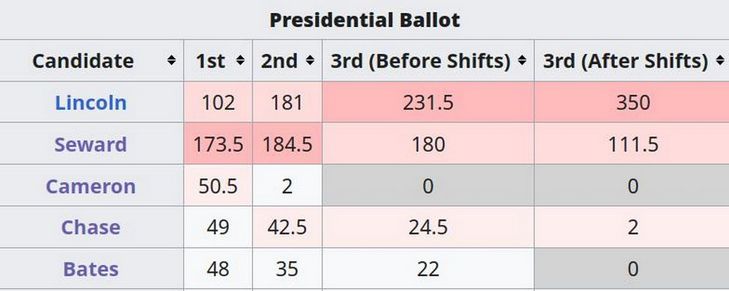
A more accurate version of events is that on the evening of May 17, Davis, Smith and Lane were able to convince the Pennsylvania delegation to support Lincoln on the Second round of voting. And they likely combined to convince a huge number of undecided voters to support Lincoln on the first ballot. This put Lincoln in a surprise second place on the first round of voting with 102 votes to Seward’s 173.5 votes. It came as a great surprise to Weed and his cohorts that Lincoln, not Bates or Cameron or Chase or McLean, stood in second place after the first round of voting.
The Fourth Miracle was securing 48 votes from the Pennsylvania Delegation
It appears that sometime during the evening of Thursday, May 17th, Henry Lane met with Andrew Curtin, the Republican candidate for governor of Pennsylvania, who was as fearful of his own chances in Pennsylvania as was Lane in Indiana. Curtin agreed with Lane that a moderate like Lincoln on the national ticket would greatly increases their chances of being elected governor in their respective states. But there was also a “Cameron” faction in the Pennsylvania delegation. Cameron appears to have been more corrupt and wanted something in return for his support. In short, he was selling his delegates to the highest bidder. It is likely that Lane relayed this information to Davis and that Davis replied that Cameron would get a seat in the cabinet.
This brought both factions of the Pennsylvania delegation of 48 votes into favoring Lincoln on the second ballot after they voted for Simon Cameron on the first ballot.
Thus, the “missing tally sheet” delay gave the Lincoln campaign the time they needed to bribe Cameron and his 48 Pennsylvania delegates before the vote to be held the next morning. They also picked up 10 delegates from Vermont and 6 from Delaware. All three delegations agreed to switch their votes to Lincoln on the second ballot which would give Lincoln a total of 64 more votes.
The Fifth Miracle was the Magic Appearance of 1000 fake tickets
The fifth miracle was that during the same evening, while Lincoln stayed home in Springfield, his campaign manager Judge David Davis, was able to print a thousand fake tickets to the convention – allowing local Lincoln supporters to pack the convention hall on the crucial third day of the convention.
The Convention hall opened at 9 am Friday and was filled with Lincoln supporters. When the Seward delegates arrived after conducting a Victory parade through Chicago that morning, many discovered that their seats had been taken by Lincoln supporters.
Here is an image of the third day of the convention packed with Lincoln supporters using their fake tickets:
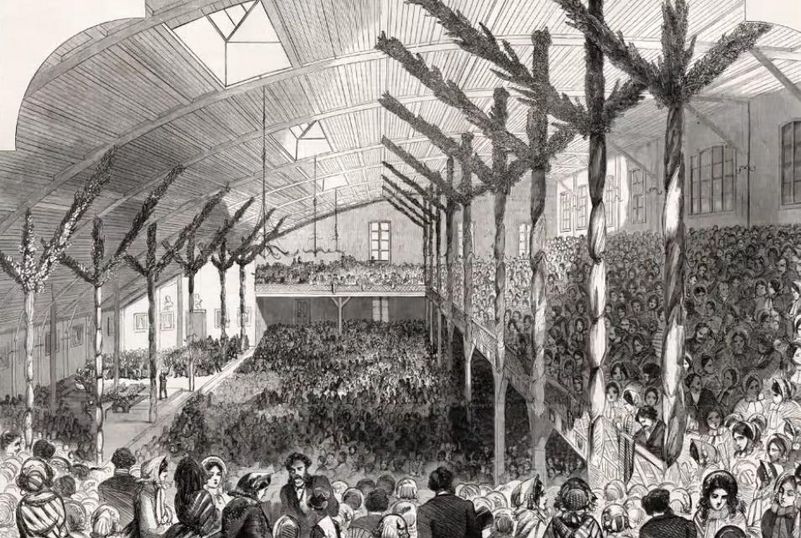
The speakers platform is near the lower left corner.
Seward was nominated first. Judd, of Illinois, nominated Lincoln and the “response was prodigious, rising and raging far beyond the Seward shriek.” Then, “Caleb Smith of Indiana seconded the nomination of Lincoln. The response was absolutely terrific.” The Seward camp – and the whole convention – was surprised when Indiana cast all 26 of her votes for Lincoln.
Below is a copy of the state by state tally for the first ballot with several states voting for their “Favorite Son”:
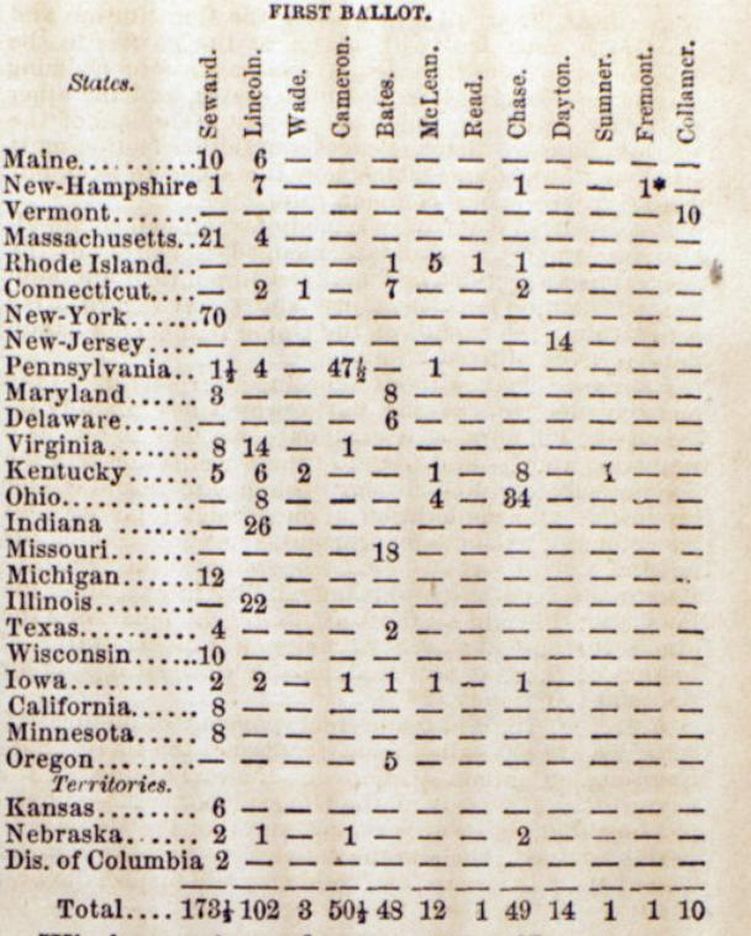
You can see that Indiana’s 26 votes were crucial to putting Lincoln in second place on the first ballot.
The biggest surprise came with the second round. Getting 48 of Cameron’s 50 delegates from Pennsylvania plus 10 votes from Vermont and 6 from Delaware put Lincoln in a virtual tie with Seward.
Below are the State by State results for the crucial second ballot:
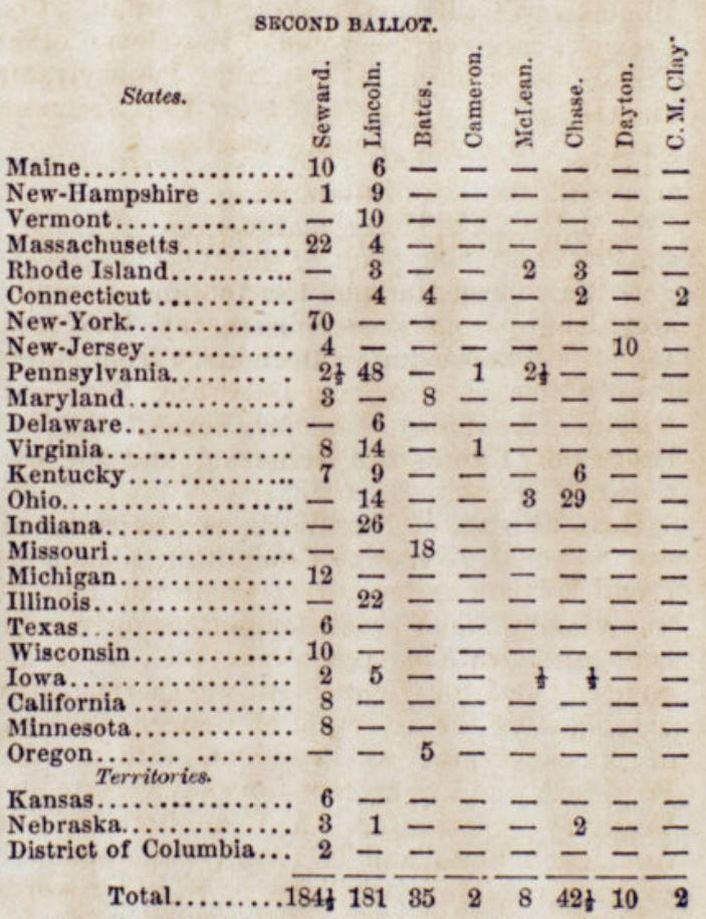
On the third and final ballot, 29 Chase delegates from Ohio switched to Lincoln simply because Simon Chase was a moral person who viewed William Seward as corrupt. Chase famously remarked that Seward was "too much of a politician for me," viewing Seward's deal-making, drinking and machine politics as immoral.
The third round of votes, Lincoln had 231 votes – 2 votes shy of the 233 he needed to win the nomination. This result made it clear that Lincoln would be the nominee – despite his lack of funds and lack of fame. Below was the vote on the third and final ballot:
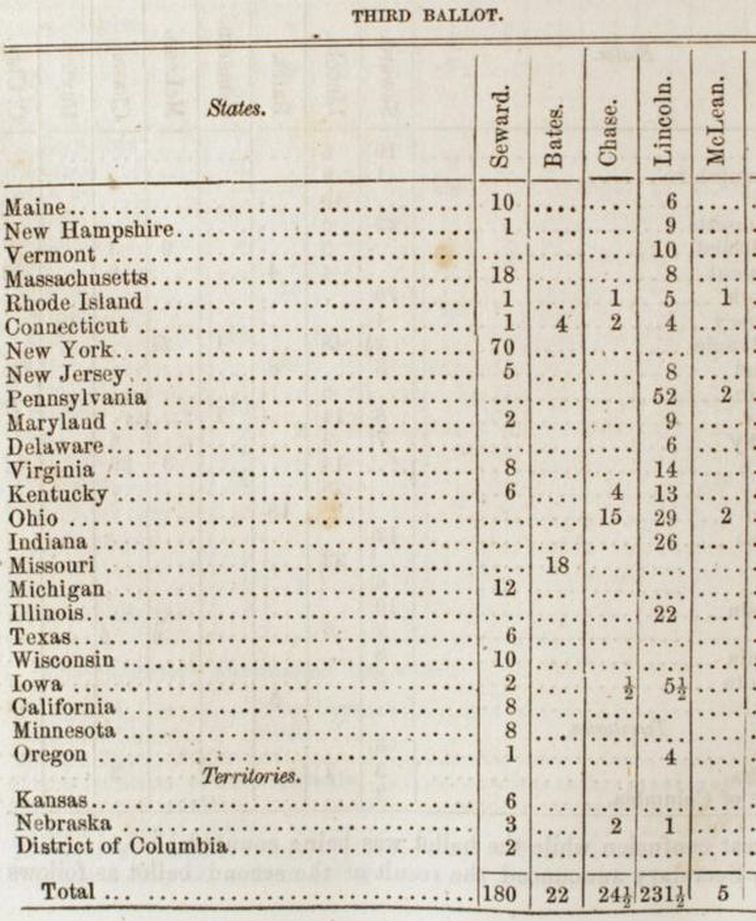
The Convention fell silent as Robert Cartter, the chair of the Ohio delegation, stuttered out: “I-I arise, Mr. Chairman, to a-announce the ch-change of four votes, from Mr. Chase to Abraham Lincoln!” For a moment, the audience was silent–then it erupted. The sound was deafening. After this change in 4 Ohio votes, many delegates left Seward to support Lincoln. Here is a table showing the Initial Third Ballot followed by the last minute switch of votes from Bates and Chase to Lincoln:
Why the Lincoln nomination saved the Union
The crucial difference between Lincoln and Seward was that Lincoln intended to honor the Constitution and defend the Union while Seward was more of a deal maker who was prepared to make compromises with the South in order to avoid Civil War. Had Seward been elected, it is likely that he would have caved to the threats and demands of the South. There would not have been a Civil War. But there also would have been no Constitution and no freedom for the slaves.
On January 12, 1861, after Lincoln won the 1860 election, Seward gave a speech in the Senate in which he ignored the Republican platform, which opposed expansion of slavery, and instead urged avoiding the Civil War by supporting a Constitutional amendment that would prohibit Congress from interfering with slavery in the states, a move designed to placate the South. Here is a portion of his speech:
“The Union cannot be saved by proving that secession is illegal or unconstitutional… little more will be gained from discussing the right of the Federal Government to coerce seceding States into obedience… I do not know what the Union would be worth if saved by the use of the sword… The President says that no State has a right to secede - but we have no constitutional power to make war against a State… Republicanism is subordinate to Union, as everything else is and ought to be… I am willing to vote for an amendment of the Constitution, declaring that it shall not, by any future amendment, be so altered as to confer on Congress a power to abolish or interfere with slavery in any State.”
The problem with Seward’s offer was not merely that he was willing to make slavery permanent, but that he began his speech by declaring that the issue of the unconstitutionality of succession was not relevant – in contrast to Lincoln who understood that the whole point of saving the Union was to save the Constitution which created the Union.
Thus, if it were not for Lincoln, there would either be no United States today or there would be no Constitution. There would only be dozens of small Independent nations combined into various shaky “Confederations.”
Each of these small nations would need its own army. Each of these small nations would be forced to compete with neighboring nations in a race to the bottom.
Here is what one study concluded that North America would look like today if the South was allowed to break up the union.
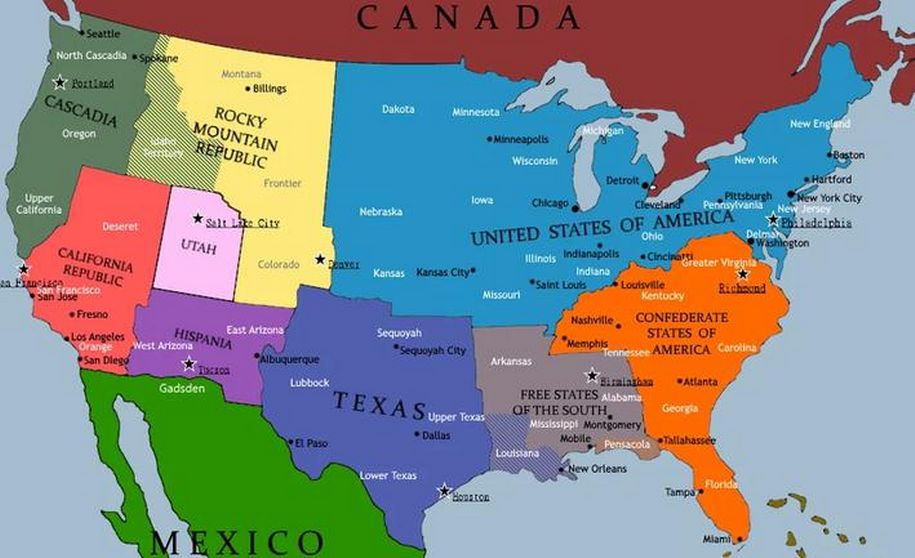
Or perhaps, these small nations, one by one, would have been swallowed back into the British Empire. Even worse, we might be the only nation on earth where slavery is not only permitted but encouraged. Without the United States, both World War One and Two might have suffered very different outcomes. There is no telling what would have happened if it were not for Abe Lincoln standing up for the preservation of the Union.
It is thus no wonder that so many books have been written about him. We read books about Lincoln out of gratitude for what he did for us – and what he did for our nation. He gave “the last full measure of devotion” so that “this nation under God shall have a new birth of freedom, and that government of the People, by the People, for the People shall not perish from the earth.”
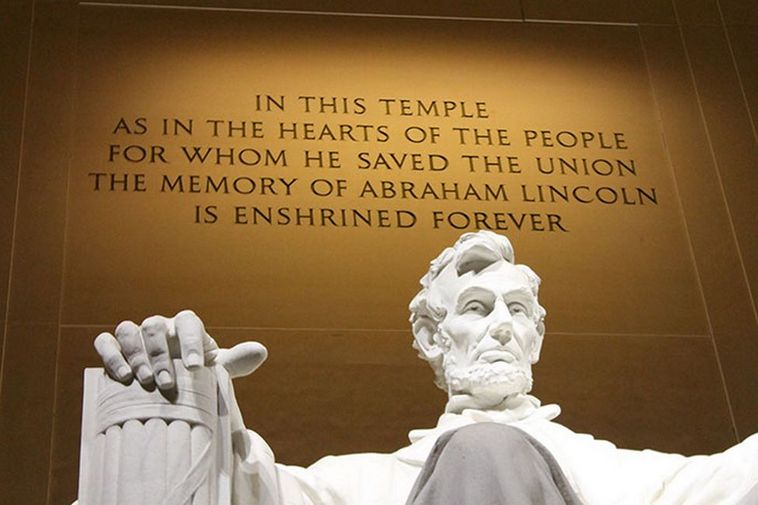
Given our current Constitutional Crisis, it is now up to us to pick up the sword of Truth and continue the unfinished work which Lincoln so nobly advanced.