header 1500

.
  • Home
  • I Learn the Truth
    • 1 Lincoln’s Secret Weapon
    • 2 Of the People, by the People, for the People
    • 3 The Meaning and History of our Constitution
      • 29 Second Inaugural Address March 4 1865
    • 4 Explaining Lincoln’s Biggest Mistake
    • 5 How Story helped Lincoln find his calling in life
    • 6 Lincoln Lyceum Speech January 27 1838
    • 7 Lincoln Peoria Speech October 16 1854
    • 8 Republican Party Platform June 17 1856
    • 9 Dred Scott 1857 Dissent Opinions
    • 10 House Divided Speech June 16 1858
  • II Tell the Truth
    • 11 Second Campaign Speech Chicago July 10 1858
    • 12 First Debate Ottawa Illinois August 21 1858
    • 13 Second Debate Freeport Doctrine August 27 1858
    • 14 Third Debate Jonesboro September 15 1858
    • 15 Fifth Debate Galesburg October 7 1858
    • 16 Douglas Popular Sovereignty September 7 1859
    • 17 Lincoln Cincinnati Speech September 17 1859
    • 18 Lincoln Indianapolis Speech September 19 1859
    • 19 Lincoln Cooper Union Address February 27 1860
    • 20 Lincoln’s Chicago Miracle
  • III Defend the Constitution
    • 21 First Inaugural Address March 4 1861
    • 22 Message to Congress July 4 1861
    • 23 First Annual Message December 2 1861
    • 24 Second Annual Message December 1 1862
    • 25 Emancipation Proclamation January 1 1863
    • 26 Gettysburg Address November 19 1863
    • 27 Third Annual Message December 8 1863
    • 28 Fourth Annual Message December 6 1864
  • Lincoln Republicans
  • American Patriots
  • Contact Us

Part I Lincoln’s Wisdom to Learn the Truth

The first 10 chapters occur before the Lincoln Douglas Debate as Lincoln developed his ideas about the Constitution, the Union and the moral, social, economic and political wrong of slavery.

1.00

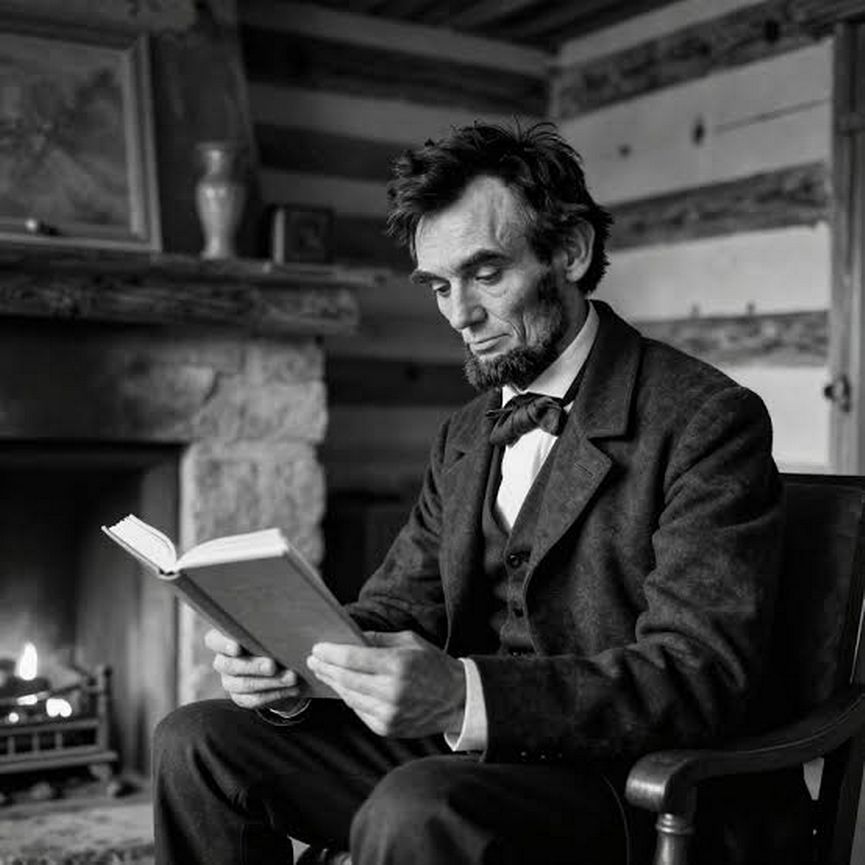
Lincoln reading a book


1 Lincoln’s Secret Weapon

If the Truth is the first casualty of War, then a new Civil War has already begun. It began as an Information War. It has turned into a War against the Civil Rights of the American people. Unless we follow Lincoln’s example of learning the truth, telling the truth and defending our Constitution, this second Civil War will end with the loss of our Liberty, the loss of our Civil Rights and the loss of our Constitutional Republic.

In this book, our goal is to outline this current Constitutional Crisis and the danger this Crisis presents for the future of our country. We will then compare this Crisis with the Constitutional Crisis that preceded the last Civil War. In that Crisis, Lincoln urged American Patriots to “do as Washington, Jefferson and Madison did” and thereby bring our nation back from the brink of disaster. We will review what Lincoln did, why he did it and how he saved our Nation and our Constitution
Read more: 1 Lincoln’s Secret Weapon

2 Of the People, by the People, for the People

The most famous phrase in Lincoln's Gettysburg Address is in the final sentence where he described the unfinished business that we should all be dedicated to: "that government of the people, by the people, for the people, shall not perish from the earth."

Because Lincoln was a man of the People, it is possible that he thought up this phrase himself as his entire Address naturally led to this conclusion - as if the conclusion was written first and the rest of the Address was written to stress the importance of this goal. But in most of his speeches, Lincoln usually talks of "saving the Union." So there is the possibility that Lincoln took this line from someone else.

Read more: 2 Of the People, by the People, for the People

3 The Meaning and History of our Constitution

Some have claimed that the last Civil War was a battle over slavery while others claim it was a battle over States Rights versus Federal Rights. After reading Story’s Commentaries, you will hopefully come to see that neither of these claims is entirely accurate. Instead, the true meaning of Lincoln’s speeches leads to the conclusion that the Civil War was actually about preserving our Constitutional Republic.

When Lincoln said that the Civil War was about “preserving the Union,” what he meant by “Union” was the “more perfect union” described in the Preamble to the Constitution which states that:

“We the People of the United States, in order to form a more perfect Union, establish Justice, insure domestic Tranquility, provide for the common defense, promote the general Welfare, and secure the Blessings of Liberty to ourselves and our Posterity, do ordain and establish this Constitution for the United States of America.”

In short, the foundation of our more perfect Union is the Constitution. Prior to the creation of our Constitution, in 1787, We, the People, had spent several harsh years enduring a LESS PERFECT UNION due to the Articles of Confederation that left each State to make its own way. The result was economic warfare that divided the States - and no way to resolve conflicts between the States. By 1786, other than New York, nearly every State was near economic collapse and political chaos.

Read more: 3 The Meaning and History of our Constitution

4 Explaining Lincoln’s Biggest Mistake

As further evidence that Lincoln was guided throughout his political life by Joseph Story and his Commentaries on the Constitution, we will here review one of Lincoln’s biggest and strangest mistakes… which was his misunderstanding of the meaning of the 1774 Articles of Association which was an early agreement between the colonies.

In his First Inaugural Address in 1861, Lincoln mistakenly referred to this document as the reason the Southern States could not leave the Union. Lincoln mistakenly believed that the Union was formed by the Articles of Association. Lincoln stated: "The Union is much older than the Constitution. It was formed in fact by the Articles of Association.”

Why did Lincoln claim that the Union was formed by the Articles of Association?

Our goal is to show that the only place Lincoln could have gotten his information about the Articles of Association was from Story and his discussion of this document in Commentaries on the Constitution.

Read more: 4 Explaining Lincoln’s Biggest Mistake

5 How Story helped Lincoln find his calling in life

Here we will take a closer look on how Joseph Story’s commentaries influenced the evolution of Lincoln’s early convictions.

5.01

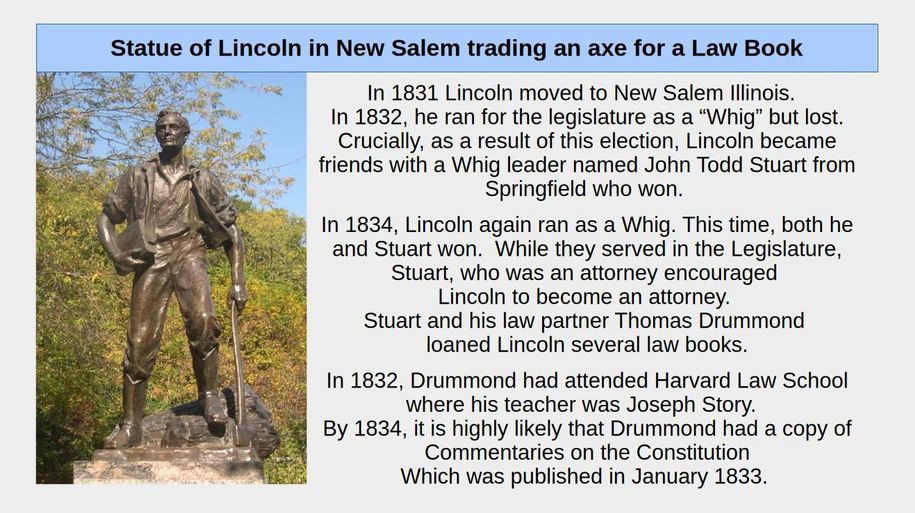
In 1831, at the age of 22, Lincoln settled in New Salem, Illinois. Lincoln became fond of hanging out at the courtroom of Judge Bowling Green. The two bonded over a mutual love of jokes and funny stories. Judge Green encouraged Lincoln’s interest in the law and allowed him to develop his speaking skills by trying small cases.

In 1832, Lincoln ran as a National Republican for the State legislature coming in 8th in a field of 13. It is odd that Lincoln chose to run as a National Republican in 1832. Jackson Democrats were in the majority in Illinois in 1828. Andrew Jackson won the national Presidential Election with over 55% of the vote. His National Republican opponent, the current President, John Quincy Adams only got 44% of the vote. In 1832, Jackson won again with 54% of the vote. His National Republican opponent, Henry Clay, only got 37% of the vote.

Democrats were the party of the people, whereas the National Republicans advocated for a strong federal government, the rule of law and protections for minority interests against majority tyranny.

So why did Lincoln decide to join the National Republicans in 1932 instead of going for the more popular Democratic Party?

Read more: 5 How Story helped Lincoln find his calling in life

6 Lincoln Lyceum Speech January 27 1838

As one of Abraham Lincoln's earliest published speeches, this address has been much scrutinized and debated by historians. Lincoln was 28 years old at the time he gave this speech and had moved just ten months earlier from a struggling pioneer village to Springfield, Illinois.

The speech was brought out by the burning to death of a negro in St. Louis a few weeks before, by a racist mob. Lincoln took this incident as a text for his remarks. But we can clearly see that Joseph Story and his love for the US Constitution was reflected in Lincoln’s remarks. The address was published in the Sangamon Journal and created a reputation for Lincoln which soon extended beyond the limits of the locality in which he lived.

Read more: 6 Lincoln Lyceum Speech January 27 1838

7 Lincoln Peoria Speech October 16 1854

Our second Lincoln speech is from October 16, 1854. Again, Lincoln opposed the immorality of slavery and supported the US Constitution. He opposed the May 1854 passage of the Kansas–Nebraska Act – which repealed the 1820 Missouri Compromise and extended popular sovereignty and therefore slavery to the Kansas and Nebraska territories.

Nationally, the Whigs were split by the Kansas–Nebraska Act and shortly after the passage of the Kansas Nebraska Act, anti-slavery Whigs combined with anti-slavery Democrats and “Free Soilers” to form the new Republican Party. In Michigan and Wisconsin, these two coalitions labeled themselves as the Republican Party, but similar groups in other states initially took on different names.

Like their Free Soil predecessors, Republican leaders generally did not call for the abolition of slavery but instead sought to prevent the extension of slavery into the territories. "In view of the necessity of battling for the first principles of republican government," resolved the Michigan state convention, "and against the schemes of aristocracy the most revolting and oppressive with which the earth was ever cursed, or man debased, we will co-operate and be known as Republicans."

Read more: 7 Lincoln Peoria Speech October 16 1854

8 Republican Party Platform June 17 1856

The first anti-Nebraska Act local meeting where the term “Republican” was suggested as a name for a new anti-slavery party was held in a Ripon, Wisconsin schoolhouse on February 28, 1854. Their second meeting on March 20, 1854 has also been called the birth of the Republican Party. The first Republican Party written platform was created at a Michigan State Convention on July 6, 1854. Here we will look at the 1856 National Republican Party platform.

Some claim that the term “Republican” used at this meeting was in honor of Jefferson’s Democratic Republican Party – which had disbanded in disgrace 30 years earlier. But others claimed (and I agree) that the name Republican was actually based on the political theory called “American Republicanism” – a theory that was widespread among Patriots during the Revolutionary War and the drafting of the US Constitution. The term “Republicanism” as discussed by Patriots such as James Madison, did not mean allegiance to a political party. In fact, many of our Founders were opposed to political parties. Instead, Republicanism meant preservation of the Republican form of government. This form of government means rule by elected Representatives and Protection for the Rights of Minorities – as opposed to a “Direct Democracy” which means only majority rule or mob rule with no protection for the individual rights of its citizens.

Read more: 8 Republican Party Platform June 17 1856

9 Dred Scott 1857 Dissent Opinions

On March 6, 1857, Justice Taney published the Dred Scott decision – a decision that falsely claimed that slaves were property and not people - now recognized as the worst decision in Supreme Court history – and also recognized as a leading cause of the American Civil War. Later in 1857, Lincoln delivered a speech criticizing the Dred Scott decision. But because Lincoln’s 1858 speeches more clearly state his objections to the Taney decision, we will not provide Lincoln’s 1857 speech. Instead, we will provide quotes from two Dissenting Opinions both of which Lincoln certainly read and both of which formed at least some of his objections to the Dred Scott decision.

We will not provide either Dissent Opinion in its entirety because the McLean Dissent is 40 pages long and the Curtis Dissent is 80 pages long. Instead, we will provide a few pages of quotes from each Dissent to give you a better understanding of why the Dred Scott Taney Opinion was the worst Supreme Court Opinion of all time.

Read more: 9 Dred Scott 1857 Dissent Opinions

10 House Divided Speech June 16 1858

This speech is the first entry in the 1860 book which helped elect Lincoln. The Speech was delivered at the close of the Republican State convention by which Mr. Lincoln had been named as their candidate for U. S. Senator. Lincoln begins with a summary of the problem - which was not the existence of slavery but the expansion of slavery to the territories and free states - and how this problem came about and the danger it presented. Lincoln began to increasingly describe the expansion of slavery as not just a Constitutional issue, but a moral, social, political and economic wrong.

10.01

************************************************************************
Mr. PRESIDENT and Gentlemen of the Convention. 

If we could first know where we are, and whither we are tending, we could then better judge what to do, and how to do it. We are now far into the fifth year, since a policy was initiated, with the avowed object, and confident promise, of putting an end to slavery agitation. Under the operation of that policy, that agitation has not only, not ceased, but has constantly augmented. In my opinion, it will not cease, until a crisis shall have been reached, and passed.

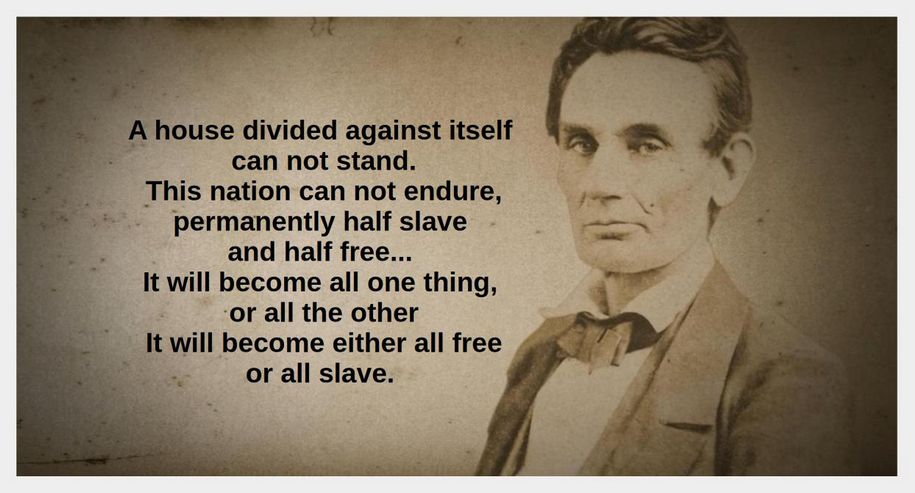
A house divided against itself cannot stand. I believe this government can not endure, permanently half slave and half free. I do not expect the Union to be dissolved---I do not expect the house to fall---but I do expect it will cease to be divided. It will become all one thing, or all the other. Either the opponents of slavery, will arrest the further spread of it, and place it where the public mind shall rest in the belief that it is in course of ultimate extinction; or its advocates will push it forward, till it shall become alike lawful in all the States, old as well as new---North as well as South.

Read more: 10 House Divided Speech June 16 1858
  • Home
  • I Learn the Truth
    • 1 Lincoln’s Secret Weapon
    • 2 Of the People, by the People, for the People
    • 3 The Meaning and History of our Constitution
      • 29 Second Inaugural Address March 4 1865
    • 4 Explaining Lincoln’s Biggest Mistake
    • 5 How Story helped Lincoln find his calling in life
    • 6 Lincoln Lyceum Speech January 27 1838
    • 7 Lincoln Peoria Speech October 16 1854
    • 8 Republican Party Platform June 17 1856
    • 9 Dred Scott 1857 Dissent Opinions
    • 10 House Divided Speech June 16 1858
  • II Tell the Truth
    • 11 Second Campaign Speech Chicago July 10 1858
    • 12 First Debate Ottawa Illinois August 21 1858
    • 13 Second Debate Freeport Doctrine August 27 1858
    • 14 Third Debate Jonesboro September 15 1858
    • 15 Fifth Debate Galesburg October 7 1858
    • 16 Douglas Popular Sovereignty September 7 1859
    • 17 Lincoln Cincinnati Speech September 17 1859
    • 18 Lincoln Indianapolis Speech September 19 1859
    • 19 Lincoln Cooper Union Address February 27 1860
    • 20 Lincoln’s Chicago Miracle
  • III Defend the Constitution
    • 21 First Inaugural Address March 4 1861
    • 22 Message to Congress July 4 1861
    • 23 First Annual Message December 2 1861
    • 24 Second Annual Message December 1 1862
    • 25 Emancipation Proclamation January 1 1863
    • 26 Gettysburg Address November 19 1863
    • 27 Third Annual Message December 8 1863
    • 28 Fourth Annual Message December 6 1864
  • Lincoln Republicans
  • American Patriots
  • Contact Us