On September 19, 1859, Lincoln traveled to Indianapolis by train from Cincinnati, Ohio to Indianapolis, Indiana. He then addressed a full house at the Masonic Lodge that evening. He began his speech by described his childhood memories of growing up in Indiana. In the fall of 1816, when he was only 8 years old, his father brought him over from Kentucky, and settled in Indiana where he lived for 12 years until he was 20 and left his father’s home for Illinois.
While this speech is rarely discussed in books about Lincoln, it was one of the most important speeches he ever gave. This speech endeared him to Republicans in Indiana. Nine 9 months later, these Indiana Republicans would give Lincoln the crucial First Round votes he needed to be the leading challenger to Seward for the Republican Party Presidential Nomination. Together with Illinois, Indiana would cast a block of 48 votes for Lincoln on the First Round in May 1860.
Indiana decided in favor of Lincoln at an early stage of the struggle, and her action had much to do in deciding Pennsylvania’s support of Lincoln in the Second Round of voting. Without these votes, Seward would likely have been the Nominee and he likely would have reached a “deal” with the South allowing slavery into new US States. This in turn would have led to the breakup of the Union into a series of much smaller countries similar to those in Europe.
There is no actual text of Lincoln’s speech. There is only a third hand account of his speech in Lincoln’s Collected Works. Since this third hand account of the speech is awkward to read and understand, I have edited it into the first hand account as follows:
*****************************************************************************
Fellow citizens of the State of Indiana:
Appearing at the capital of this now great State, and traveling through a good portion of it in coming from Cincinnati, has combined to revive a recollection of the earlier years of my life. Back in the fall of 1816, when I was in my eighth year, my father brought me over from the neighboring State of Kentucky, and settled in the State of Indiana.
I grew up to my present enormous height on the good soil of Indiana. [Laughter.] The scenes I passed through today while on the train from Cincinnati are wonderfully different from the first scenes I witnessed in the State of Indiana, where I was raised, in Spencer county, on the Ohio river. There was an unbroken wilderness there then. At a young age, an axe was put in my hand; and with the trees and logs and grubs, I fought until I reached my twentieth year.
I expect you all came to hear something about politics. It is almost impossible for me to speak of politics without associating Judge Douglas with it. I hope you will permitt me to take, among the range of political topics, the same that Judge Douglas took, when he spoke here while stopping on his way to Chicago. He knew his Democratic friends thought a Republican speaker could not speak of anything but the negro. He would ask if they ever heard their leader talk of anything else in the past few years of his political career. He did not hesitate to enter upon this subject. There were so many points arising out of that single topic, in the range that it has taken, that he could give but a very small portion of it.
During the last canvass, I expressed the opinion that this government of ours cannot ``endure permanently, half slave and half free; that a house divided against itself cannot stand.' Some time after, Governor Seward, of New York, in a speech of his, expressed the same opinion in different language.
These expressions of our opinion on the spread of slavery gave very great offense to Judge Douglas. He denounced them as heresy, a fatal heresy. How it is fatal, or in what way a fatality is to come out of it, the Judge has not said. Still he denounced this opinion as a heresy, and he raised a great many concerns about it. Among other things, he asked, ``why cannot this government endure forever, part free, part slave, as the original framers of the constitution made it?''
There was couched in his question an assumption that is false. It is true that our fathers made this government, and that when it was made it was part slave and part free. But the assumption of his question is, that our fathers made the government part free and part slave from choice---that they had chosen to make it so because they thought a government thus made, was the best that could be made.
Of choice they made it part free and part slave. That was the assumption of his question, and I will try to prove it untrue. It was not the judgment of the framers of the Constitution, that it was best that the States should be part free and part slave.
There was no provision made by our fathers for peopling one portion of the States with slaves. But our fathers did expect Congress to prohibit the slave trade in 20 years. They made a provision in the constitution by which they prohibited them from doing so prior to the expiration of 20 years. The language is the migration or importation of such persons as the States shall see fit to admit shall not be prohibited, but a certain tax might be levied on such importation. None of the States then existing should be prohibited for 20 years. But what was to be done after that time? The Constitution is silent about that.
The framers of the Constitution expected that the slave trade would be abolished before that time, owing to public sentiment. Nothing was said about new States. It had reference to the then existing States. All the States had slavery, with one exception. Some, so small an amount as not to feel it, and others quite a large amount. All the States of the South had a considerable amount of slavery in them. The Southern people were cultivating their soil with slaves, and it was in deference to that state of things that the framers of the Constitution put in the provision, that Congress should not prohibit that trade until after the expiration of 20 years.
The ordinance of 1787 was passed simultaneously with the making of the Constitution of the United States. It prohibited the taking of slavery into the Northwestern Territory, consisting of Ohio, Indiana, Illinois, Michigan and Wisconsin. There was nothing said in the Constitution relative to the spread of slavery in the Territories, but the same generation of men said something about it in this ordinance of 1787, through the influence of which you of Indiana, and your neighbors in Ohio, Illinois, Wisconsin and Michigan, are prosperous, free men. Our fathers who made the government, made the ordinance of 1787.
Under the control of this same generation, in 1802, the first portion of this NorthWestern Territory sought admission into the Union. An Act was passed by Congress to enable Ohio to make a Constitution and come into the Union in accordance with the Ordinance of 1787.
Congress composed of the same generation of men that framed the Constitution, enabled Ohio to make a State Constitution, provided it was not repugnant to this ordinance. The same process was gone through when Indiana applied for admission. Then followed Illinois and Wisconsin. In the case of Michigan there was no enabling act.
Indiana, in her territorial condition, more than once petitioned Congress to abrogate the ordinance entirely, or at least to so far as to suspend its operation for a time, in order that they should exercise the ``popular sovereignty'' of having slaves if they wanted them. The men then controlling the government refused Indiana that privilege. So, had it not been for the ordinance of 1787, Indiana would have been a slave State, and all the other States included in the NorthWestern Territory. Thus, down through a period of 60 years, until the last inch of that Territory came into the Union, the prohibition of slavery was religiously adhered to.
That the fathers of this government did not make it part slave and part free to remain permanently so, I would like to bring forward a few facts tending to show a reasonable and unbiassed mind, that it was expected at that time that the institution of slavery would gradually come to an end.
If they intended slavery to endure forever, why did they hedge it into its then existent limit? There is nothing said about it in the Constitution. The word slave or slavery is not mentioned anywhere in the Constitution. This was very singular if it was the intention that slavery should become a permanent institution.
It is my opinion that the whole subject of slavery was left out of the Constitution by design. It was not done by accident but by design---as the framers of the Constitution expected that the institution would die. Some of them declared it as their desire that it should die. Nothing should be left on the face of the Constitution to tell that there had ever been slavery in the land. If this is so, then we have the fact established, that our fathers made the government contrary to the manner in which Judge Douglas said it was done. The assumption hidden in his question is false in truth and in fact.
Not one of Judge Douglas's propositions is consistent with the Ordinance of 1787. He repeatedly asserts that Congressional interference never made any State a free State, and that if Ohio was a free State, it was made free on his great principle of ``Popular Sovereignty.''
While a Territory, a portion of the people of Indiana asked Congress to suspend the Ordinance of 1787, but Congress refused to do so. The people wanted to exercise the principle of popular sovereignty, and chafed at the barrier of the Ordinance of 1787. But that ordinance kept slavery out of their limits and made Indiana a free State.
There was no difficulty in introducing slaves into Kentucky if the people wished, but it is a hard job to get them out of it. When the Kentuckians came to form their Constitution, they had the embarrassing circumstances of slavery among them. Therefore, they were not a free people to make their Constitution a free state or a slave state. It already was a slave state. The people of Indiana had no such embarrassment, but would have had, had not slavery been kept away by the ordinance of 1787.
The general course of the river Ohio, from the eastern boundary of the State of Ohio, is very nearly southwest. The northeastern part of Kentucky, and the western part of Virginia, are north of that portion of Ohio where Cincinnati is, and still farther north of the southern portions of this State and Illinois. Now, it so happens that the country south of the Ohio river is slave, and the country north is free. What caused this?
Judge Douglas says that the ordinance of 1787 did not do it. If not, what did? There is no difference in soil nor in climate. It could not be because the people on the south bank of the Ohio had worse hearts than the people on the north bank of the Ohio. They are as good as we of the North---the same people. There was some other reason. You could light upon nothing in the whole range of conjecture, save and except that the ordinance of 1787, that kept slavery out of the country north of the Ohio, but there was no similar law to keep slavery out of Kentucky and the South.
In 1810 there was a little slavery in Illinois and a little in Missouri. The two States ran along together, getting ready to form a State Constitution until 1820. Each one of them had a few slaves. When they were ready to come into the Union, they had not kept parallel on the subject of slavery. In Illinois slavery had decreased, while in Missouri the number of slaves had increased to 10,000. Missouri came in as a slave State and Illinois as a free State. The two States are to a certain extent in the same parallel of latitude, so that the climate would have the same effect on one as the other, and in the soil there is no material difference as far as bears upon the question of slavery being settled upon one or the other. There were no natural causes to make a difference in the filling up of the two States. So, what was the cause of the difference between them in regards to slavery?
The answer to this question is that in Missouri there was no law to keep that country from filling up with slaves, while in Illinois there was the Ordinance of 1787. The Ordinance being in Illinois, slavery decreased during that ten years.
The Ordinance not being in Missouri, slavery increased from a few to ten thousand. The proposition of Judge Douglas, that the Ordinance of 1787, or the national restriction of slavery, has never had a tendency to make a Free State, is not true. Douglas has said that all the States that have become free, have all become so on his great principle. But instead there was not a single free State in the Union but what had a national prohibition of slavery in it when it came into the Union.
Several free States have come into the Union since the original thirteen---and they have all come in with the national prohibition of slavery over them during their existence as Territories. All the States south of the Ohio and the Missouri Compromise have all come into the Union as slave States. The ordinance of 1787 did not apply to them.
Kansas will come in as a free State, not because of popular sovereignty, but because the people of the North are making a strong effort on her behalf to maintain the restriction on slavery that has always existed. But Kansas is not in yet. Popular sovereignty has not made a single free State in a run of seventy or eighty years.
It is agreed, on every hand, that labor is the great source from whence all our comforts and necessaries are derived. There is a difference of opinion among political economists, about the elements of labor in society. Some men say that there is a necessary connection between labor and capital, and this connection draws within it the whole of the labor of the community. They assume that nobody works unless capital excites them to work. They say there are but two ways to induce men to labor: the one is to hire men, and to allow them to labor by their own consent; the other is to buy the men and force them to do labor. That is slavery.
Assuming that these are the two ways to get men to labor, these economists proceed to discuss the question of whether the laborers themselves are better off in the condition of slaves or of hired laborers. Some claim that men are better off as slaves. They have no responsibility on them, and when they get old, they are taken care of.
But in the State of Indiana, of all that is produced, seven-eighths of it is produced by the hands of men who work upon their own ground with no payment by another man. No more than one-eighth is produced by hired men. Even for the hired man, their condition is not worse than that of the slave – because the hired man still has his freedom.
I myself was a hired man 28 years ago. I didn't think I was worse off than a slave. I am now working for myself. There is a certain relation between capital and labor, and it is proper that it exists. Men who are industrious and sober, and honest in the pursuit of their own interests, should after a while accumulate capital, and after that, should be allowed to enjoy it in peace, and if they chose, when they had accumulated capital, to use it to save themselves from actual labor and hire other people to labor for them, it was right.
They do not wrong the man they employ, for they found men who have not their own land to work upon or shops to work in, and who were benefitted by working for them as hired laborers, receiving their capital for it. If a hired laborer works as a true man, he saves means to buy land of his own, a shop of his own, and to increase his property. For a new beginner, this was the true, genuine principle of free labor. A few men that own capital, hire others, and thus establish the relation of capital and labor rightfully.
By contrast, Judge Douglas's popular sovereignty, as a principle, is simply this: If one man choose to make a slave of another man, neither that other man or anybody else has a right to object. Applied in government, as he seeks to apply it, if in a new Territory, into which a few people are beginning to enter, they choose to either exclude or to establish slavery there, however one or the other may affect the persons to be enslaved, or the greater number of persons who are to inhabit that Territory, there is no power or right to interfere.
This is the application of Douglas's popular sovereignty. Douglas thinks slavery so insignificant that the people must decide that question for themselves, though they are not fit to decide who shall be their officers. Planting slavery is a small matter, in his estimation, and nobody ought to be allowed to say anything about it.
But there is a hidden feature in connection with Judge Douglas's Popular Sovereignty, that is more dangerous than anything else. That is the debauching of public sentiment. The institution of slavery operates against the principle of liberty.
The Judge says he does not care whether slavery is voted up or voted down. That is as much as to say, that he does not believe it to be wrong.
This was not the opinion held by the good men of the American Revolution. It was not the expressed opinion of Mr. Jefferson. Douglas does not care whether slavery goes up or down. He tells us that the Declaration of Independence never meant negroes.
I ask any Democrat present, if he has the boldness to say that the Declaration did not include negroes as well as whites? [Here Mr. Lincoln looked hard at Gov. Willard, who was sitting in front of him.]
I have never heard any one say so, and I have asked thousands. No President had ever said so---no head of any department, nor a member of Congress has ever said so. And yet we have allowed this man Douglas to debauch public sentiment among us with this falsehood.
He has taken the negro out of the catagory of man, when no one had not thought of such a thing five years ago.
Five years ago, no living man expressed the opinion that the negro had no share in the Declaration of Independence. But within that space Douglas had got his entire party, almost without exception, to join in saying that the negro has no share in the Declaration. The tendency of that change, that debauchery in public sentiment is to bring the public mind to the conclusion that when white men are spoken of, the negro is not meant, and when negroes are spoken of, brutes alone are contemplated. That change has already depressed the black man in the estimation of Douglas himself, and the negro was thus being debased from the condition of being a man to that of being a brute.
Douglas has declared that in all contests between the negro and the white man, he was for the white man. But that, in all contests between the negro and the crocodile, he was for the negro.
Douglas made the remark a great many times in the canvass in Illinois last year. The first inference from his remark, seemed to me to be that you are wronging the white man in some way or other, and that whoever is opposed to the negro being enslaved is in some way opposed to the white man.
That was not true. If there were any conflict between the white man and negro, I would be for the white man as much as Douglas. But there is no such conflict. But there is a conflict between freedom and slavery. The mass of white men are injured by the unfair and unjust effect of slave labor in the neighborhood of their own labor.
The next inference of Douglas comparing a negro to a crocodile is that there is a conflict between the negro and the crocodile. I do not think there is any such struggle. I suppose that if a crocodile - or alligator, as the broad boat men on the Ohio river used to term it, came across a white man, he would kill him if he could! And so he would kill a negro.
The proposition amounts to this. As the negro is to the white man, so is the crocodile to the negro. And as the negro may treat the crocodile as a beast or reptile, so the white man may treat the negro as a beast or reptile. That was what Douglas is implying. But I say that slavery is morally wrong and is a threat to the freedom of all of us.
Note: Lincoln’s discussion of being a hired man and his discussion of rivers is a reminder to his audience that one of Lincoln’s first jobs was guiding River Boats on the Ohio River. Below is an image of young Abraham Lincoln as he ferries passengers out to a steamboat on the Ohio River.
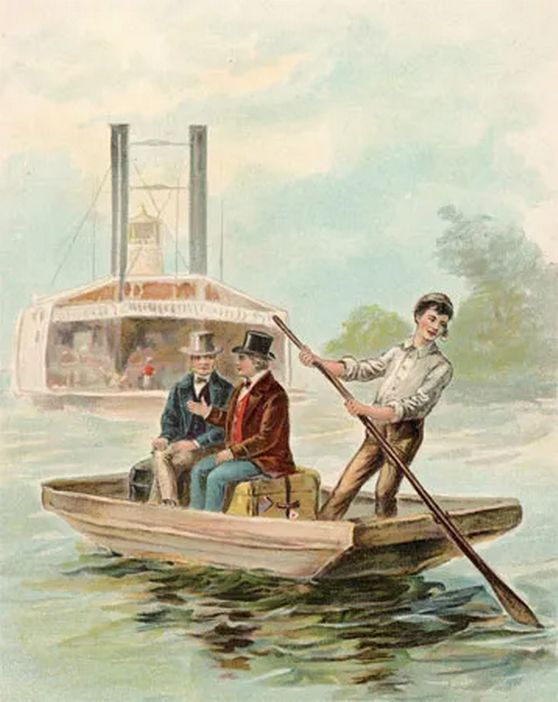
When Lincoln was a young man, there were very few roads in the Territories. So river boats were the main method of transportation.