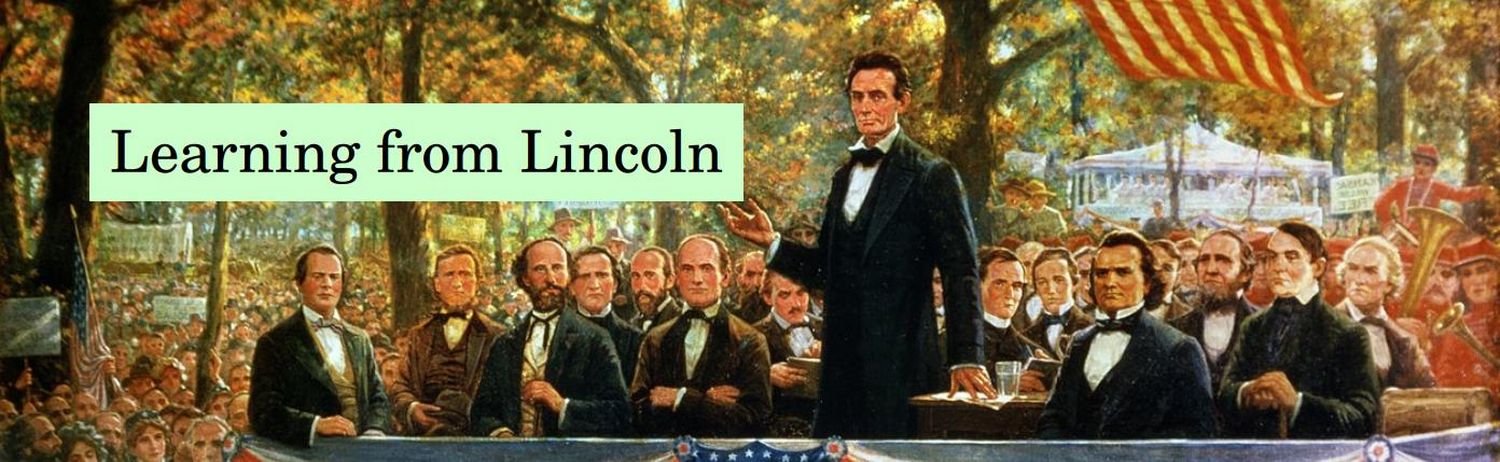
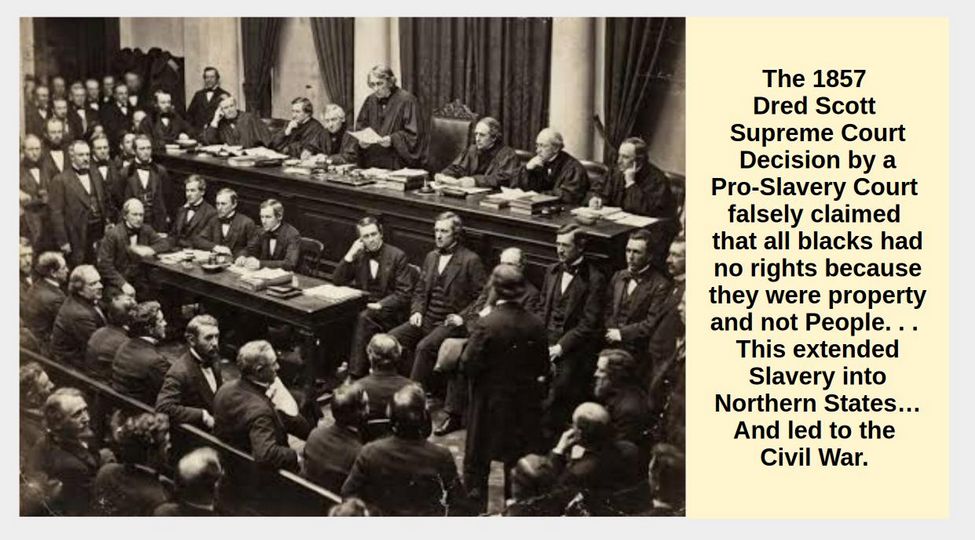
On March 6, 1857, Justice Taney published the Dred Scott decision – a decision that falsely claimed that slaves were property and not people - now recognized as the worst decision in Supreme Court history – and also recognized as a leading cause of the American Civil War. Later in 1857, Lincoln delivered a speech criticizing the Dred Scott decision. But because Lincoln’s 1858 speeches more clearly state his objections to the Taney decision, we will not provide Lincoln’s 1857 speech. Instead, we will provide quotes from two Dissenting Opinions both of which Lincoln certainly read and both of which formed at least some of his objections to the Dred Scott decision.
We will not provide either Dissent Opinion in its entirety because the McLean Dissent is 40 pages long and the Curtis Dissent is 80 pages long. Instead, we will provide a few pages of quotes from each Dissent to give you a better understanding of why the Dred Scott Taney Opinion was the worst Supreme Court Opinion of all time.
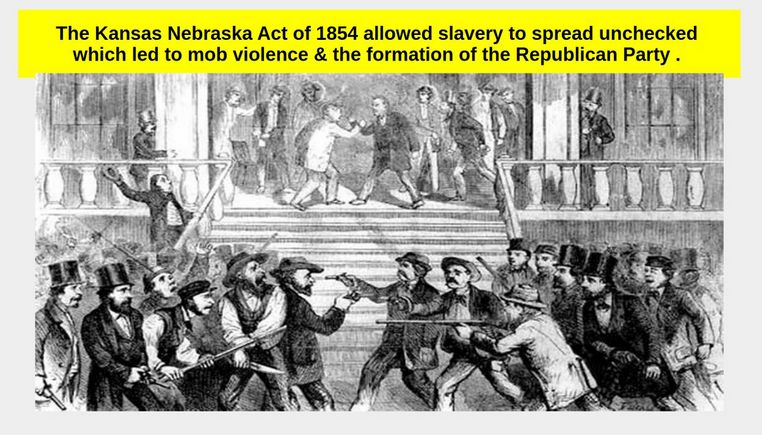
The Missouri Compromise of 1820 ruled out slavery in the United States north of Missouri’s southern border. The Kansas-Nebraska Act of 1854 made slavery north of this line possible again. The Kansas-Nebraska Act allowed the people of each territory to decide whether or not to allow slavery. This angered people who wanted to end slavery. It led to violence in Kansas, where people fought and killed each other over the issue of slavery.
1857 Dred Scott Supreme Court Decision
We will begin with quotes from the McLean Dissent because it is shorter.
****************************************************************************
The defendant's counsel complain, that if the court take jurisdiction on the ground that the plaintiff is free, the assumption is against the right of the master. This argument is easily answered. In the first place, the plea does not show him to be a slave; it does not follow that a man is not free whose ancestors were slaves.
In Jacob v. Sharp, the court held, when there was doubt as to the construction of a will which emancipated a slave, 'it must be construed to be subordinate to the higher and more important right of freedom.'
In the argument, it was said that a colored citizen would not be an agreeable member of society. This is more a matter of taste than of law. Several of the States have admitted persons of color to the right of suffrage, and in this view have recognized them as citizens; and this has been done in the slave as well as the free States.
Under the late treaty with Mexico, we have made citizens of all grades, combinations, and colors. The same was done in the admission of Louisiana and Florida. No one ever doubted, and no court ever held, that the people of these Territories did not become citizens under the treaty. They have exercised all the rights of citizens, without being naturalized under the acts of Congress.
There are several important principles involved in this case, which have been argued, and which may be considered under the following heads:
1. The locality of slavery, as settled by this court and the courts of the States.
2. The relation which the Federal Government bears to slavery in the States.
3. The power of Congress to establish Territorial Governments, and to prohibit the introduction of slavery therein.
4. The effect of taking slaves into a new State or Territory, and so holding them, where slavery is prohibited.
5. Whether the return of a slave under the control of his [60 U.S. 393, 534] master, after being entitled to his freedom, reduces him to his former condition.
6. Are the decisions of the Supreme Court of Missouri, on the questions before us, binding on this court, within the rule adopted.
In the course of my judicial duties, I have had occasion to consider and decide several of the above points.
1. As to the locality of slavery. The civil law throughout the Continent of Europe, it is believed, without an exception, is, that slavery can exist only within the territory where it is established; and that, if a slave escapes, or is carried beyond such territory, his master cannot reclaim him, unless by virtue of some express stipulation.
In the great and leading case of Prigg v. The State of Pennsylvania, this court say that, by the general law of nations, no nation is bound to recognize the state of slavery, as found within its territorial dominions, where it is in opposition to its own policy and institutions. There was some contrariety of opinion among the judges on certain points ruled in Prigg's case, but there was none in regard to the great principle, that slavery is limited to the range of the laws under which it is sanctioned.
The relation of the Federal Government to slavery in the States:
Slavery is emphatically a State institution.
In the ninth section of the first article of the Constitution, it is provided 'that the migration or importation of such persons as any of the States now existing shall think proper to admit, shall not be prohibited by the Congress prior to the year 1808, but a tax or duty may be imposed on such importation.'
The only connection which the Federal Government holds with slaves in a State, arises from that provision of the Constitution which declares that 'No person held to service or labor in one State, under the laws thereof, escaping into another, shall... be discharged from such service or labor, but shall be delivered up, on claim of the party to whom such service or labor may be due.'
In the formation of the Federal Constitution, care was taken to confer no power on the Federal Government to interfere with this institution in the States. In the provision respecting the slave trade, in fixing the ratio of representation, and providing for the reclamation of fugitives from labor, slaves were referred to as persons, and in no other respect are they considered in the Constitution.
We know as a historical fact, that James Madison, that great and good man, a leading member in the Federal Convention, was solicitous to guard the language of that instrument so as not to convey the idea that there could be property in man.
I prefer the lights of Madison, Hamilton, and Jay, as a means of construing the Constitution in all its bearings, rather than to look behind that period, into a traffic which is now declared to be piracy, and punished with death by Christian nations.
While I admit the Government was not made especially for the colored race, yet many of them were citizens of the New England States, and exercised, the rights of suffrage when the Constitution was adopted, and it was not doubted by any intelligent person that its tendencies would greatly ameliorate their condition. Many of the States, on the adoption of the Constitution, shortly afterward, took measures to abolish slavery within their respective jurisdictions; and it is a well-known fact that a belief was cherished by the leading men, South as well as North, that the institution of slavery would gradually decline, until it would become extinct.
The power of Congress to establish Territorial Governments, and to prohibit the introduction of slavery therein
After the cession of western territory by Virginia and other States, to the United States, the public attention was directed to the best mode of disposing of it for the general benefit.
In May, 1787, Mr. Edmund Randolph submitted to the Federal Convention certain propositions. Afterward, Mr. Madison submitted to the Convention, in order to be referred to the committee of detail, the following powers, as proper to be added to those of general legislation: 'To dispose of the unappropriated lands of the United States. To institute temporary Governments for new States arising therein. To regulate affairs with the Indians, as well within as without the limits of the United States.'
Mr. Gouverneur Morris proposed the following: The Legislature shall have power to dispose of and make all needful rules and regulations respecting the territory or other property belonging to the United States; and nothing in this Constitution contained shall be so construed as to prejudice any claims either of the United States or of any particular State. This was adopted as a part of the Constitution, with two verbal alterations-Congress was substituted for Legislature, and the word either was stricken out.
The passage of the Ordinance of 1787, and the adoption of that instrument by Congress, under the Constitution, which gave to it validity.
On the 13th of July, the Ordinance of 1787 was passed, 'for the government of the United States territory northwest of the river Ohio,' with but one dissenting vote. This instrument provided there should be organized in the territory not less than three nor more than five States, designating their boundaries. It passed while the Federal Convention was in session, about two months before the Constitution was adopted by the Convention. The members of the Convention must therefore have been well acquainted with the provisions of the Ordinance. It provided for a temporary Government, as initiatory to the formation of State Governments. Slavery was prohibited in the territory.
Slavery was prohibited in the entire Northwestern Territory, with the approbation of leading men, South and North.
In March, 1803 - fifty-four years ago, a petition was presented to Congress by citizens in Indiana, praying the suspension of the provision which prohibited slavery in that Territory. The petition was rejected.
The prohibition of slavery north of thirty-six degrees thirty minutes, and of the State of Missouri, contained in the act admitting that State into the Union, was passed by a vote of 134, in the House of Representatives, to 42. Before Mr. Monroe signed the act, it was submitted by him to his Cabinet, and they held the restriction of slavery in a Territory to be within the constitutional powers of Congress. It would be singular, if in 1804 Congress had power to prohibit the introduction of slaves in Orleans Territory from any other part of the Union, under the penalty of freedom to the slave, if the same power, embodied in the Missouri compromise, could not be exercised in 1820. It did not purport to forfeit property, or take it for public purposes. It only prohibited slavery; in doing which, it followed the ordinance of 1787.
Taking slaves into a State or Territory where slavery is prohibited
If the principle laid down in the case of Prigg v. The State of Pennsylvania is to be maintained, and it is certainly to be maintained until overruled, as the law of this court, there can be no difficulty on this point. In that case, the court says:
“The state of slavery is deemed to be a mere municipal regulation, founded upon and limited to the range of the territorial laws.' If this be so, slavery can exist nowhere except under the authority of law, founded on usage having the force of law, or by statutory recognition. And the court further says: 'It is manifest, from this consideration, that if the Constitution had not contained the clause requiring the rendition of fugitives from labor, every non- slaveholding State in the Union would have been at liberty to have declared free all runaway slaves coming within its limits, and to have given them entire immunity and protection against the claims of their masters.”
Where no slavery exists, the presumption, without regard to color, is in favor of freedom.
By virtue of what law is it, that a master may take his slave into free territory, and exact from him the duties of a slave? The law of the Territory does not sanction it. No authority can be claimed under the Constitution of the United States, or any law of Congress.
Next are a few quotes from the 80 page Curtis Dissent:
The question which arises is, whether the facts, that the plaintiff is a negro, of African descent, whose ancestors were of pure African blood, and were brought into this country and sold as negro slaves, may all be true, and yet the plaintiff be a citizen of the State of Missouri, within the meaning of the Constitution and laws of the United States, which confer on citizens of one State the right to sue citizens of another State in the Circuit Courts.
Now, the plea to the jurisdiction in this case does not controvert the fact that the plaintiff resided in Missouri at the date of the writ. If he did then reside there, and was also a citizen of the United States, no provisions contained in the Constitution or laws of Missouri can deprive the plaintiff of his right to sue citizens of States other than Missouri, in the courts of the United States.
So that, under the allegations contained in this plea, and admitted by the demurrer, the question is, whether any person of African descent, whose ancestors were sold as slaves in the United States, can be a citizen of the United States. If any such person can be a citizen, this plaintiff has the right to the judgment of the court that he is so; for no cause is shown by the plea why he is not so.
The Constitution of New Hampshire conferred the elective franchise upon 'every inhabitant of the State having the necessary qualifications,' of which color or descent was not one.
The Constitution of New York gave the right to vote to 'every male inhabitant, who shall have resided, making no discrimination between free colored persons and others.
That of New Jersey, to 'all inhabitants of this colony, of full age, who are worth œ50 proclamation money, clear estate.'
New York, by its Constitution of 1820, required colored persons to have some qualifications as prerequisites for voting, which white persons need not possess.
On the 25th of June, 1778, the Articles of Confederation being under consideration by the Congress, the delegates from South Carolina moved to amend this fourth article, by inserting after the word 'free,' and before the word 'inhabitants,' the word 'white,' so that the privileges and immunities of general citizenship would be secured only to white persons. Two States voted for the amendment, eight States against it, and the vote of one State was divided.
The language of the article stood unchanged, and both by its terms of inclusion, 'free inhabitants,' and the strong implication from its terms of exclusion, 'paupers, vagabonds, and fugitives from justice,' who alone were excepted, it is clear, that under the Confederation, and at the time of the adoption of the Constitution, free colored persons of African descent might be, and, by reason of their citizenship in certain States, were entitled to the privileges and immunities of general citizenship of the United States.
Among the powers expressly granted to Congress is 'the power to establish a uniform rule of naturalization.' It is not doubted that this is a power to prescribe a rule for the removal of the disabilities consequent on foreign birth. To hold that it extends further than this, would do violence to the meaning of the term naturalization, fixed in the common law, and in the minds of those who concurred in framing and adopting the Constitution. It was in this sense of conferring on an alien and his issue the rights and powers of a native-born citizen, that it was employed in the Declaration of Independence. It was in this sense it was expounded in the Federalist, (No. 42,) has been understood by Congress, by the Judiciary, (2 Wheat., 259, 269; 3 Wash. R., 313, 322; 12 Wheat., 277,) and by commentators on the Constitution. (3 Story's Com. on Con., 1-3.)
'The citizens of each State shall be entitled to all the privileges and immunities of citizens of the several States.' Nowhere else in the Constitution is there anything concerning a general citizenship; but here, privileges and immunities to be enjoyed throughout the United States.
It has been often asserted that the Constitution was made exclusively by and for the white race. It has already been shown that in five of the thirteen original States, colored persons then possessed the elective franchise, and were among those by whom the Constitution was ordained and established. If so, it is not true, in point of fact, that the Constitution was made exclusively by the white race.
I dissent, therefore, from that part of the opinion of the majority of the court, in which it is held that a person of African descent cannot be a citizen of the United States.
When a strict interpretation of the Constitution, according to the fixed rules which govern the interpretation of laws, is abandoned, and the theoretical opinions of individuals are allowed to control its meaning, we have no longer a Constitution; we are under the government of individual men, who for the time being have power to declare what the Constitution is, according to their own views of what it ought to mean.
When such a method of interpretation of the Constitution obtains, in place of a republican Government, with limited and defined powers, we have a Government which is merely an exponent of the will of Congress; or what, in my opinion, would not be preferable, an exponent of the individual political opinions of the members of this court.
The Constitution refers to slaves as 'persons held to service in one State, under the laws thereof.' Nothing can more clearly describe a status created by municipal law. In Prigg v. Pennsylvania, this court said: 'The state of slavery is deemed to be a mere municipal regulation, founded on and limited to the range of territorial laws.'
If the Constitution prescribe one rule, and the law another and different rule, it is the duty of courts to declare that the Constitution, and not the law, governs the case before them for judgment.
The second section of the fourth article is,
“This Constitution, and the laws of the United States which shall be made in pursuance thereof... shall be the supreme law of the land.”
For these reasons, I am of opinion that so much of the several acts of Congress as prohibited slavery and involuntary servitude within that part of the Territory of Wisconsin lying north of thirty-six degrees thirty minutes north latitude, and west of the river Mississippi, were constitutional and valid laws.