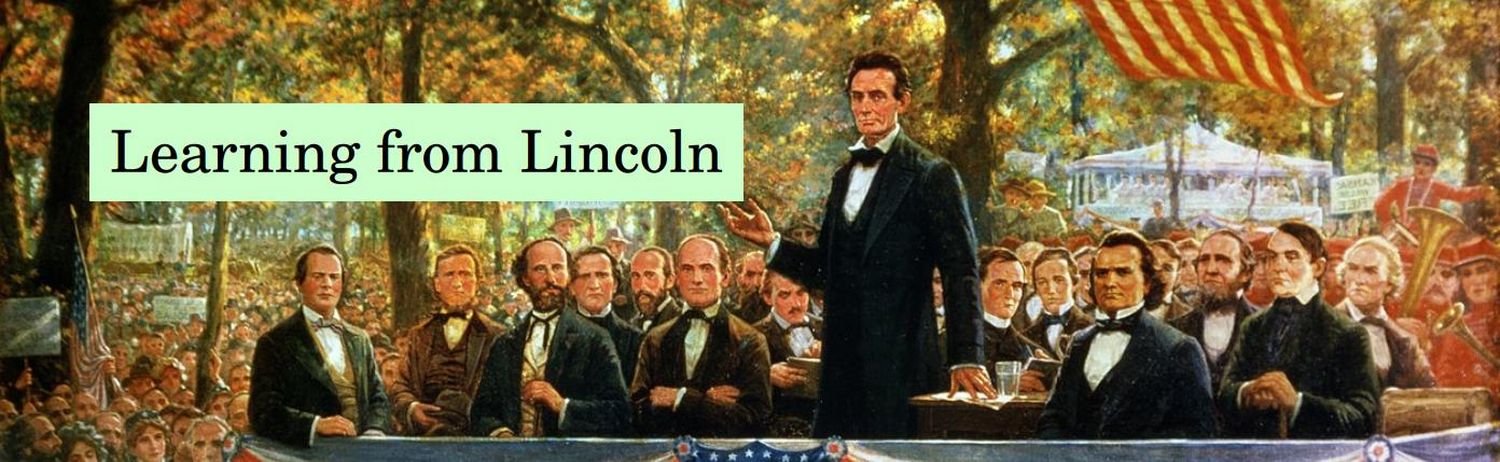
While Republicans who supported Lincoln won the popular vote in the 1858 Illinois Senate race with 53% of the vote, he lost in the Illinois State legislature on January 5, 1859 by a vote of 54 to 46 – which was the group who actually chose the Senator. This result was due to “apportionment” problems as well as “hold over” Democrats in the State Senate. Lincoln therefore entered 1859 buried in debt from his 1858 campaign and with little hope of reviving his political career.
However, an opportunity rose around September 1, 1859, when Harpers Magazine published a lengthy article written by Stephen Douglas explaining his “popular sovereignty” solution to the Slavery question. Douglas claimed that allowing or disallowing slavery to extend into the territories based on the vote of its local citizens—his popular sovereignty—was a concept that matched the intent of the Founding Fathers. Democrats in Ohio used this article to schedule a series of speeches by Douglas in Ohio to promote his Popular Sovereignty claim and help Democrats win the 1859 Ohio Governor’s election to be held on October 11, 1859. His speeches would also help Douglas in his run for the Democratic Presidential nomination in 1860.
The Republican Party started in Ohio on July 13, 1854, at a convention in Columbus and they were the first state to elect a Republican governor (Salmon Chase) in 1855 by only 11,000 votes out of 400,000 voters. They also won in 1857 – this time by only 1,000 votes. The 1859 Ohio election was seen across the country by both sides as an early indicator of the 1860 Presidential election.
Both sides needed Ohio to win the 1860 Presidential election. Surprisingly, incumbent Ohio Governor Simon Chase did not campaign for the Republican candidate William Dennison in the 1859 Ohio Governors race. The reason was that the Ohio Republican party was divided into factions who had strong disagreements with each other. An outsider was needed to appeal to the Ohio voters and refute Douglas. So the Ohio State party leaders reached out to Lincoln as being the most well known and well spoken opponent of Douglas.
In response to the Douglas article and campaign events, the Ohio Republican Party invited Lincoln to give a series of six speeches that September explaining why Douglas and his supporters were wrong. It seemed odd that they would invite Lincoln given that their current governor was in the running for the 1860 Presidential nomination. But it appears that they did not take Lincoln as a serious Presidential contender – due in part to his lack of experience in running a State and due in part to his complete lack of money. Lincoln not only lacked political prospects of the bandwagon variety, he lacked funds and organization for big-time office. No Weed or Blair to build a political organization. No Greeley to give him newspaper editorial acclaim. He lacked both executive training and administrative experience.
Lincoln’s final speech was in Cincinnati on September 17, 1859 At the time, Cincinnati was one of the largest cities in America and home to the Republican Governor candidate William Dennison. Thanks to having read Joseph Story’s Commentaries on the Constitution, which explained in detail why many of the Founding Fathers opposed slavery and how they had restricted it in the Constitution, Lincoln likely knew immediately that Douglas was wrong in his claim that the Founders would have supported his position.
First, we will review what Douglas said in Columbus and then review Lincoln’s response 10 days later in Cincinnati. Be aware that most of the claims made by Douglas below are factually incorrect. But reading them will help you better understand Lincoln’s reply – a reply that would revive his political career.
Fellow Citizens of Ohio: I appear before you today for the purpose of discussing some of those great leading topics which now agitate the public mind of this country. It is not my intention to enter into an examination of any one question pertaining to the local policy of your own State, because, in regard to the interests of your State, I hold my political action bound by that great principle of the Nebraska bill which tells every political community to regulate its own affairs and mind its own business, and not to interfere with those of its neighbors. But there are certain great principles, of universal application, which it is proper to discuss in all parts of the Confederation in the same way, and to enforce by the same arguments...
So long as we live under a common Constitution, which is the supreme law of the entire public, our political creed should be as broad as the Republic and as universal as that Constitution. I wish to invite your attention today to those great principles which underlie the Democratic creed, and draw the dividing line between the Democracy and all the other political parties in this country upon this vexed question of slavery, which for the last few years seems to have absorbed all other questions. The Democratic party hold that it is the right of the people of every State, of every Territory, and every political community within this Confederacy to decide that question to suit themselves. We not only apply that principle to the question of slavery, but we extend it to all the local and domestic institutions of all the States and all the Territories of the Union.
Douglas Claim: Several times in the Douglas speech, he falsely stated that the United States was a Confederacy in 1859.
Fact: The US was a Confederation from 1781 to 1789 during which time its economic collapsed. Once the Constitution was ratified, the Confederation was replaced by a Constitutional Republic which balanced Power between the Federal and State governments with Checks and Balances to protect the rights of the People.
Conclusion: In the Douglas speech, he makes several false claims about the Constitution indicating that Douglas has not read Story’s Commentaries on the Constitution – either that or he simply does not care about the Truth.
Back to Douglas Speech: On the other hand, we are told by the leaders of the Republican party that there is an irrepressible conflict between freedom and slavery, free labor and slave labor, free States and slave States, and that it is their intention to continue to agitate and divide the country until slavery shall be abolished or established throughout the country.
In other words, the Republican party hold that there must be uniformity in the local institutions of all the States and Territories of the Union. Mr. Seward, in his Rochester speech, says that it is an irrepressible conflict between enduring forces, that must last until uniformity shall be established.
Mr. Lincoln, in the Illinois canvass of last year, compared it to a house divided against itself which could not stand, and said that this Union could not permanently endure divided into free and slave States, as our fathers made it. Hence you find that in the platform of the Republican party, adopted in Philadelphia in 1856, it is declared that Congress possesses sovereign powers over all the Territories of the Union, and that it is both their right and their duty to exercise that power for the prohibition of slavery.
Here you find at once the line of conflict between the Republicans and the Democratic party. The Republican party hold that the federal government can decide the slavery question for the people of the Territories and the new States. We Democrats maintain that the federal government has no right to interfere with the question, either to establish, to protect, to abolish, or to prohibit slavery; but that the people in each State, and each Territory, shall be left entirely free to decide it for themselves.
Douglas Claim: Congress has no power to regulate the Territories.
Fact: Article IV, Section 3, Clause 2 of the US Constitution states “The Congress shall have power to dispose of and make all needful rules and regulations respecting the territories.”
Conclusion: See Story Commentaries, Section 1316 for a complete analysis of the history and meaning of this clause. Like many politicians, Douglas is just making stuff up.
Back to Douglas Speech: This question of the right of the people in their local legislatures to decide all internal questions to suit themselves is not a new doctrine. It is as old as the principles of free government on the American continent. It was the first question that seriously divided the American Colonies from the British Government, and out of which the first serious cause of quarrel arose.
The American Colonies claimed the right in their Colonial legislatures to regulate the slavery question, and all other matters affecting their internal policy, to suit themselves, without the interference of the British Parliament, or any other power on earth. In accordance with that right, as early as 1699, the Colonial legislature of Virginia passed a law imposing heavy penalties upon all slaves brought into that Colony subsequently to the date of that act. Virginia did not pass that law because of her hostility to slavery, but she did it as a matter of domestic policy, affecting her own interests and her own safety. The Colony of Virginia was a feeble settlement, surrounded by formidable savage tribes of Indians, and the large number of African savages poured into her midst made her feel alarmed for the safety of her firesides, and stimulated her to the enactment of a law for her own preservation, by which a tax was imposed upon all African slaves subsequently brought into the Colony. So soon as that tax was levied, the British merchants who were engaged in the African slave trade petitioned the King of England to annul that law of Virginia, upon the ground that the Colonies were the common property of the Empire, that every British subject had a right to move into them, carry his slaves and other property with him, and hold it there in defiance of the local law, and that Virginia had no right to exclude them or their property by a mere legislative enactment.
It strikes me that I have heard a very similar argument advanced in the American Congress, and that in modern days that same proposition has found its advocates in America. The British king, after mature consideration, decided in favor of the British slave trader, and against the right of the people of Virginia to exclude slavery from their limits by law. Virginia immediately passed another act, intended to keep slavery out, and then another, and still another, until she had passed thirty-one laws, each designed to enforce the right of the Colony to decide the slavery question for itself.
Douglas Claim: Beginning in 1699, Virginia passed 31 laws taxing and restricting slavery, all of which were intended to “keep slavery out.”
Fact: The first 20 slaves were brought to Virginia in 1619. The Virginia Slave Code laws began in 1661 with a law stating that the status of a child followed that of the mother, thus beginning the principle of perpetual slavery. In 1667, Virginia passed a law prohibiting freeing a slave because they were baptized. In 1670 and 1672, the conversion law was further clarified. In 1669, a law was passed legalizing the murder of slaves. In 1680, a law was passed preventing any slave from carrying a defensive weapon, such as a club.
In 1691, Virginia passed a law discouraging the freeing of slaves by imposing a tax on it. In 1705, Virginia passed a Slave law preventing slaves from owning property, or running away or attending church or owning a gun and defining them as property and making it legal to kill or dismember slaves. By 1705 Virginia had passed 20 oppressive slave laws. These laws were due to the rapid rise in the slave population from 1000 (or 14%) in 1663 to 16,000 (or 31%) in 1701. By 1775, the slave population in Virginia was 210,000 (or 40%) of the total population.
Conclusion: Virginia did not pass laws to restrict the slave population. They passed laws to oppress the slaves. Virginia did pass a law imposing a tax on slaves. But it was mainly to generate more income. The slave traders did petition the King who did overturn this law. There is no record of Virginia during this time passing any law to exclude slavery. However, in 1807, Britain banned the slave trade and in 1833 Britain passed a law banning slavery, not only in Britain but in nearly all of its colonies. So once again, Douglas is making stuff up.
Back to Douglas Speech: In 1772, four years before the Declaration of Independence, Virginia passed another act, imposing a 5 per cent tax upon all slaves brought into the territory, and, in addition, petitioned the King to remove the restrictions upon the right of the Colony to decide the question to suit themselves... Read the history of the Colonies up to the time of the Revolution, and you will find upon the statute books of every one of the thirteen enactments regulating and controlling this slavery question. Assembled for the first time, in 1774, they for their first act adopted a Bill of Rights for the Colonies. Look into that Bill of Rights, and you will find the great foundation principles upon which all of our institutions have been based since in that Bill of Rights. The Colonies first declared that they were willing to grant to Great Britain the right to regulate commerce and decide all their questions of a general character, but they said that they claimed for themselves the free and exclusive power of legislation in their Provincial legislatures upon all subjects of internal policy. There is the principle, distinctly asserted, for which they went to war. It was the principle that every Colony has a right to decide for itself, in its own legislature, all questions of taxation and internal policy.
That was a reply to the preamble to the Stamp Act, in which the Parliament of England had declared its right to bind the Colonies in all cases whatsoever. It will be seen, therefore, that the Tories of the Revolution held at that day that the imperial Parliament had a right to govern the Territories as it pleased, not only in general matters, but in matters affecting their local interests, slavery included.
The Colonies, on the other hand, denied that pretension of the Tories, and said that they as Colonies had the exclusive right to decide all questions of Territorial policy, slavery included, to suit themselves.
Douglas Claim: In 1774, Parliament passed a law restricting the slave laws in the colonies.
Facts: In 1774, Parliament passed four laws called the Intolerable Acts which led to the First Congress which passed a series of ten Resolves. None of the four Intolerable Acts had anything to do with slavery. One law closed Boston Harbor, the second suspended the Massachusetts charter and limited town meetings. The third moved trials of royal officials into a royal court. The fourth allowed British officers to be quartered in peoples houses in Boston. As for the 1774 Bill of Rights, the “resolves” asserted that colonists had the right to life, liberty and property (the same as all other British citizens). They also objected to Taxation without Representation. They objected to a standing army. There is no mention of slavery anywhere in the 4 Intolerable Acts or the 10 Resolves. Nor did the colonies demand to decide all local policies. Instead, they demanded the right to Petition the King – a right they had under the Magna Carta.
Conclusion: Once again, Douglas, like many modern politicians, is making stuff up.
Back to Douglas Speech: The Declaration of Independence was put forth, and all the battles of the Revolution were fought in vindication of that great principle. Our fathers did not at first desire independence—they protested that they did not wish to separate from Great Britain; but what they contended for was the right of local self-government in their internal affairs, with out the interference of Parliament; and if they could not obtain that right under the British government, they would declare their independence and fight for the right. They did fight the battle out nobly, for seven long years. They carried in triumph the flag of local self-government for the Colonies, until at last Great Britain recognized their independence, and the war ceased.
Douglas Claim: That the Declaration of Independence was put forth to protect the right of colonists to make their own local rules including rules about slavery.
Facts: Jefferson spelled out a series of 26 complaints against the King in detail in the Declaration of Independence. One of the complaints was about suspending their local legislatures. But none of the 26 complaints was about slavery. Mainly it was about taxation without representation, keeping troops in the colonies and “He has plundered our seas, ravaged our Coasts, burnt our towns, and destroyed the lives of our people.” None of the complaints in the Declaration was about slavery. To the contrary, while Jefferson was a slave owner, he publicly opposes slavery on moral grounds. In fact, Jefferson’s initial draft of the Declaration had an entire section condemning slavery. Jefferson accused the King of violating the rights of life and liberty of a "distant people" who had not offended him, calling it "piratical warfare" and calling the slave trade a "cruel war against human nature." On July 3, 1776, the delegates from Georgia and South Carolina insisted that this anti-slavery statement by Jefferson be removed.
Conclusion: Neither the Declaration or the Revolutionary War was about protecting slavery. It was not even about local control. It was about gaining their independence from a King who refused to comply with the Magna Carta and was failing to respect their basic civil rights as British citizens. Jefferson was not the only Founding Father opposed to slavery as we will see below. Again, Douglas is grossly distorting US History which is clearly documented in Story’s Commentaries.
Back to Douglas Speech: After the independence was established, the different States ceded to the federal government the land which they held in the western country to the north of the Ohio River. This country, where we are now assembled, belonged to the State of Virginia, and she ceded it to the Government—first for the common benefit of the Union, on condition that it should be formed into States and admitted into the Union on an equal footing with the original States. That deed of cession was accepted on the first day of March, 1784, and on the same day Thomas Jefferson, the author of the Declaration of Independence, reported his plan for the government of the new Territories or new States northwest of the Ohio River. By that plan the Territories were recognized as States, the people having the right to decide all internal questions to suit themselves. It is true that Mr. Jefferson proposed to obtain their consent to a proposition prohibiting slavery—not that the present Government had the right or power—but he asked for their consent to such a compact, and Congress struck out the clause and passed the plan of Mr. Jefferson recognizing these Territories as States and the right of the people inhabiting them to decide the slavery question to suit themselves, without the interference of Congress or of any other State or power on earth. Thus you find that up to the time the Constitution was adopted this great principle of local self-government was maintained in the government of the new Territories, or new States as they were then called.
Douglas Claim: That the NW Ordinance of 1787 did not ban slavery and that while Jefferson proposed such a ban, Congress voted to strike out the proposed ban.
Facts: Story’s Commentaries goes into detail on the Northwest Ordinance of 1787 in Section 1319 in which the Ordinance not only gives Congress the right to set rules for these Territories but in addition, includes a clause prohibiting slavery in the lands north and west of the Ohio river. Passed by the Continental Congress on July 13, 1787, Article 6 of the Ordinance stated: “There shall be neither slavery nor involuntary servitude in the said territory.” The vote in favor of banning slavery in the NW Territories was 17 to 1. Note that in 1787, the Constitution had not been passed yet. So under the Articles of Confederation, each state got one vote. The only State to vote against the ban on slavery was Maryland.
Conclusion: Again, the Truth was the exact opposite of what Douglas claimed. Slavery was banned, the Federal government did have the power to set rules and the Founding Fathers were strongly against the expansion of slavery beyond the States where it already existed. Lincoln used these facts in his famous Cooper Union speech to expose Douglas as a liar. Lincoln’s knowledge of the Truth and courage in continually telling the Truth is why he was know as Honest Abe and why the delegate in Chicago chose him as their nominee in May 1860.
Back to Douglas Speech: Now let me ask you, is it reasonable to suppose, after our fathers had fought the battles of the Revolution in behalf of the right of each Colony to govern itself in respect to its local and domestic concerns, that then they conferred upon Congress the arbitrary sovereign power which they had refused to the British Parliament?
The Republican party, in their Philadelphia National Convention, affirmed that Congress has sovereign power over the Territories for their government, and that it is their duty to prohibit slavery. This is precisely the principle asserted by the British Parliament over the American Colonies. That Parliament and the Tories of King George's time asserted that the former had sovereign power for the government of the Colonies, and the Republican party now repeat that Congress possesses sovereign power for the government of the Territories. Washington, Jefferson, Hancock, Franklin, and the sages of the Revolution decided that the Colonies, Provinces, and Territories, when organized as political communities, had the inalienable right to govern themselves in respect to their local and domestic concerns. That is precisely what I now assert on behalf of the Territories.
Douglas Claim: Douglas implied that all four of these Founding Fathers supported slavery and he is only asking to follow in the footsteps of Washington, Jefferson, Hancock, Franklin.
Facts: While Washington, Jefferson, Hancock, Franklin were all wealthy people and three had inherited slaves, they were all four strongly and publicly opposed to slavery.
Conclusion: Lincoln used this fact that the Founding Fathers opposed slavery at the end of his Cooper Union speech to urge the audience to follow in the steps of Washington, Jefferson, Hancock, Franklin and oppose slavery themselves.
Back to Douglas Speech: Our fathers, previous to the Revolution, declared that it was the inalienable birthright of Englishmen, when forming political communities, to govern themselves in their internal polity. Now if that was the birthright of Englishmen before the Revolution, did it not become the birthright of all Americans after the Revolution? And by virtue of it to govern themselves without the interference of the American Congress? I only claim for the people of the Territories those same rights for which our fathers fought for the American Colonies. Remember, the Revolution was not fought for the rights of sovereign States. Our fathers were contending for the rights of Colonies, of Provinces, of dependent Territories, when they asserted this inalienable right of local self-government; and we are asserting now, in behalf of the people of the American Territories, the same great inalienable right. Why should it not be granted?
Douglas Claim: that the Revolutionary War was fought to insure the rights of Colonies and not sovereign States.
Facts: As Joseph Story explains in Commentaries, the colonies became States on July 4, 1776 when they passed the Declaration of Independence. In addition, they agreed to the Articles of Confederation as States not colonies. Thus the war was fought to protect their rights as States. But all of these new States except New York suffered from economic collapse which led to political chaos – and eventually to replacing the Articles of Confederation with the US Constitution.
Conclusion: Douglas is really grasping at straws with this crazy claim.
Back to Douglas Speech: ...Bear in mind that Congress never passed a law for the protection of any kind of property whatever in the Territories of the United States. Congress never passed a criminal code for any organized Territory. If any man steals your horse, you do not look to Congress, but to the local law, for protection. If he robs your house or your store you cannot apply to Congress, but must go to the local law for protection. All crimes perpetrated against the rights and property of the citizen are punished in the State courts or in the Territorial courts, and not in the Federal courts. Property, life, all your rights are under the protection of the local law. Then, if my horse, or your oxen, or dry goods, or property of every kind is dependent upon the local law for protection, not only in the States but in the Territories, why should not negro property be subject to the same local law? I hold that the people of the Territories have the same right to legislate in regard to slave property that they have in regard to any and every other kind of property. The Constitution places all kinds of property on an equal footing.
Douglas Claim: That the Constitution deems slaves to be nothing more than property.
Facts: Lincoln made a joke out of this section of the Douglas speech. Lincoln said that there was a crucial difference between a runaway slave and a run away horse in that Congress never passed a law to require the return of a run away horse. But they did pass a law requiring the return of a run away slave. As for the claim that slaves are only property, this is not anywhere in the Constitution. Instead, it was made up by Justice Taney when he wrote the horrible Dred Scott Decision – a decision that falsely claimed that slavery could and must be introduced and protected in all of the free States – a false and shocking claim that eventually led to the Civil War.
Conclusion: Douglas supported the Dred Scott decision and its claim that slaves were nothing more than property while Lincoln argued against it. Were it not for Lincoln (and Joseph Story’s Commentaries), Douglas might have gotten away with his lies and won the Presidency in 1860 – an event which would have forced slavery on the free states of the north.
Back to Douglas Speech: If we will only apply the great principle of non-intervention by Congress and self-government in the Territories, leaving the people to do as they please, there will be peace and harmony between all sections of the Union.
What interest have you in Ohio in the question of slavery in South Carolina? You say that you do not think that slavery is necessary or beneficial. That may be true, but your opinion might be different if your property was all invested in a nice plantation in South Carolina, where the white man cannot live and cultivate the soil. In Ohio it is a question only between the white man and the negro. But if you go further South you will find that it is a question between the negro and the crocodile. The question then may be a very different one under different climates.
Douglas Claim: That if we just allow slavery in the South and if we allow “Popular Sovereignty” in the Territories then peace and happiness will return to the Union.
Fact: What the South wanted, and what Dred Scott demanded, was not Popular Sovereignty, it was slavery throughout the Union. This was plainly evident in Bloody Kansas where just a few months before the Douglas speech, 200 pro-slavery advocates tried to use voter fraud to deny the rights of thousands of “free soil settlers” of their Popular Sovereignty to be a Free State. These pro-slavery crooks had the support of the President and most of Congress as well as the backing of the Supreme Court and its Dred Scott decision.
Conclusion: The reason the Free Soil settlers in Kansas and elsewhere opposed slavery was not merely because it was immoral, but also because they knew that slavery was so profitable that slave holders could use their wealth and free slave labor to drive the settlers off of their land and into poverty. The wealthy pro-slavery people were also able to use their wealth to buy off Congress and corrupt politicians like Stephen Douglas. It was an early version of “concentration of wealth and power in the hands of a few people” at the expense of the rest of us.
Back to Douglas Speech: Our fathers, when they framed this Government under which we live, understood this question just as well, and even better, than we do now. They knew when they made this Republic that a country so broad as ours, with such a variety of climate, soil, and productions, must have a variety of interests, requiring different laws adapted to each locality. They knew that the laws which would suit the green hills of New England were ill adapted to the rice plantations of South Carolina; that the laws and regulations which would suit the corn and wheat fields of Ohio might not be well adapted to the sugar plantations of Louisiana; that the people in different localities, having a different climate, different interests and necessities, would want different laws adapted to each locality; and hence, when the Constitution was made, it was adopted on the theory that each State should decide the slavery question for itself, and also all the local and domestic questions.
Douglas Claim: That the Founding Fathers supported his view that the question of slavery should be decided by each state.
Facts: As Joseph Story explains in Commentaries, nothing could be further from the Truth. The only reason that the Three Fifths Rule was included in the Constitution was to get the support of the Southern States. The vast majority of the Founding Fathers strongly and publicly opposed slavery in any form in any location.
Conclusion: Lincoln repeated this sentence many times in his Cooper Union Address: “Our fathers, when they framed this Government under which we live, understood this question just as well, and even better, than we do now.“ Lincoln then carefully provided irrefutable evidence that nearly all of the Founders opposed slavery. He then ended his speech by encouraging the audience to respect the judgement of the Founding Fathers and follow in their footsteps.
We will skip most of the rest of Douglas’s speech as it is basically more of the same. There is one section which is important to address. It is the following:
Back to Douglas Speech: Now, there need be no diversity of principle on this question if each man will read the Constitution of the United States, and then take an oath to support it. Just look into the Constitution, and then you will find what a slave is, who may be a slave, where they may be held, and by what authority they are held. You will find it all in one section. I have not the book with me, but I can repeat that section to you.
"No person held to service in labor in one State under the law thereof, escaping into another, shall be released by any law or regulation therein, but shall be delivered up to the party to whom said service or labor may be due."
Now, by the express provisions of that clause of the Constitution, a slave is a person held to service or labor in one State under the laws thereof—not under the Constitution of the United States—not under the laws of the United States—not by virtue of any federal authority, but in a State under the laws thereof.
Douglas Claim: The above sentence is Article IV, Section 2, Clause 3 of the US Constitution. Douglas is attempting to use this clause as support for his false claim that the Founders supported slavery.
Facts: It should be obvious by now that the Founders did not support slavery. In fact, the clause was deliberately worded so that the word Slavery did not appear anywhere in the Constitution. What this clause really does is the exact opposite of Douglas’s Popular Sovereignty Policy. Instead of allowing local laws to prevail, and local citizens to decide, it forces citizens of States opposed to slavery to return slaves back to States in favor of slavery. It was forced into the Constitution by the States of Georgia and South Carolina who were essentially blackmailing the other States to get their approval of the Constitution.
Conclusion: This shameful clause not only violated Douglas’s Popular Sovereignty Policy, it was used by the Dred Scott ruling to justify their claim that slaves are property. But look carefully at the wording. It begins with “No PERSON” which clearly indicates that people held to service in labor are still PEOPLE and not property.
In summary, it is certain that Article IV, Section 2, Clause 3 of the US Constitution along with the Dred Scott decision and Douglas’s Popular Sovereignty Policy – all of which forced slavery policies on States that were morally opposed to slavery – were all major factors in the rise of the Republican Party and the election of Lincoln in 1860.
Article IV, Section 2, Clause 3 was a Poison Pill that eventually led to the destruction of the Southern States. The People in Northern States made a Deal with the Devil – because they had a gun pointed at their head in the form of the still existing threat from the British Empire. But they refused to make a second Deal with the Devil.
Had the delegates from Georgia and South Carolina been willing to omit this clause and leave the Northern States alone, it is possible that the Civil War never would have happened and there would still be slavery in the South today. It was obvious during the debate on this clause that many in the north bitterly opposed slavery and would not comply with this provision.
But at the same time, the delegates from the North insisted on Article I, Section 9 which put a time limit on slavery whereby the slave trade would end in 20 years: “The Migration or Importation of such Persons as any of the States now existing shall think proper to admit, shall not be prohibited by the Congress prior to the Year one thousand eight hundred and eight, but a Tax or duty may be imposed on such Importation, not exceeding ten dollars for each Person.”
This clause as much as the NW Ordinance clearly indicated that they were opposed to slavery and wanted to head in the direction of eventually ending it. In addition, as soon as the 20 year period was up, in 1807, Congress passed a law prohibiting the importation of slaves. This law took effect on January 1, 1808.
Both Lincoln and the Republican Party were willing to honor the Deal with the Devil to allow slavery to remain in Southern States that were already addicted to this evil drug. What they were not willing to do was to allow the disease of slavery to infect either the Northern States or the new Western States that were about to enter the Union.
As Lincoln said many times, they were willing to let the status quo continue. It was the Southern States who started the Civil War because they insisted on the expansion of slavery into States where it did not exist.
The irony was that the South could have still defeated Lincoln and the Republican party had they been willing to accept Douglas as their candidate and accept the Constitution as it was. Lincoln only got 39% of the vote in the 1860 election.
But the Democratic Party doomed any chance they had when the party split into Northern and Southern wings early in 1860. This insured that a Republican would be elected President. The only question left was who would get the Republican nomination.
As fate would have it, 10 days after the Douglas Popular Sovereignty speech in Columbus Ohio, Lincoln was invited to speak in Cincinnati Ohio. Lincoln used his speech to expose many of the false statements made by Douglas. His speech was so well received that it lead to a Republican Party victory in Ohio on October 11 – followed by an invitation on October 15th to speak on the same topic in New York.
It is amazing how a series of very small events can make such a huge difference in the history of our nation.