As further evidence that Lincoln was guided throughout his political life by Joseph Story and his Commentaries on the Constitution, we will here review one of Lincoln’s biggest and strangest mistakes… which was his misunderstanding of the meaning of the 1774 Articles of Association which was an early agreement between the colonies.
In his First Inaugural Address in 1861, Lincoln mistakenly referred to this document as the reason the Southern States could not leave the Union. Lincoln mistakenly believed that the Union was formed by the Articles of Association. Lincoln stated: "The Union is much older than the Constitution. It was formed in fact by the Articles of Association.”
Why did Lincoln claim that the Union was formed by the Articles of Association?
Our goal is to show that the only place Lincoln could have gotten his information about the Articles of Association was from Story and his discussion of this document in Commentaries on the Constitution.
Our point is that Lincoln never mentioned the Articles of Association in any speech before or after his First Inaugural Address. Nor did any other politician – at least not in any record that we could find in the time period between 1830 to 1861. Not in any speech and not in any legal book – with the sole exception of Commentaries on the Constitution published in 1833 and first read by Lincoln in 1834.
In Commentaries Book 2, Chapter 1, History of the Revolution and of the Confederation, Section 200 through 202, Story states:
“In 1774, Massachusetts recommended the assembling of a Continental Congress to deliberate upon the state of public affairs; and according to her recommendation, delegates were appointed by the colonies for a congress, to be held in Philadelphia in the autumn of the same year…. The congress of delegates… assembled on the 4th of September, 1774; and having chosen officers, they adopted certain fundamental rules for their proceedings… The congress, thus assembled, exercised de facto and de jure a sovereign authority; not as the delegated agents of the governments de facto of the colonies, but in virtue of original powers derived from the people.”
“The revolutionary government, thus formed, terminated only, when it was regularly superceded by the confederated government under the articles of confederation finally ratified in 1781… They also, in behalf of themselves and their constituents, adopted and signed certain Articles of Association, containing an agreement of non-importation, non-exportation, and non-consumption in order to carry into effect the preceding resolves; and also an agreement to discontinue the slave-trade. “
A superficial reading of the above summary might lead to the conclusion that Story had claimed that the Articles of Association created a “de facto and de jure a sovereign authority which became the revolutionary government with the First Continental Congress representing the will of the People. But it is very clear from the actions of the First Congress that they had no power at all. They could merely make suggestions to the various independent States – suggestions which were often ignored by those State. And because those suggestions were often ignored, General Washington was often placed at great risk of losing the Revolutionary War.
Nevertheless, in his First Inaugural Address on March 4, 1861, Abraham Lincoln asserted that the Union is much older than the Constitution, declaring specifically that the Union was first formed by the Articles of Association in 1774.
There are still more problems with Lincoln’s claim that the Union – or the United States of America – was first formed by the 1774 Articles of Association. For example, this appears to be the only time Lincoln ever even brought up the 1774 Articles of Association.
By contrast, in nearly all of his speeches, he brought up the 1776 Declaration of Independence and the 1789 US Constitution. By one count, in 1858, Lincoln mentioned the Declaration of Independence 70 times in his debates with Stephen Douglas.
Even in Lincoln’s July 4, 1861 Message to Congress, he did not refer to the Articles of Association but instead only mentioned the Declaration of Independence, the Articles of Confederation and the US Constitution.
Lincoln stated that “By the Declaration of Independence… the United Colonies were declared to be free and independent States; but even then the object plainly was not to declare their independence of one another or of the Union, but directly the contrary, as their mutual pledge and their mutual action before, at the time, and afterwards abundantly show… the Articles of Confederation, two years later, that the Union shall be perpetual is most conclusive.”
“Having never been States, either in substance or in name, outside of the Union, whence this magical omnipotence of "State rights," asserting a claim of power to lawfully destroy the Union itself? Much is said about the "sovereignty" of the States, but the word even is not in the National Constitution… the Constitution and the laws and treaties of the United States made in pursuance of the Constitution to be for her the supreme law of the land. The States have their status in the Union, and they have no other legal status. If they break from this, they can only do so against law and by revolution. The Union, and not themselves separately, procured their independence and their liberty. By conquest or purchase the Union gave each of them whatever of independence and liberty it has. The Union is older than any of the States, and, in fact, it created them as States.”
Lincoln claimed that the Association created in 1774 was later “matured” by the Declaration of Independence in 1776. In fact, the Association of Colonies was replaced by a Confederation of Independent States which later adopted the Articles of Confederation – which were still Independent States lacking a national government.
In his First Inaugural Address, Lincoln used the Articles of Association to argue that the Union is perpetual and that no state can on its own lawfully withdraw from the Union. In fact, the word “perpetual” was only added in 1781 with the Articles of Confederation. Even then, it did not mean that the Union was perpetual, but that the Articles of Confederation were perpetual.
Lincoln viewed the Constitution of 1789 as an effort to "form a more perfect Union" rather than creating the Union itself. But the “more perfect Union” was in reference to the defects of the Articles of Confederation which did not really form a real Union but was instead a confederation of Independent States.
Lincoln then contended that because the Union originated with the 1774 Agreement, state resolutions to leave the Union are legally void, and any attempt to break the Union requires an Amendment to the Constitution. In fact, it was the Constitution, ratified in 1789, which created the United States of America and that required Amendments to modify it. So while Lincoln was right in his conclusion that States could not leave the Union, he was wrong about the reason they could not leave the Union.
Here is what the Articles of Association really said and really did:
The Articles of Association banned exports to and imports from Britain. It was significant in that it was the first official agreement of the colonies to work together for their common interests. It was also significant in that the signers unanimously agreed to end the Slave Trade in the colonies.
Here are the Articles of Association of the 1st Continental Congress, October 20, 1774
“We, his majesty's most loyal subjects, the delegates of the several colonies of New-Hampshire, Massachusetts-Bay, Rhode-Island, Connecticut, New-York, New-Jersey, Pennsylvania, the three lower counties of Newcastle, Kent and Sussex on Delaware, Maryland, Virginia, North-Carolina, and South-Carolina, deputed to represent them in a continental Congress, held in the city of Philadelphia, on the 5th day of September, 1774, avowing our allegiance to his majesty, our affection and regard for our fellow-subjects in Great-Britain and elsewhere, affected with the deepest anxiety, and most alarming apprehensions, at those grievances and distresses, with which his Majesty's American subjects are oppressed; and having taken under our most serious deliberation, the state of the whole continent, find, that the present unhappy situation of our affairs is occasioned by a ruinous system of colony administration, adopted by the British ministry about the year 1763, evidently calculated for enslaving these colonies, and, with them, the British Empire. In prosecution of which system, various acts of parliament have been passed, for raising a revenue in America, for depriving the American subjects, in many instances, of the constitutional trial by jury, exposing their lives to danger, by directing a new and illegal trial beyond the seas, for crimes alleged to have been committed in America: And in prosecution of the same system, several late, cruel, and oppressive acts have been passed, respecting the town of Boston and the Massachusetts-Bay, and also an act for extending the province of Quebec, so as to border on the western frontiers of these colonies, establishing an arbitrary government therein, and discouraging the settlement of British subjects in that wide extended country; thus, by the influence of civil principles and ancient prejudices, to dispose the inhabitants to act with hostility against the free Protestant colonies, whenever a wicked ministry shall choose so to direct them.”
“To obtain redress of these grievances, which threaten destruction to the lives liberty, and property of his majesty's subjects, in North America, we are of opinion, that a non-importation, non-consumption, and non-exportation agreement, faithfully adhered to, will prove the most speedy, effectual, and peaceable measure: And, therefore, we do, for ourselves, and the inhabitants of the several colonies, whom we represent, firmly agree and associate, under the sacred ties of virtue, honor and love of our country, as follows:”
“1. That from and after the first day of December next, we will not import, into British America, from Great-Britain or Ireland, any goods, wares, or merchandise whatsoever, or from any other place, any such goods, wares, or merchandise, as shall have been exported from Great-Britain or Ireland; nor will we, after that day, import any East-India tea from any part of the world.”
“2. We will neither import nor purchase, any slave imported after the first day of December next; after which time, we will wholly discontinue the slave trade, and will neither be concerned in it ourselves, nor will we hire our vessels, nor sell our commodities or manufactures to those who are concerned in it.”
“3. As a non-consumption agreement, strictly adhered to, will be an effectual security for the observation of the non-importation, we, solemnly agree, that from this day, we will not purchase or use any tea, imported on account of the East-India company, or any on which a duty hath been or shall be paid; and from and after the first day of March next, we will not purchase or use any East-India tea whatever.”
“4. The earnest desire we have not to injure our fellow-subjects in Great-Britain, Ireland, or the West-Indies, induces us to suspend a non-exportation, until the tenth day of September, 1775; at which time, if the said acts and parts of acts of the British parliament herein after mentioned, ate not repealed, we will not directly or indirectly, export any merchandise or commodity whatsoever to Great-Britain, Ireland, or the West-Indies, except rice to Europe. (Note: South Carolina insisted that rice be exempted).”
“5. Such as are merchants, and use the British and Irish trade, will give orders, as soon as possible, to their factors, agents and correspondents, in Great-Britain and Ireland, not to ship any goods to them, on any pretense whatsoever, as they cannot be received in America; and if any merchant, residing in Great-Britain or Ireland, shall directly or indirectly ship any goods, wares or merchandize, for America, in order to break the said non-importation agreement, or in any manner contravene the same, on such unworthy conduct being well attested, it ought to be made public; and, on the same being so done, we will not, from thenceforth, have any commercial connection with such merchant.”
“6. That such as are owners of vessels will give positive orders to their captains, or masters, not to receive on board their vessels any goods prohibited by the said non-importation agreement, on pain of immediate dismission from their service.”
“7. We will use our utmost endeavors to improve the breed of sheep, and increase their number to the greatest extent; and to that end, we will kill them as seldom as may be, especially those of the most profitable kind; nor will we export any to the West-Indies or elsewhere; and those of us, who are or may become overstocked with, or can conveniently spare any sheep, will dispose of them to our neighbors, especially to the poorer sort, on moderate terms.”
“8. We will, in our several stations, encourage frugality, economy, and industry, and promote agriculture, arts and the manufactures of this country, especially that of wool; and will discountenance and discourage every species of extravagance and dissipation, especially all horse-racing, and all kinds of games, cock fighting and other expensive diversions and entertainments; and on the death of any relation or friend, none of us, or any of our families will go into any further mourning-dress, than a black crepe or ribbon on the arm or hat, for gentlemen, and a black ribbon and necklace for ladies, and we will discontinue the giving of gloves and scarves at funerals.”
“9. Such as are vendors of goods or merchandize will not take advantage of the scarcity of goods, that may be occasioned by this association, but will sell the same at the rates we have been respectively accustomed to do, for twelve months last past. And if any vendor of goods or merchandise shall sell such goods on higher terms, or shall, in any manner, or by any device whatsoever, violate or depart from this agreement, no person ought, nor will any of us deal with any such person, or his or her factor or agent, at any time thereafter, for any commodity whatever.”
“10. In case any merchant, trader, or other person, shall import any goods or merchandize, after the first day of December, and before the first day of February next, the same ought forthwith, at the election of the owner, to be either re-shipped or delivered up to the committee of the country or town, wherein they shall be imported, to be stored at the risk of the importer, until the non-importation agreement shall cease, or be sold under the direction of the committee aforesaid; and in the last-mentioned case, the owner or owners of such goods shall be reimbursed out of the sales, the first cost and charges, the profit, if any, to be applied towards relieving and employing such poor inhabitants of the town of Boston, as are immediate sufferers by the Boston port-bill; and a particular account of all goods so returned, stored, or sold, to be inserted in the public papers.”
“11. That a committee be chosen in every county, city, and town, by those who are qualified to vote for representatives in the legislature, whose business it shall be attentively to observe the conduct of all persons touching this association; and when it shall be made to appear, to the satisfaction of a majority of any such committee, that any person within the limits of their appointment has violated this association, that such majority do forthwith cause the truth of the case to be published in the gazette; to the end, that all such foes to the rights of British-America may be publicly known, and universally condemned as the enemies of American liberty.”
“12. That the committees, in the respective colonies, do frequently inspect the entries of their customhouses, and inform each other, from time to time, of the true state thereof, and of every other material circumstance that may occur relative to this association.”
“13. That all manufactures of this country be sold at reasonable prices, so that no undue advantage be taken of a future scarcity.”
“14. And we do further agree and resolve that we will have no trade, commerce, dealings or intercourse whatsoever, with any colony or province, in North-America, which shall not accede to, or which shall hereafter violate this association, but will hold them as unworthy of the rights of freemen, and as inimical to the liberties of their country.”
“And we do solemnly bind ourselves and our constituents, under the ties aforesaid, to adhere to this association, until such parts of the several acts of parliament passed since the close of the last war, as impose or continue duties on tea, wine, molasses, syrups panels, coffee, sugar, pimento, indigo, foreign paper, glass, and painters' colors, imported into America, and extend the powers of the admiralty courts beyond their ancient limits, deprive the American subject of trial by jury, authorize the judge's certificate to indemnify the prosecutor from damages, that he might otherwise be liable to from a trial by his peers, require oppressive security from a claimant of ships or goods seized, before he shall be allowed to defend his property, are repealed.—And until that part of the act of the 12 G. 3. ch. 24, entitled; "An act for the better securing his majesty's dock-yards magazines, ships, ammunition, and stores," by which any persons charged with committing any of the offenses therein described, in America, may be tried in any shire or county within the realm, is repealed and until the four acts, passed the last session of parliament, viz. that for stopping the port and blocking up the harbour of Boston, that for altering the charter and government of the Massachusetts-Bay and that which is entitled "An act for the better administration of justice, " and that "for extending the limits of Quebec" are repealed. And we recommend it to the provincial conventions, and to the committees in the respective colonies, to establish such further regulations as they may think proper, for carrying into execution this association.”
The vote in favor of the Association was unanimous. The document was signed by 53 delegates, including George Washington, John Adams, and Peyton Rudolph, who was President of the First Congress. Here are the signers of every State (note that Georgia did not have a delegate at this first 1774 Congress).
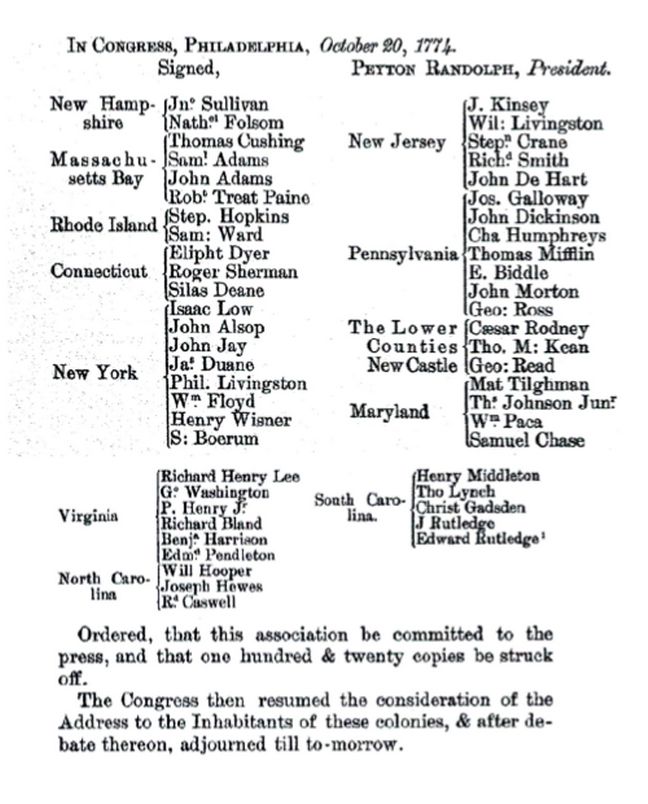
The above text of the Articles of Association, which were not published in Story’s Commentaries, makes it clear that the Association was written as 12 colonies each of which still avowed allegiance to the King. They thus were not “United States” in 1774. They were merely an association of colonies with allegiance to the King. The Association of Colonies was replaced by the United States with the Declaration of Independence on July 4, 1776. This loose association of states became a Confederation with the ratification of the Articles of Confederation in 1781.
In his Cooper Union Address, in 1860, Lincoln claimed that the Articles of Confederation contained an explicit clause promising a “perpetual union.” While Article XIII did state that the union was to be “perpetual” and that no changes could be made to the Articles unless agreed to by Congress and ratified by the legislatures of all 13 States, it is a fact that the Confederation, despite the name “United States”, reserved nearly all of the power to each State and was therefore nothing more than a loose Confederation of Independent States.
They did not become the “United States of America” until after the ratification of the Constitution in 1789 when a “more perfect Union” was formed by “We, the People.” So while Lincoln was correct that, under the Constitution, States could not leave the Union without an Amendment permitting it, he was wrong about when the United States as a Constitutional Republic was formed.
Why Lincoln’s Misunderstanding Matters
There are at least three important reasons Lincoln’s misunderstanding about the Articles of Association matters. First, the confusion between States Rights and Federal Rights – as defined by the US Constitution – was a major, if not the most important reason our nation was forced to endure the first Civil War – which led to the death of hundreds of thousands of Americans.
Second, we are now facing a second Constitutional Crisis in which the leaders of many States are once again claiming that they do not need to comply with the US Constitution, federal laws or Supreme Court decisions. It is essential that all those who wish to preserve, protect and defend the US Constitution have a clear understanding of the line between Federal and State Rights as defined by the Constitution.
Third, Lincoln’s misunderstanding is further evidence that he read Joseph Story’s Commentaries and thus provides further reason that we should all read – and encourage our political leaders to read – Story’s Commentaries. While Lincoln’s argument about the Articles of Association was incorrect, it is easy to see how his misunderstanding about the Articles of Association could have been taken from reading Sections 200 to 2002 of the second book in Joseph Story’s Commentaries.