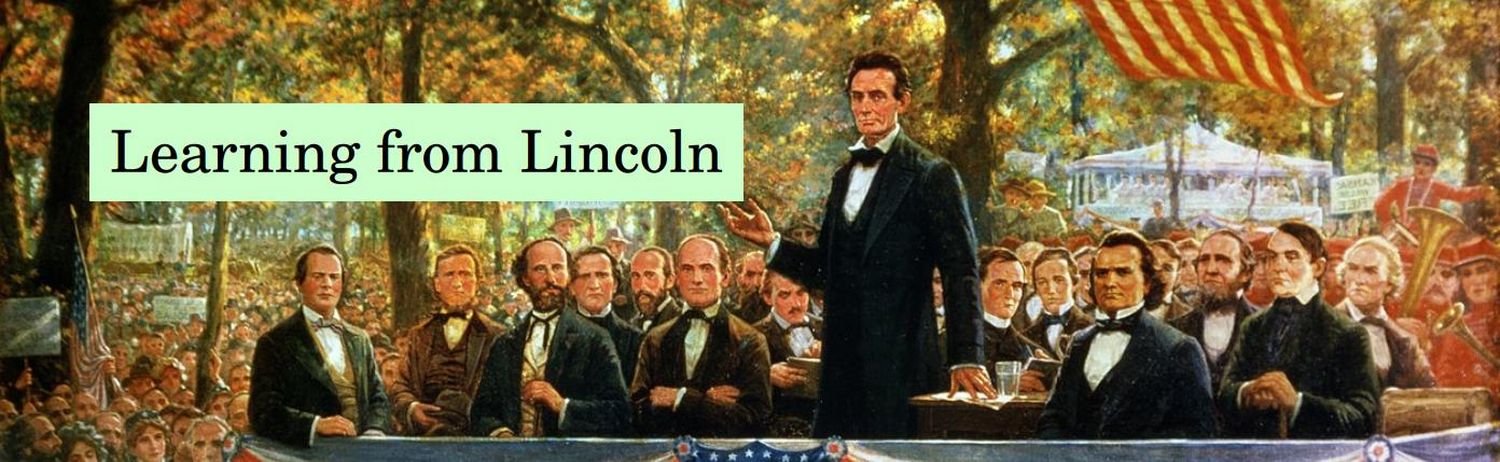
At Freeport I answered several interrogatories that had been propounded to me by Judge Douglas at the Ottawa meeting. The Judge has yet not seen fit to find any fault with the position that I took in regard to those seven interrogatories, which were certainly broad enough, in all conscience, to cover the entire ground. In my answers, which have been printed, and all have had the opportunity of seeing, I take the ground that those who elect me must expect that I will do nothing which will not be in accordance with those answers. I have some right to assert that Judge Douglas has no fault to find with them.
But he chooses to still try to thrust me upon different ground without paying any attention to my answers. At the same time, I propounded four interrogatories to him, claiming it as a right that he should answer as many interrogatories for me as I did for him, and I would reserve myself for a future installment when I got them ready. The Judge in answering me upon that occasion, put in what I suppose he intends as answers to all four of my interrogatories.
The first one of these interrogatories I have before me, and it is in these words:
"Question 1. If the people of Kansas shall, by means entirely unobjectionable in all other respects, adopt a State Constitution, and ask admission into the Union under it, before they have the requisite number of inhabitants according to the English bill-some ninety-three thousand - will you vote to admit them?"
As I read the Judge's answer in the newspaper, and as I remember it as pronounced at the time, he does not give any answer which is equivalent to yes or no-I will or I wont. He answers at very considerable length, rather quarreling with me for asking the question, and insisting that Judge Trumbull had done something that I ought to say something about; and finally getting out such statements as induce me to infer that he means to be understood he will, in that supposed case, vote for the admission of Kansas. I only bring this forward now for the purpose of saying that if he chooses to put a different construction upon his answer he may do it. But if he does not, I shall from this time forward assume that he will vote for the admission of Kansas in disregard of the English bill. He has the right to remove any misunderstanding I may have. I only mention it now that I may hereafter assume this to be the true construction of his answer, if he does not now choose to correct me.
The second interrogatory that I propounded to him, was this:
"Question 2. Can the people of a United States Territory, in any lawful way, against the wish of any citizen of the United States, exclude slavery from its limits prior to the formation of a State Constitution?"
To this Judge Douglas answered that they can lawfully exclude slavery from the Territory prior to the formation of a Constitution. He goes on to tell us how it can be done. As I understand him, he holds that it can be done by the Territorial Legislature refusing to make any enactments for the protection of slavery in the Territory, and especially by adopting unfriendly legislation to it. For the sake of clearness I state it again; that they can exclude slavery from the Territory, 1st, by withholding what he assumes to be an indispensable assistance to it in the way of legislation; and, 2d, by unfriendly legislation. If I rightly understand him, I wish to ask your attention for a while to his position.
In the first place, the Supreme Court of the United States has decided that any Congressional prohibition of slavery in the Territories is unconstitutional-that they have reached this proposition as a conclusion from their former proposition, that the Constitution of the United States expressly recognizes property in slaves, and from that other Constitutional provision, that no person shall be deprived of property without due process of law. Hence they reach the conclusion that as the Constitution expressly recognizes property in slaves, and prohibits any person from being deprived of property without due process of law, to pass an act of Congress by which a man who owned a slave on one side of a line would be deprived of him if he took him on the other side, is depriving him of that property without due process of law. That I understand to be the decision of the Supreme Court.
I understand also that Judge Douglas adheres most firmly to that decision; and the difficulty is, how is it possible for any power to exclude slavery from the Territory unless in violation of that decision?
In the Senate of the United States, in 1856, Judge Trumbull, in a speech, substantially, if not directly, put the same interrogatory to Judge Douglas, as to whether the people of a Territory had the lawful power to exclude slavery prior to the formation of a Constitution? Judge Douglas then answered at considerable length, and his answer will be found in the Congressional Globe, under date of June 9th, 1856. The Judge said that whether the people could exclude slavery prior to the formation of a Constitution or not was a question to be decided by the Supreme Court.
I maintain that when he says, after the Supreme Court have decided the question, that the people may yet exclude slavery by any means whatever, he does virtually say, that it is not a question for the Supreme Court. He shifts his ground. I appeal to you whether he did not say it was a question for the Supreme Court? Has not the Supreme Court decided that question?
When he now says the people may exclude slavery, does he not make it a question for the people? Does he not virtually shift his ground and say that it is not a question for the court, but for the people? This is a very simple proposition. It seems to me that there is no difficulty in deciding it. In a variety of ways he said that it was a question for the Supreme Court. He did not stop then to tell us that whatever the Supreme Court decides, the people can by withholding necessary "police regulations" keep slavery out. I submit to you now, whether the new state of the case has not induced the Judge to sheer away from his original ground. Would not this be the impression of every fair-minded man?
I hold that the proposition that slavery cannot enter a new country without police regulations is historically false. It is not true at all. I hold that the history of this country shows that the institution of slavery was originally planted upon this continent without these "police regulations" which the Judge now thinks necessary for the actual establishment of it. Not only so, but is there not another fact-how came this Dred Scott decision to be made?
It was made upon the case of a negro being taken and actually held in slavery in Minnesota Territory, claiming his freedom because the act of Congress prohibited his being so held there. Will the Judge pretend that Dred Scott was not held there without police regulations? There is at least one matter of record as to his having been held in slavery in the Territory, not only without police regulations, but in the teeth of Congressional legislation supposed to be valid at the time.
This shows that there is vigor enough in slavery to plant itself in a new country even against unfriendly legislation. It takes not only law but the enforcement of law to keep it out. That is the history of this country upon the subject.
I wish to ask one other question. It being understood that the Constitution guaranties property in slaves in the Territories, if there is any infringement of the right of that property, would not the United States Courts, organized for the government of the Territory, apply such remedy as might be necessary in that case? It is a maxim held by the courts, that there is no wrong without its remedy; and the courts have a remedy for whatever is acknowledged and treated as a wrong.
Again: I will ask you, my friends, if you were elected members of the Legislature, what would be the first thing you would have to do before entering upon your duties? Swear to support the Constitution of the United States. Suppose you believe, as Judge Douglas does, that the Constitution guaranties to your neighbor the right to hold slaves in that Territory - that they are his property-how can you clear your oaths unless you give him such legislation as is necessary to enable him to enjoy that property? Can you, if you swear to support the Constitution, and believe that the Constitution establishes a right, clear your oath, without giving it support? Do you support the Constitution if, knowing or believing there is a right established under it which needs specific legislation, you withhold that legislation? Do you not violate and disregard your oath? I can conceive of nothing plainer in the world. There can be nothing in the words "support the Constitution," if you may run counter to it by refusing support to any right established under the Constitution. And what I say here will hold with still more force against the Judge's doctrine of "unfriendly legislation." How could you, having sworn to support the Constitution and believing it guarantied the right to hold slaves in the Territories, assist in legislation intended to defeat that right? That would be violating your own view of the Constitution. If you were to do so, how long would it take the courts to hold your votes unconstitutional and void? Not a moment.
Lastly I would ask-is not Congress, itself, under obligation to give legislative support to any right that is established under the United States Constitution? A member of Congress swears to support the Constitution, and if he sees a right established by that Constitution which needs specific legislative protection, can he clear his oath without giving that protection?
Let me ask you why many of us who are opposed to slavery upon principle, give our acquiescence to a Fugitive Slave law? Why do we hold ourselves under obligations to pass such a law, and abide by it when it is passed? Because the Constitution makes provision that the owners of slaves shall have the right to reclaim them. It gives the right to reclaim slaves, and that right is a barren right, unless there is legislation that will enforce it.The mere declaration, "No person held to service or labor in one State under the laws thereof, escaping into another, shall in consequence of any law or regulation therein be discharged from such service or labor, but shall be delivered up on claim of the party to whom such service or labor may be due," is powerless without specific legislation to enforce it.
Now, on what ground would a member of Congress who is opposed to slavery in the abstract, vote for a Fugitive law, as I would deem it my duty to do? Because there is a Constitutional right which needs legislation to enforce it.
And although it is distasteful to me, I have sworn to support the Constitution, and having so sworn, I cannot conceive that I do support it if I withhold from that right any necessary legislation to make it practical. And if that is true in regard to a Fugitive Slave law, is the right to have fugitive slaves reclaimed any better fixed in the Constitution than the right to hold slaves in the Territories? For this decision is a just exposition of the Constitution, as Judge Douglas thinks. Is the one right any better than the other? Is there any man who, while a member of Congress, would give support to the one any more than the other?
If I wished to refuse to give legislative support to slave property in the Territories, if a member of Congress, I could not do it, holding the view that the Constitution establishes that right. If I did it at all, it would be because I deny that this decision properly construes the Constitution.
But if I acknowledge, with Judge Douglas, that this decision properly construes the Constitution, I cannot conceive that I would be less than a perjured man if I should refuse in Congress to give such protection to that property as in its nature it needed.
At the end of what I have said here I propose to give the Judge my fifth interrogatory, which is this:
If the slaveholding citizens of a United States Territory should need and demand Congressional legislation for the protection of their slave property in such Territory, would you, as a member of Congress, vote for or against such legislation?
After having argued that Congress had no power to pass a law excluding slavery from a United States Territory, they then used language to this effect: That inasmuch as Congress itself could not exercise such a power, it followed as a matter of course that it could not authorize a Territorial Government to exercise it, for the Territorial Legislature can do no more than Congress could do. Thus it expressed its opinion emphatically against the power of a Territorial Legislature to exclude slavery, leaving us in just as little doubt on that point as upon any other point they really decided.