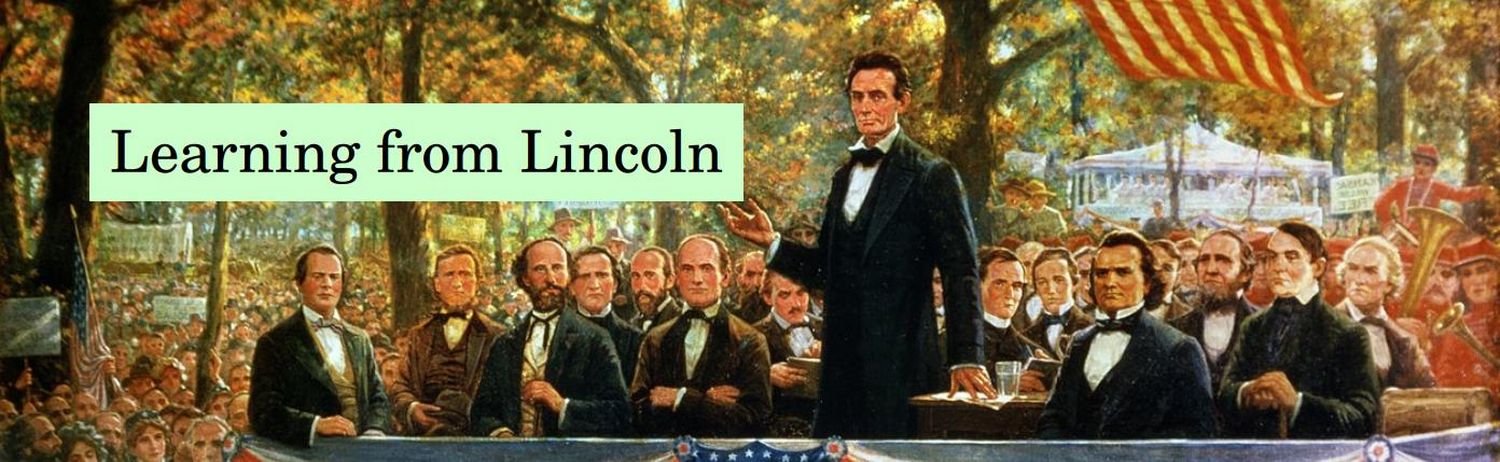
Never before and never since has a single speech so clearly launched a dark horse candidate towards a Presidential victory. Lincoln’s speech in Cincinnati on September 17th and the Ohio victory on October 11th convinced the New York Young Mens’ Central Republican Club, led in part by Horace Greeley, on October 12, 1859 to invite Lincoln to speak in New York on November 29th 1859 in the same subject as his informative speech in Cincinnati a few weeks earlier. Despite the fact that this was his first invitation to speak on the East Coast, Lincoln asked that the date be postponed to February 1860.
At the beginning of 1860, Lincoln was not even on lists of potential candidates for the 1860 Republican nomination. The leading candidates were William Seward, Senator of New York, Simon Cameron of Pennsylvania, Salmon Chase, Governor of Ohio, and Edward Bates of Missouri. Among the leading candidates, Seward was the favorite.
But many thought Seward was too radical to win in the “swing” states in the Midwest due to his 1850 speech in which claimed that slavery in the territories violated a “higher law than the Constitution” – a moral and divine law and not just a legal law. In October 1858, Seward also gave a speech stating that there was an “irrepressible conflict” between the Northern and Southern States. While his speech sounded similar to Lincoln’s House Divided speech, there was a crucial difference. Lincoln made it clear that he only wanted to honor the current US Constitution, which limited slavery to the existing southern states and opposed it only in the new states and territories under his theory that slavery would eventually die a slow death.
By contrast, Seward, speaking in New York, stated that the “Democratic Party must be permanently dislodged from the government.”
In addition, many reformers in the New York Republican Party, including Horace Greeley, felt Seward was corrupt and controlled by “Machine Boss Tweed.”
These New York reformers wanted to tip the Presidential nomination to Salmon Chase who, like Lincoln, wanted merely to prevent slavery in the new states and territories.
Salmon Chase declined to speak at Cooper Union
Of the alternatives, one speech stands alone for its originality, quality, and impact on Lincoln's future—the Cincinnati speech of September 17, 1859. It was the last of five speeches that Lincoln delivered in a two-day Ohio trip, a tour that began with two speeches in Columbus, a stop in Dayton, and then a brief whistle-stop in Hamilton as he rode the rails from Dayton to Cincinnati for the final event.
He crafted a new speech about the principles of the Republican Party with a focus on the immorality of slavery and the imperative need to prevent its extension into the territories. Lincoln delivered the crux of this address in speeches delivered in Chicago in March, and in Council Bluffs, Iowa, in August. Unfortunately for Lincoln, those speeches garnered little attention in the press. By the end of August, Lincoln had been out of sight and out of mind; his heightened status from the year-old debates essentially had disintegrated.
Douglas had spoken in Cincinnati on September 9, 1859. In the September 19, 1859 issue of Harper's New Monthly Magazine, Douglas published a lengthy article in which he made the brazen claim that allowing or disallowing slavery to extend into the territories based on the vote of its citizens—the tenets of popular sovereignty—was a concept that matched the intent of the Founding Fathers. That September 19 issue of the Gazette would carry farther across the country than Lincoln or Douglas could have ever imagined.
It also allowed the best possible setting to counter Douglas by appearing in the same town where the "Little Giant" had performed days before. In essence, this became the sequel to the Lincoln-Douglas debates, only the focus would be entirely on Lincoln, who would not be sharing the platform with the counter-punching senator.
Lincoln claimed that Douglas wanted Northerners to adopt his detached opinion to allow another Dred Scott-like decision to permit slavery to permeate into the current slave-free states of the North.
Lincoln stressed that "whenever your minds are brought to adopt his argument, as surely you will have reached the conclusion that although slavery is not profitable in Ohio, if any man wants it, it is wrong to him not to let him have it."
"We mean to treat you, as near as we possibly can, like Washington, Jefferson, and Madison treated you. We mean to leave you alone...."
Approximately ninety minutes into the Cincinnati speech, Lincoln left the Kentuckians and directed his remarks to the Ohioans; i.e., Northerners. The change of tactic was necessary for Lincoln to destroy another provocative postulate of Douglas in the Harper's New Monthly Magazine article: that Ohio and the other five states (including the eastern portion of Minnesota) carved out of the Northwest Territory were created as slave-free entities not because of the Ordinance of 1787, which restricted slavery in the original territory from where the states were formed, but because of popular sovereignty, which empowered the citizens of Ohio, Indiana, Illinois, Wisconsin, Michigan, and Minnesota to vote out slavery when their respective states were formed from the territory.
Douglas's evidence for this claim included the fact that slavery had been permitted in Illinois, both as a territory and in its early history of statehood, and that its citizens were responsible for eliminating it as they were in Ohio, Indiana, Michigan, Wisconsin, and the portion of Minnesota that formed the original territory. Popular sovereignty made these states slave free, concluded Douglas, "and that the Ordinance of 1787 was not entitled in any degree to divide the honor with them.
These New York reformers therefore invited several other candidates to come to New York and give a speech. Lincoln was one of three who gave speeches at Cooper Union Hall. This has been called the speech that made Lincoln president.
Had Lincoln failed in New York, few might recognize today the nation he went on to defend and rededicate. It can be argued that without Cooper Union, hence without Lincoln at the helm, the United States might be remembered today as a failed experiment that fractured into a North American Balkans.
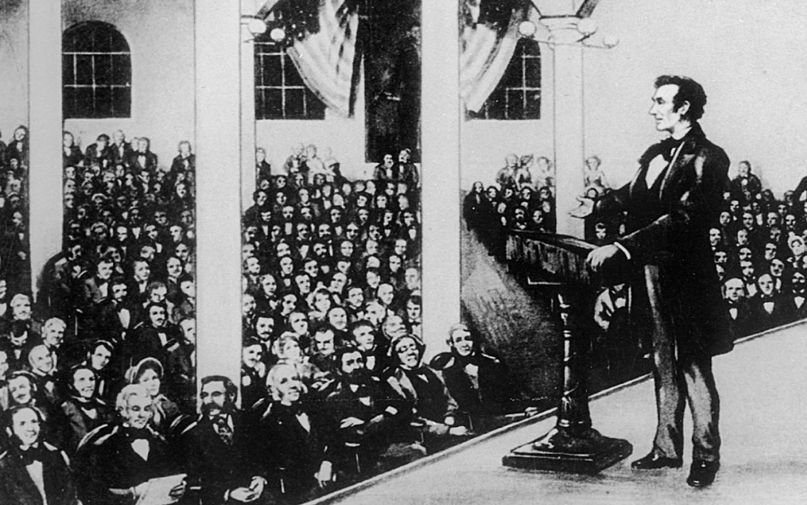
Below is an image of Lincoln speaking at Cooper Union Hall
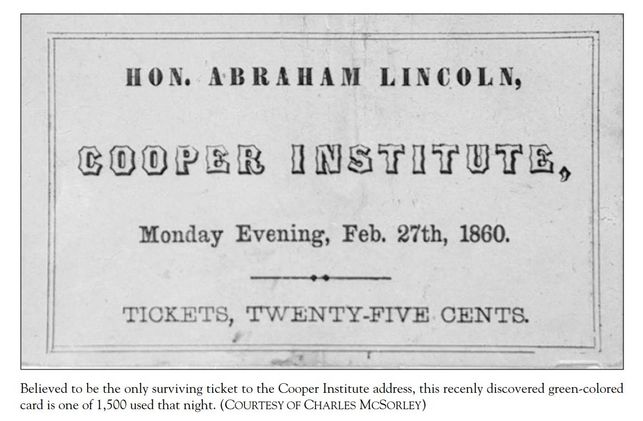
Below is an image of the only surviving ticket to the Lincoln Cooper Hall speech.
Lincoln's speech can be divided into three parts. In the first, he showed that twenty-one of the thirty-nine signers of the Constitution were on record that the Federal Government could prohibit slavery in the national territories. In the second, Lincoln explained to the South that Republicans were no threat to slavery where it already existed. Finally, Lincoln spoke to the North. They must fearlessly persist in excluding slavery from the national territories, and therefore, confine it to the states where it already existed.
The entire speech was printed and circulated throughout the country. Also printed and circulated was the Lincoln Douglas Debates book. Together, these speeches propelled Lincoln to the Republican Party nomination in May 1860.
Source: Collected Works of Abraham Lincoln
The notes to the Cooper Union Address were added by the New York Young Republicans Club in September 1860 after months of research and with the written approval of Abraham Lincoln
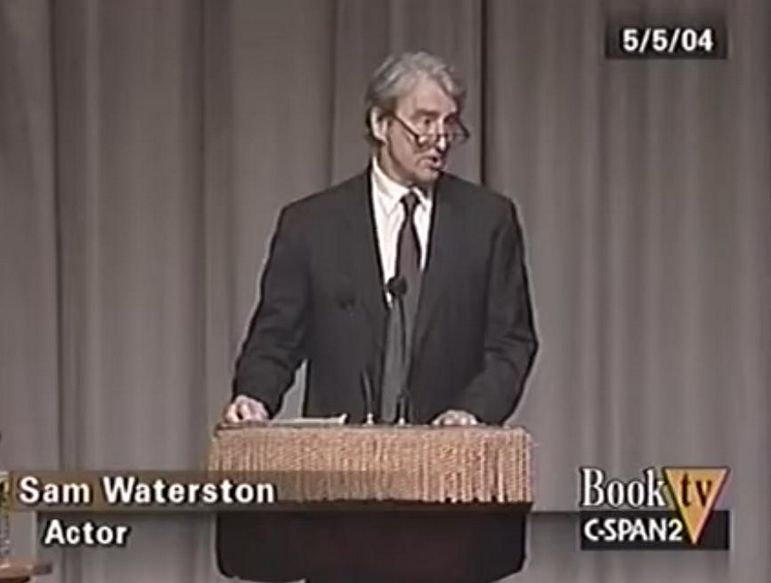
Here is a link to an hour and a half Youtube video that in 2004 re-enacted Lincoln’s speech, one of the most important speeches in US history by Sam Waterston.
Included with the text of Lincoln’s speech are a series of notes by the New York Young Republicans Club added in September 1860 after several months researching the claims made in the speech and getting the permission of Lincoln to publish their notes and his speech in book form.
*****************************************************************************
Mr. President and fellow citizens of New York:
The facts with which I shall deal this evening are mainly old and familiar; nor is there anything new in the general use I shall make of them. If there shall be any novelty, it will be in the mode of presenting the facts, and the inferences and observations following that presentation.
In his speech last autumn, at Columbus, Ohio, as reported in "The New-York Times," Senator Douglas said: "Our fathers, when they framed the Government under which we live, understood this question just as well, and even better, than we do now."
But enough! Let all who believe that "our fathers, who framed the Government under which we live, understood this question just as well, and even better, than we do now," speak as they spoke, and act as they acted upon it. This is all Republicans ask - all Republicans desire - in relation to slavery.
As those fathers marked it, so let it be again marked, as an evil not to be extended, but to be tolerated and protected only because of and so far as its actual presence among us makes that toleration and protection a necessity. Let all the guarantees those fathers gave it, be, not grudgingly, but fully and fairly, maintained. For this Republicans contend, and with this, so far as I know or believe, they will be content.And now, if they would listen - as I suppose they will not - I would address a few words to the Southern people.
I would say to them: - You consider yourselves a reasonable and a just people; and I consider that in the general qualities of reason and justice you are not inferior to any other people.
Still, when you speak of us Republicans, you do so only to denounce us a reptiles, or, at the best, as no better than outlaws. You will grant a hearing to pirates or murderers, but nothing like it to "Black Republicans."
In all your contentions with one another, each of you deems an unconditional condemnation of "Black Republicanism" as the first thing to be attended to. Indeed, such condemnation of us seems to be an indispensable prerequisite - license, so to speak - among you to be admitted or permitted to speak at all. Now, can you, or not, be prevailed upon to pause and to consider whether this is quite just to us, or even to yourselves? Bring forward your charges and specifications, and then be patient long enough to hear us deny or justify.You say we are sectional. We deny it. That makes an issue; and the burden of proof is upon you. You produce your proof; and what is it? Why, that our party has no existence in your section - gets no votes in your section. The fact is substantially true; but does it prove the issue? If it does, then in case we should, without change of principle, begin to get votes in your section, we should thereby cease to be sectional. You cannot escape this conclusion; and yet, are you willing to abide by it? If you are, you will probably soon find that we have ceased to be sectional, for we shall get votes in your section this very year. You will then begin to discover, as the truth plainly is, that your proof does not touch the issue.
The fact that we get no votes in your section, is a fact of your making, and not of ours. And if there be fault in that fact, that fault is primarily yours, and remains until you show that we repel you by some wrong principle or practice. If we do repel you by any wrong principle or practice, the fault is ours; but this brings you to where you ought to have started - to a discussion of the right or wrong of our principle.
If our principle, put in practice, would wrong your section for the benefit of ours, or for any other object, then our principle, and we with it, are sectional, and are justly opposed and denounced as such. Meet us, then, on the question of whether our principle, put in practice, would wrong your section; and so meet it as if it were possible that something may be said on our side. Do you accept the challenge? No! Then you really believe that the principle which "our fathers who framed the Government under which we live" thought so clearly right as to adopt it, and endorse it again and again, upon their official oaths, is in fact so clearly wrong as to demand your condemnation without a moment's consideration.Some of you delight to flaunt in our faces the warning against sectional parties given by Washington in his Farewell Address. Less than eight years before Washington gave that warning, he had, as President of the United States, approved and signed an act of Congress, enforcing the prohibition of slavery in the Northwestern Territory, which act embodied the policy of the Government upon that subject up to and at the very moment he penned that warning; and about one year after he penned it, he wrote Lafayette that he considered that prohibition a wise measure, expressing in the same connection his hope that we should at some time have a confederacy of free States.
(See Note 25)
Bearing this in mind, and seeing that sectionalism has since arisen upon this same subject, is that warning a weapon in your hands against us, or in our hands against you? Could Washington himself speak, would he cast the blame of that sectionalism upon us, who sustain his policy, or upon you who repudiate it? We respect that warning of Washington, and we commend it to you, together with his example pointing to the right application of it.But you say you are conservative - eminently conservative - while we are revolutionary, destructive, or something of the sort. What is conservatism? Is it not adherence to the old and tried, against the new and untried? We stick to, contend for, the identical old policy on the point in controversy which was adopted by "our fathers who framed the Government under which we live;" while you with one accord reject, and scout, and spit upon that old policy, and insist upon substituting something new.
True, you disagree among yourselves as to what that substitute shall be. You are divided on new propositions and plans, but you are unanimous in rejecting and denouncing the old policy of the fathers. Some of you are for reviving the foreign slave trade; some for a Congressional Slave-Code for the Territories; some for Congress forbidding the Territories to prohibit Slavery within their limits; some for maintaining Slavery in the Territories through the judiciary; some for the "gur-reat pur-rinciple" that "if one man would enslave another, no third man should object," fantastically called "Popular Sovereignty;" but never a man among you is in favor of federal prohibition of slavery in federal territories, according to the practice of "our fathers who framed the Government under which we live." Not one of all your various plans can show a precedent or an advocate in the century within which our Government originated. Consider, then, whether your claim of conservatism for yourselves, and your charge or destructiveness against us, are based on the most clear and stable foundations.Again, you say we have made the slavery question more prominent than it formerly was. We deny it. We admit that it is more prominent, but we deny that we made it so. It was not we, but you, who discarded the old policy of the fathers. We resisted, and still resist, your innovation; and thence comes the greater prominence of the question. Would you have that question reduced to its former proportions? Go back to that old policy. What has been will be again, under the same conditions. If you would have the peace of the old times, readopt the precepts and policy of the old times.You charge that we stir up insurrections among your slaves. We deny it; and what is your proof? Harper's Ferry! John Brown!! John Brown was no Republican; and you have failed to implicate a single Republican in his Harper's Ferry enterprise. If any member of our party is guilty in that matter, you know it or you do not know it.
If you do know it, you are inexcusable for not designating the man and proving the fact. If you do not know it, you are inexcusable for asserting it, and especially for persisting in the assertion after you have tried and failed to make the proof.
You need to be told that persisting in a charge which one does not know to be true, is simply malicious slander. (See Note 26)Some of you admit that no Republican designedly aided or encouraged the Harper's Ferry affair, but still insist that our doctrines and declarations necessarily lead to such results. We do not believe it. We know we hold to no doctrine, and make no declaration, which were not held to and made by "our fathers who framed the Government under which we live." You never dealt fairly by us in relation to this affair. When it occurred, some important State elections were near at hand, and you were in evident glee with the belief that, by charging the blame upon us, you could get an advantage of us in those elections. The elections came, and your expectations were not quite fulfilled.
Every Republican man knew that, as to himself at least, your charge was a slander, and he was not much inclined by it to cast his vote in your favor. Republican doctrines and declarations are accompanied with a continual protest against any interference whatever with your slaves, or with you about your slaves. Surely, this does not encourage them to revolt. True, we do, in common with "our fathers, who framed the Government under which we live," declare our belief that slavery is wrong; but the slaves do not hear us declare even this. For anything we say or do, the slaves would scarcely know there is a Republican party. I believe they would not, in fact, generally know it but for your misrepresentations of us, in their hearing. In your political contests among yourselves, each faction charges the other with sympathy with Black Republicanism; and then, to give point to the charge, defines Black Republicanism to simply be insurrection, blood and thunder among the slaves.Slave insurrections are no more common now than they were before the Republican party was organized. What induced the Southampton insurrection, twenty-eight years ago, in which, at least three times as many lives were lost as at Harper's Ferry? (See Note 27)
You can scarcely stretch your very elastic fancy to the conclusion that Southampton was "got up by Black Republicanism." In the present state of things in the United States, I do not think a general, or even a very extensive slave insurrection is possible. The indispensable concert of action cannot be attained. The slaves have no means of rapid communication; nor can incendiary freemen, black or white, supply it. The explosive materials are everywhere in parcels; but there neither are, nor can be supplied, the indispensable connecting trains.Much is said by Southern people about the affection of slaves for their masters and mistresses; and a part of it, at least, is true. A plot for an uprising could scarcely be devised and communicated to twenty individuals before some one of them, to save the life of a favorite master or mistress, would divulge it. This is the rule; and the slave revolution in Hayti was not an exception to it, but a case occurring under peculiar circumstances. (See Note 28)
The gunpowder plot of British history, though not connected with slaves, was more in point. In that case, only about twenty were admitted to the secret; and yet one of them, in his anxiety to save a friend, betrayed the plot to that friend, and, by consequence, averted the calamity. Occasional poisonings from the kitchen, and open or stealthy assassinations in the field, and local revolts extending to a score or so, will continue to occur as the natural results of slavery; but no general insurrection of slaves, as I think, can happen in this country for a long time. Whoever much fears, or much hopes for such an event, will be alike disappointed.In the language of Mr. Jefferson, uttered many years ago, "It is still in our power to direct the process of emancipation, and deportation, peaceably, and in such slow degrees, as that the evil will wear off insensibly; and their places be, pari passu, filled up by free white laborers. If, on the contrary, it is left to force itself on, human nature must shudder at the prospect held up." (See Note 29)Mr. Jefferson did not mean to say, nor do I, that the power of emancipation is in the Federal Government. He spoke of Virginia; and, as to the power of emancipation, I speak of the slaveholding States only. The Federal Government, however, as we insist, has the power of restraining the extension of the institution - the power to insure that a slave insurrection shall never occur on any American soil which is now free from slavery.
John Brown's effort was peculiar. It was not a slave insurrection. It was an attempt by white men to get up a revolt among slaves, in which the slaves refused to participate. In fact, it was so absurd that the slaves, with all their ignorance, saw plainly enough it could not succeed. That affair, in its philosophy, corresponds with the many attempts, related in history, at the assassination of kings and emperors. An enthusiast broods over the oppression of a people till he fancies himself commissioned by Heaven to liberate them. He ventures the attempt, which ends in little else than his own execution. Orsini's attempt on Louis Napoleon, and John Brown's attempt at Harper's Ferry were, in their philosophy, precisely the same. The eagerness to cast blame on old England in the one case, and on New England in the other, does not disprove the sameness of the two things.
And how much would it avail you, if you could, by the use of John Brown, Helper's Book, and the like, break up the Republican organization? Human action can be modified to some extent, but human nature cannot be changed. There is a judgment and a feeling against slavery in this nation, which cast at least a million and a half of votes. You cannot destroy that judgment and feeling - that sentiment - by breaking up the political organization which rallies around it. You can scarcely scatter and disperse an army which has been formed into order in the face of your heaviest fire; but if you could, how much would you gain by forcing the sentiment which created it out of the peaceful channel of the ballot-box, into some other channel? What would that other channel probably be? Would the number of John Browns be lessened or enlarged by the operation?
But you will break up the Union rather than submit to a denial of your Constitutional rights. (See Note 30)
That has a somewhat reckless sound; but it would be palliated, if not fully justified, were we proposing, by the mere force of numbers, to deprive you of some right, plainly written down in the Constitution. But we are proposing no such thing.
When you make these declarations, you have a specific and well-understood allusion to an assumed Constitutional right of yours, to take slaves into the federal territories, and to hold them there as property. But no such right is specifically written in the Constitution. That instrument is literally silent about any such right. We, on the contrary, deny that such a right has any existence in the Constitution, even by implication.Your purpose, then, plainly stated, is that you will destroy the Government, unless you be allowed to construe and enforce the Constitution as you please, on all points in dispute between you and us. You will rule or ruin in all events.This, plainly stated, is your language. Perhaps you will say the Supreme Court has decided the disputed Constitutional question in your favor. Not quite so. But waiving the lawyer's distinction between dictum and decision, the Court have decided the question for you in a sort of way. The Court have substantially said, it is your Constitutional right to take slaves into the federal territories, and to hold them there as property. When I say the decision was made in a sort of way, I mean it was made in a divided Court, by a bare majority of the Judges, and they not quite agreeing with one another in the reasons for making it; (See Note 31)
that it is so made as that its avowed supporters disagree with one another about its meaning, and that it was mainly based upon a mistaken statement of fact - the statement in the opinion that "the right of property in a slave is distinctly and expressly affirmed in the Constitution." (See Note 32)An inspection of the Constitution will show that the right of property in a slave is not "distinctly and expressly affirmed" in it. Bear in mind, the Judges do not pledge their judicial opinion that such right is impliedly affirmed in the Constitution; but they pledge their veracity that it is "distinctly and expressly" affirmed there - "distinctly," that is, not mingled with anything else - "expressly," that is, in words meaning just that, without the aid of any inference, and susceptible of no other meaning.If they had only pledged their judicial opinion that such right is affirmed in the instrument by implication, it would be open to others to show that neither the word "slave" nor "slavery" is to be found in the Constitution, nor the word "property" even, in any connection with language alluding to the things slave, or slavery; and that wherever in that instrument the slave is alluded to, he is called a "person;" - and wherever his master's legal right in relation to him is alluded to, it is spoken of as "service or labor which may be due," - as a debt payable in service or labor. (See Note 33)
Also, it would be open to show, by contemporaneous history, that this mode of alluding to slaves and slavery, instead of speaking of them, was employed on purpose to exclude from the Constitution the idea that there could be property in man. To show all this, is easy and certain. (See Note 34)When this obvious mistake of the Judges shall be brought to their notice, is it not reasonable to expect that they will withdraw the mistaken statement, and reconsider the conclusion based upon it?
And then it is to be remembered that "our fathers, who framed the Government under which we live" - the men who made the Constitution - decided this same Constitutional question in our favor, long ago - decided it without division among themselves, when making the decision; without division among themselves about the meaning of it after it was made, and, so far as any evidence is left, without basing it upon any mistaken statement of facts.
Under all these circumstances, do you really feel yourselves justified to break up this Government unless such a court decision as yours is, shall be at once submitted to as a conclusive and final rule of political action? But you will not abide the election of a Republican president!
In that supposed event, you say, you will destroy the Union; and then, you say, the great crime of having destroyed it will be upon us! That is cool. A highwayman holds a pistol to my ear, and mutters through his teeth, "Stand and deliver, or I shall kill you, and then you will be a murderer!"To be sure, what the robber demanded of me - my money - was my own; and I had a clear right to keep it; but it was no more my own than my vote is my own; and the threat of death to me, to extort my money, and the threat of destruction to the Union, to extort my vote, can scarcely be distinguished in principle.A few words now to Republicans.
It is exceedingly desirable that all parts of this great Confederacy shall be at peace, and in harmony, one with another. Let us Republicans do our part to have it so. Even though much provoked, let us do nothing through passion and ill temper. Even though the southern people will not so much as listen to us, let us calmly consider their demands, and yield to them if, in our deliberate view of our duty, we possibly can. (See Note 35)
Judging by all they say and do, and by the subject and nature of their controversy with us, let us determine, if we can, what will satisfy them.Will they be satisfied if the Territories be unconditionally surrendered to them? We know they will not. In all their present complaints against us, the Territories are scarcely mentioned. Invasions and insurrections are the rage now. Will it satisfy them, if, in the future, we have nothing to do with invasions and insurrections? We know it will not. We so know, because we know we never had anything to do with invasions and insurrections; and yet this total abstaining does not exempt us from the charge and the denunciation.The question recurs, what will satisfy them? Simply this: We must not only let them alone, but we must somehow, convince them that we do let them alone. This, we know by experience, is no easy task. We have been so trying to convince them from the very beginning of our organization, but with no success. In all our platforms and speeches we have constantly protested our purpose to let them alone; but this has had no tendency to convince them. Alike unavailing to convince them, is the fact that they have never detected a man of us in any attempt to disturb them.These natural, and apparently adequate means all failing, what will convince them? This, and this only: cease to call slavery wrong, and join them in calling it right. And this must be done thoroughly - done in acts as well as in words. Silence will not be tolerated - we must place ourselves avowedly with them.
Senator Douglas' new sedition law must be enacted and enforced, suppressing all declarations that slavery is wrong, whether made in politics, in presses, in pulpits, or in private. We must arrest and return their fugitive slaves with greedy pleasure. We must pull down our Free State constitutions. The whole atmosphere must be disinfected from all taint of opposition to slavery, before they will cease to believe that all their troubles proceed from us.I am quite aware they do not state their case precisely in this way. Most of them would probably say to us, "Let us alone, do nothing to us, and say what you please about slavery." But we do let them alone - have never disturbed them - so that, after all, it is what we say, which dissatisfies them. They will continue to accuse us of doing, until we cease saying.I am also aware they have not, as yet, in terms, demanded the overthrow of our Free-State Constitutions. (See Note 36)
Yet those Constitutions declare the wrong of slavery, with more solemn emphasis, than do all other sayings against it; and when all these other sayings shall have been silenced, the overthrow of these Constitutions will be demanded, and nothing be left to resist the demand. It is nothing to the contrary, that they do not demand the whole of this just now. Demanding what they do, and for the reason they do, they can voluntarily stop nowhere short of this consummation.
Holding, as they do, that slavery is morally right, and socially elevating, they cannot cease to demand a full national recognition of it, as a legal right, and a social blessing. (See Note 37)Nor can we justifiably withhold this, on any ground save our conviction that slavery is wrong. If slavery is right, all words, acts, laws, and constitutions against it, are themselves wrong, and should be silenced, and swept away. If it is right, we cannot justly object to its nationality - its universality; if it is wrong, they cannot justly insist upon its extension - its enlargement. All they ask, we could readily grant, if we thought slavery right; all we ask, they could as readily grant, if they thought it wrong. (See Note 38)
Their thinking it right, and our thinking it wrong, is the precise fact upon which depends the whole controversy. Thinking it right, as they do, they are not to blame for desiring its full recognition, as being right; but, thinking it wrong, as we do, can we yield to them? Can we cast our votes with their view, and against our own? In view of our moral, social, and political responsibilities, can we do this?
Wrong as we think slavery is, we can yet afford to let it alone where it is, because that much is due to the necessity arising from its actual presence in the nation; but can we, while our votes will prevent it, allow it to spread into the National Territories, and to overrun us here in these Free States?
If our sense of duty forbids this, then let us stand by our duty, fearlessly and effectively. Let us be diverted by none of those sophistical contrivances wherewith we are so industriously plied and belabored - contrivances such as groping for some middle ground between the right and the wrong, vain as the search for a man who should be neither a living man nor a dead man - such as a policy of "don't care" on a question about which all true men do care - such as Union appeals beseeching true Union men to yield to Disunionists, reversing the divine rule, and calling, not the sinners, but the righteous to repentance - such as invocations to Washington, imploring men to unsay what Washington said, and undo what Washington did.Neither let us be slandered from our duty by false accusations against us, nor frightened from it by menaces of destruction to the Government nor of dungeons to ourselves.
LET US HAVE FAITH THAT RIGHT MAKES MIGHT, AND IN THAT FAITH, LET US, TO THE END, DARE TO DO OUR DUTY AS WE UNDERSTAND IT.
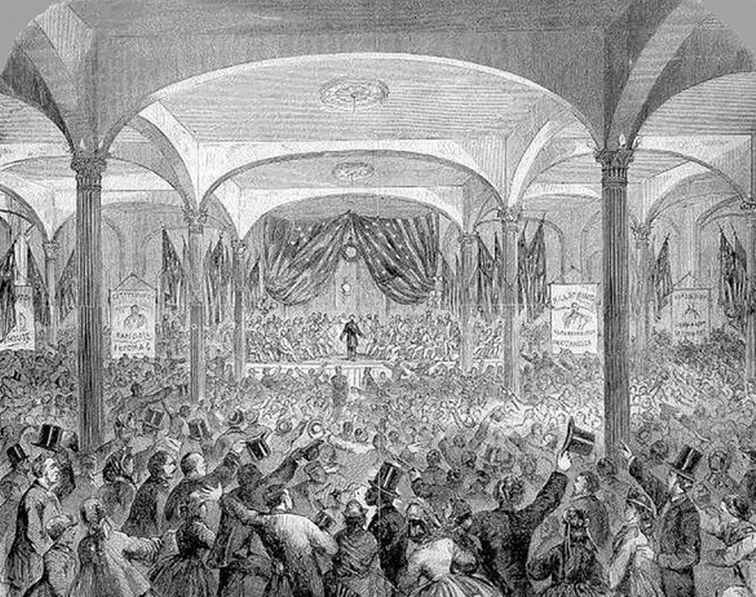
Artist rendition of Lincoln at Cooper Hall February 27 1860.
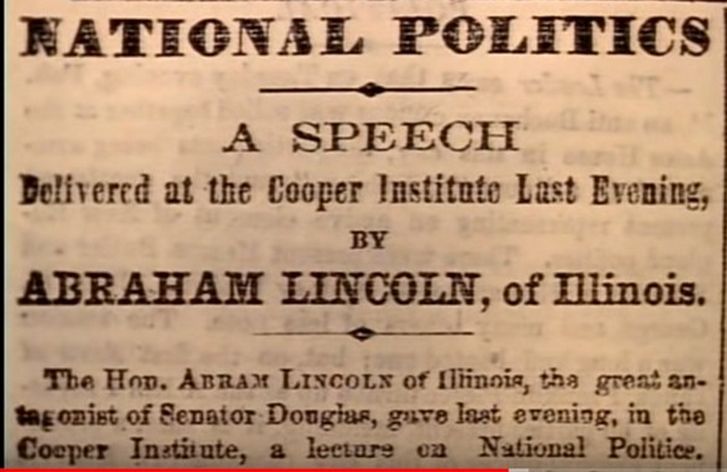
On the next page was a newspaper account of Lincoln’s speech published the next day:
Notes by the New York Young Republicans Club in September 1860 after several months researching the claims made in the speech and getting the permission of Lincoln to publish their notes:
[1] The Constitution is attested September 17, 1787. It was ratified by all of the States, excepting North Carolina and Rhode Island, in 1788, and went into operation on the first Wednesday in January, 1789. The first Congress proposed, in 1789, ten articles of amendments, all of which were ratified. Article XI. of the amendments was prepared by the Third Congress, in 1794, and Article XII. by the Eighth Congress, in 1803. Another Article was proposed by the Eleventh Congress, prohibiting citizens from receiving titles of nobility, presents or offices, from foreign nations. Although this has been printed as one of the amendments, it was in fact never ratified, being approved by but twelve States. Vide Message of President Monroe, Feb. 4, 1818.
[2] The Convention consisted of sixty-five members. Of these, ten did not attend the Convention, and sixteen did not sign the Constitution. Of these sixteen, six refused to sign, and published their reasons for so refusing, viz.: Robert Yates and John Lansing, of New-York; Edmund Randolph and George Mason, of Virginia; Luther Martin, of Maryland, and Elbridge Gerry, of Mass. Alexander Hamilton alone subscribed for New-York, and Rhode Island was not represented in the Convention. The names of the "thirty-nine," and the States which they represented are subsequently given.
[3] The cession of Territory was authorized by New-York, Feb. 19, 1780; by Virginia, January 2, 1781, and again, (without certain conditions at first imposed,) "at their sessions, begun on the 20th day of October, 1783;" by Mass., Nov. 13, 1784; by Conn., May——, 1786; by S. Carolina, March 8, 1787; by N. Carolina, Dec.——, 1789; and by Georgia at some time prior to April, 1802.
The deeds of cession were executed by New-York, March 1, 1781; by Virginia, March 1, 1784; by Mass., April 19, 1785; by Conn., Sept. 13, 1786; by S. Carolina, August 9, 1787; by N. Carolina, Feb. 25, 1790; and by Georgia, April 24, 1802. Five of these grants were therefore made before the adoption of the Constitution, and one afterward; while the sixth (North Carolina) was authorized before, and consummated afterward. The cession of this State contains the express proviso "that no regulations made, or to be made by Congress, shall tend to emancipate slaves." The cession of Georgia conveys the Territory subject to the Ordinance of '87, except the provision prohibiting slavery.
These dates are also interesting in connection with the extraordinary assertions of Chief Justice Taney, (19 How., page 434,) that "the example of Virginia was soon afterwards followed by other States," and that (p. 436) the power in the Constitution "to dispose of and make all needful rules and regulations respecting the Territory or other property belonging to the United States," was intended only "to transfer to the new Government the property then held in common," "and has no reference whatever to any Territory or other property which the new sovereignty might afterwards itself acquire." On this subject, vide Federalist, No. 43, sub. 4 and 5.
[4] Sherman was from Connecticut; Mifflin from Penn.; Williamson from North Carolina, and M'Henry from Maryland.
[5] What Mr. M'Henry's views were, it seems impossible to ascertain. When the Ordinance of '87 was passed he was sitting in the Convention. He was afterwards appointed Secretary of War; yet no record has thus far been discovered of his opinion. Mr. M'Henry also wrote a biography of La Fayette, which, however, cannot be found in any of the public libraries, among which may be mentioned the State Library at Albany, and the Astor, Society, and Historical Society Libraries, at New York. Hamilton says of him, in a letter to Washington (Works, vol. vi., p. 65): "M'Henry you know. He would give no strength to the Administration, but he would not disgrace the office; his views are good."
[6] William Blount was from North Carolina, and William Few from Georgia—the two States which afterward ceded their Territory to the United States. In addition to these facts the following extract from the speech of Rufus King in the Senate, on the Missouri Bill, shows the entire unanimity with which the Southern States approved the prohibition:
"The State of Virginia, which ceded to the United States her claims to this Territory, consented, by her delegates in the Old Congress, to this Ordinance. Not only Virginia, but North Carolina, South Carolina, and Georgia, by the unanimous votes of their delegates in the Old Congress, approved of the Ordinance of 1787, by which Slavery is forever abolished in the Territory northwest of the river Ohio. Without the votes of these States, the Ordinance could not have been passed; and there is no recollection of an opposition from any of these States to the act of confirmation passed under the actual Constitution."
[7] "The famous Ordinance of Congress of the 13th July, 1787, which has ever since constituted, in most respects, the model of all our territorial governments, and is equally remarkable for the brevity and exactness of its text, and for its masterly display of the fundamental principles of civil and religious liberty."—Justice Story, 1 Commentaries: §1312.
"It is well known that the Ordinance of 1787 was drawn by the Hon. Nathan Dane, of Massachusetts, and adopted with scarcely a verbal alteration by Congress. It is a noble and imperishable monument to his fame."—Id. note.
The ordinance was reported by a committee, of which Wm. S. Johnson and Charles Pinckney were members. It recites that, "for extending the fundamental principles of civil and religious liberty, which form the basis whereon these republics, their laws and constitutions, are erected; to fix and establish those principles as the basis of all laws, constitutions, and governments which forever hereafter shall be formed in the said Territory; to provide also for the establishment of States and permanent government, and for their admission to a share in the federal councils, on an equal footing with the original States, at as early periods as may be consistent with the general interest—
"It is hereby ordained and declared, by the authority aforesaid, that the following articles shall be considered as articles of compact between the original States and the people and States in the said Territory, and forever remain unalterable, unless by common consent, to wit:"
"Art. 6. There shall be neither slavery nor involuntary servitude in the said Territory otherwise than in the punishment of crimes whereof the party shall have been duly convicted; provided always that any person escaping into the same, from whom labor or service is lawfully claimed in any one of the original States, such fugitive may be lawfully reclaimed, and conveyed to the person claiming his or her labor or service."
On passing the ordinance, the ayes and nays were required by Judge Yates, of New York, when it appeared that his was the only vote in the negative.
The ordinance of April 23, 1784, was a brief outline of that of '87. It was reported by a Committee, of which Mr. Jefferson was chairman, and the report contained a slavery prohibition intended to take effect in 1800. This was stricken out of the report, six States voting to retain it—three voting to strike out—one being divided (N.C.), and the others not being represented. (The assent of nine States was necessary to retain any provision.) And this is the vote alluded to by Mr. Lincoln. But subsequently, March 16, 1785, a motion was made by Rufus King to commit a proposition "that there be neither slavery nor involuntary servitude" in any of the Territories; which was carried by the vote of eight States, including Maryland.—Journal Am. Congress, vol. 4, pp. 373, 380, 481, 752.
When, therefore, the ordinance of '87 came before Congress, on its final passage, the subject of slavery prohibition had been "agitated" for nearly three years; and the deliberate and almost unanimous vote of that body upon that question leaves no room to doubt what the fathers believed, and how, in that belief, they acted.
[8] It singularly and fortunately happens that one of the "thirty-nine," "while engaged on that instrument," viz., while advocating its ratification before the Pennsylvania Convention, did express an opinion upon this "precise question," which opinion was never disputed or doubted, in that or any other Convention, and was accepted by the opponents of the Constitution, as an indisputable fact. This was the celebrated James Wilson, of Pennsylvania. The opinion is as follows:
MONDAY, Dec. 3, 1787.
"With respect to the clause restricting Congress from prohibiting the migration or importation of such persons as any of the States now existing shall think proper to admit, prior to the year 1808: The Hon. gentleman says that this clause is not only dark, but intended to grant to Congress, for that time, the power to admit the importation of slaves. No such thing was intended; but I will tell you what was done, and it gives me high pleasure that so much was done. Under the present Confederation, the States may admit the importation of slaves as long as they please; but by this article, after the year 1808, the Congress will have power to prohibit such importation, notwithstanding the disposition of any State to the contrary. I consider this as laying the foundation for banishing slavery out of this country; and though the period is more distant than I could wish, yet it will produce the same kind, gradual change which was pursued in Pennsylvania. It is with much satisfaction that I view this power in the general government, whereby they may lay an interdiction on this reproachful trade. But an immediate advantage is also obtained; for a tax or duty may be imposed on such importation, not exceeding $10 for each person; and this, sir, operates as a partial prohibition; it was all that could be obtained. I am sorry it was no more; but from this I think there is reason to hope that yet a few years, and it will be prohibited altogether. And in the meantime, the new States which are to be formed will be under the control of Congress in this particular, and slaves will never be introduced amongst them."—2 Elliott's Debates, 423.
It was argued by Patrick Henry in the Convention in Virginia, as follows:
"May not Congress enact that every black man must fight? Did we not see a little of this in the last war? We were not so hard pushed as to make emancipation general. But acts of Assembly passed, that every slave who would go to the army should be free. Another thing will contribute to bring this event about. Slavery is detested. We feel its fatal effects. We deplore it with all the pity of humanity. Let all these considerations press with full force on the minds of Congress. Let that urbanity which, I trust, will distinguish America, and the necessity of national defence—let all these things operate on their minds, they will search that paper, and see if they have power of manumission. And have they not, sir? Have they not power to provide for the general defence and welfare? May they not think that these call for the abolition of slavery? May they not pronounce all slaves free, and will they not be warranted by that power? There is no ambiguous implication, no logical deduction. The paper speaks to the point; they have the power in clear, unequivocal terms, and will clearly and certainly exercise it."—3 Elliott's Debates, 534.
Edmund Randolph, one of the framers of the Constitution, replied to Mr. Henry, admitting the general force of the argument, but claiming that, because of other provisions, it had no application to the States where slavery then existed; thus conceding that power to exist in Congress as to all territory belonging to the United States.
Dr. Ramsay, a member of the Convention of South Carolina, in his history of the United States, vol. 3, pages 36, 37, says: "Under these liberal principles, Congress, in organizing colonies, bound themselves to impart to their inhabitants all the privileges of coequal States, as soon as they were capable of enjoying them. In their infancy, government was administered for them without any expense. As soon as they should have 60,000 inhabitants, they were authorized to call a convention, and, by common consent, to form their own constitution. This being done, they were entitled to representation in Congress, and every right attached to the original States. These privileges are not confined to any particular country or complexion. They are communicable to the emancipated slave (for in the new State of Ohio, slavery is altogether prohibited), to the copper-colored native, and all other human beings who, after a competent residence and degree of civilization, are capable of enjoying the blessings of regular government."
[9] The Act of 1789, as reported by the Committee, was received and read Thursday, July 16th. The second reading was on Friday, the 17th, when it was committed to the Committee of the whole house, "on Monday next." On Monday, July 20th, it was considered in Committee of the whole, and ordered to a third reading on the following day; on the 21st, it passed the House, and was sent to the Senate. In the Senate it had its first reading on the same day, and was ordered to a second reading on the following day (July 22d), and on the 4th of August it passed, and on the 7th was approved by the President.
[10] The "sixteen" represented these States: Langdon and Oilman, New Hampshire; Sherman and Johnson, Connecticut; Morris, Fitzsimmons, and Clymer, Pennsylvania; King, Massachusetts; Paterson, New Jersey; Few and Baldwin, Georgia; Bassett and Read, Delaware; Butler, South Carolina; Carroll, Maryland; and Madison, Virginia
[11] Vide note 3, ante.
[12] Chap. 28, § 7, U.S. Statutes, 5th Congress, 2d Session.
[13] Langdon was from New Hampshire, Read from Delaware, and Baldwin from Georgia.
[14] Chap. 38, § 10, U.S. Statutes, 8th Congress, 1st Session.
[15] Baldwin was from Georgia, and Dayton from New Jersey.
[16] Rufus King, who sat in the old Congress, and also in the Convention, as the representative of Massachusetts, removed to New York and was sent by that State to the U.S. Senate of the first Congress. Charles Pinckney was hi the House, as a representative of South Carolina.
[17] Although Mr. Pinckney opposed "slavery prohibition" in 1820, yet his views, with regard to the powers of the general government, may be better judged by his actions in the Convention:
FRIDAY, June 8th, 1787.—"Mr. Pinckney moved 'that the National Legislature shall have the power of negativing all laws to be passed by the State Legislatures, which they may judge improper,' in the room of the clause as it stood reported.
"He grounds his motion on the necessity of one supreme controlling power, and he considers this as the corner-stone of the present system; and hence the necessity of retrenching the State authorities, in order to preserve the good government of the national council."—T. 400, Elliott's Debates.
And again, THURSDAY, August 23d, 1787, Mr. Pinckney renewed the motion with some modifications.—T. 1409. Madison Papers.
And although Mr. Pinckney, as correctly stated by Mr. Lincoln, "steadily voted against slavery prohibition, and against all compromises," he still regarded the passage of the Missouri Compromise as a great triumph of the South, which is apparent from the following letter:
CONGRESS HALL, March 2d, 1820, 3 o'clock at night.
DEAR SIR:——I hasten to inform you, that this moment we have carried the question to admit Missouri, and all Louisiana to the southward of 36° 30', free from the restriction of slavery, and give the South, in a short time, an addition of six, perhaps eight, members to the Senate of the United States. It is considered here by the slave holding States as a great triumph.
The votes were close—ninety to eighty-six—produced by the seceding and absence of a few moderate men from the North. To the north of 36° 30,' there is to be, by the present law, restriction; which you will see by the votes, I voted against. But it is at present of no moment; it is a vast tract, uninhabited, only by savages and wild beasts, in which not a foot of the Indian claims to soil is extinguished, and in which, according to the ideas prevalent, no land office will be opened for a great length of time.
With respect, your obedient servant,
CHARLES PINCKNEY.
But conclusive evidence of Mr. Pinckney's views is furnished in the fact that he was himself a member of the Committee which reported the Ordinance of '87, and that on every occasion, when it was under the consideration of Congress, he voted against all amendments.—Jour. Am. Congress, Sept. 29th, 1786. Oct. 4th. When the ordinance came up for its final passage, Mr. Pinckney was sitting in the Convention, and did not take any part in the proceedings of Congress.
[18] By reference to notes 4, 6, 10, 13, 15, and 16 it will be seen that, of the twenty-three who acted upon the question of prohibition, twelve were from the present slaveholding States.
[19 Vide notes 5 and 17, ante.
[20] "The remaining sixteen" were Nathaniel Gorham, Massachusetts; Alex. Hamilton, New York; William Livingston and David Brearly, New Jersey; Benjamin Franklin, Jared Ingersoll, James Wilson, and Gouverneur Morris, Pennsylvania; Gunning Bedford, John Dickinson, and Jacob Broom, Delaware; Daniel, of St. Thomas, Jenifer, Maryland; John Blair, Virginia; Richard Dobbs Spaight, North Carolina; and John Rutledge and Charles Cotesworth Pinckney, South Carolina.
[21] "The only distinction between freedom and slavery consists in this: in the former state, a man is governed by the laws to which he has given his consent, either in person or by his representative; in the latter, he is governed by the will of another. In the one case, his life and property are his own; in the other, they depend upon the pleasure of a master. It is easy to discern which of the two states is preferable. No man in his senses can hesitate in choosing to be free rather than slave.... Were not the disadvantages of slavery too obvious to stand in need of it, I might enumerate and describe the tedious train of calamities inseparable from it. I might show that it is fatal to religion and morality; that it tends to debase the mind, and corrupt its noblest springs of action. I might show that it relaxes the sinews of industry and clips the wings of commerce, and works misery and indigence in every shape."—HAMILTON, Works, vol. 2, pp. 3, 9.
"That you will be pleased to countenance the restoration of liberty to those unhappy men, who, alone in this land of freedom, are degraded into perpetual bondage, and who, amidst the general joy of surrounding freemen, are groaning in servile subjection; that you will devise means for removing this inconsistency from the character of the American people; that you will promote mercy and justice toward this distressed race; and that you will step to the very verge of the power vested in you for discouraging every species of traffic in the persons of our fellow-men."—Philadelphia, Feb. 3rd, 1790. Franklin's Petition to Congress for the Abolition of Slavery.
Mr. Gouverneur Morris said: "He never would concur in upholding domestic slavery. It was a notorious institution. It was the curse of heaven on the States where it prevailed.... The admission of slavery into the representation, when fairly explained, comes to this—that the inhabitant of South Carolina or Georgia, who goes to the coast of Africa, and, in defiance of the most sacred laws of humanity, tears away his fellow-creatures from their dearest connections, and damns them to the most cruel bondage, shall have more votes, in a government instituted for the protection of the rights of mankind, than the citizen of Pennsylvania or New Jersey, who views with a laudable horror so notorious a practice.... He would sooner submit himself to a tax for paying for all the negroes in the United States than saddle posterity with such a constitution."—Debate on Slave Representation in the Convention. Madison Papers.
[22] An eminent jurist (Chancellor Walworth) has said that "The preamble which was prefixed to these amendments, as adopted by Congress, is important to show in what light that body considered them." (8 Wend. R., p. 100.) It declares that a number of the State Conventions "having at the time of their adopting the Constitution expressed a desire, in order to prevent misconstruction or abuse of its powers, that further declaratory and restrictive clauses should be added," resolved, etc.
This preamble is in substance the preamble affixed to the "Conciliatory Resolutions" of Massachusetts, which were drawn by Chief Justice Parsons, and offered in the Convention as a compromise by John Hancock. (Life Ch. J. Parsons, p. 67.) They were afterward copied and adopted with some additions by New Hampshire.
The fifth amendment, on which the Supreme Court relies, is taken almost literally from the declaration of rights put forth by the Convention of New York, and the clause referred to forms the ninth paragraph of the declaration. The tenth amendment, on which Senator Douglas relies, is taken from the Conciliatory Resolutions, and is the first of those resolutions somewhat modified. Thus, these two amendments, sought to be used for slavery, originated in the two great anti-slavery States, New York and Massachusetts.
[23] The amendments were proposed by Mr. Madison in the House of Representatives, June 8, 1789. They were adopted by the House, August 24, and some further amendments seem to have been transmitted by the Senate, September 9. The printed journals of the Senate do not state the time of the final passage, and the message transmitting them to the State Legislatures speaks of them as adopted at the first session, begun on the fourth day of March, 1789. The date of the introduction and passage of the act enforcing the Ordinance of '87 will be found at note 9, ante.
[24] It is singular that while two of the "thirty-nine" were in that Congress of 1819, there was but one (besides Mr. King) of the "seventy-six." The one was William Smith, of South Carolina. He was then a Senator, and, like Mr. Pinckney, occupied extreme Southern ground.
[25] The following is an extract from the letter referred to:
"I agree with you cordially in your views in regard to negro slavery. I have long considered it a most serious evil, both socially and politically, and I should rejoice in any feasible scheme to rid our States of such a burden. The Congress of 1787 adopted an ordinance which prohibits the existence of involuntary servitude in our Northwestern Territory forever. I consider it a wise measure. It meets with the approval and assent of nearly every member from the States more immediately interested in slave labor. The prevailing opinion in Virginia is against the spread of slavery in our new Territories, and I trust we shall have a confederation of free States."
The following extract from a letter of Washington to Robert Morris, April, 12th, 1786, shows how strong were his views, and how clearly he deemed emancipation a subject for legislative enactment: "I can only say that there is no man living who wishes more sincerely than I do to see a plan adopted for the abolition of it; but there is but one proper and effective mode by which it can be accomplished, and that is, BY LEGISLATIVE AUTHORITY, and that, as far as my suffrage will go, shall never be wanting."
[26] A Committee of five, consisting of Messrs. Mason, Davis, and Fitch (Democrats), and Collamer and Doolittle (Republicans), was appointed Dec. 14, 1859, by the U.S. Senate, to investigate the Harper's Ferry affair. That Committee was directed, among other things, to inquire: (1) "Whether such invasion and seizure was made under color of any organization intended to subvert the government of any of the States of the Union." (2) "What was the character and extent of such organisation." (3) "And whether any citizens of the United States, not present, were implicated therein, or accessory thereto, by contributions of money, arms, munitions, or otherwise."
The majority of the Committee, Messrs. Mason, Davis, and Fitch, reply to the inquiries as follows:
1. "There will be found in the Appendix a copy of the proceedings of a Convention held at Chatham, Canada, of the Provisional Form of Government there pretended to have been instituted, the object of which clearly was to subvert the government of one or more States, and of course, to that extent, the government of the United States." By reference to the copy of Proceedings it appears that nineteen persons were present at that Convention, eight of whom were either killed or executed at Charlestown, and one examined before the Committee.
2. "The character of the military organization appears, by the commissions issued to certain of the armed party as captains, lieutenants, etc., a specimen of which will be found in the Appendix."
(These Commissions are signed by John Brown as Commander-in-Chief, under the Provisional Government, and by J.H. Kagi as Secretary.)
"It clearly appeared that the scheme of Brown was to take with him comparatively but few men; but those had been carefully trained by military instruction previously, and were to act as officers. For his military force he relied, very clearly, on inciting insurrection amongst the Slaves."
3. "It does not appear that the contributions were made with actual knowledge of the use for which they were designed by Brown, although it does appear that money was freely contributed by those styling themselves the friends of this man Brown, and friends alike of what they styled the cause of freedom (of which they claimed him to be an especial apostle), without inquiring as to the way in which the money would be used by him to advance such pretended cause."
In concluding the report the majority of the Committee thus characterize the "invasion": "It was simply the act of lawless ruffians, under the sanction of no public or political authority—distinguishable only from ordinary felonies by the ulterior ends in contemplation by them," etc.
[27] The Southampton insurrection, August, 1831, was induced by the remarkable ability of a slave calling himself General Nat Turner. He led his fellow bondsmen to believe that he was acting under the order of Heaven. In proof of this he alleged that the singular appearance of the sun at that time was a divine signal for the commencement of the struggle which would result in the recovery of their freedom. This insurrection resulted in the death of sixty-four white persons, and more than one hundred slaves. The Southampton was the eleventh large insurrection in the Southern States, besides numerous attempts and revolts.
[28] In March, 1790, the General Assembly of France, on the petition of the free people of color in St. Domingo, many of whom were intelligent and wealthy, passed a decree intended to be in their favor, but so ambiguous as to be construed in favor of both the whites and the blacks. The differences growing out of the decree created two parties—the whites and the people of color; and some blood was shed. In 1791, the blacks again petitioned, and a decree was passed declaring the colored people citizens, who were born of free parents on both sides. This produced great excitement among the whites, and the two parties armed against each other, and horrible massacres and conflagrations followed. Then the Assembly rescinded this last decree, and like results followed, the blacks being the exasperated parties and the aggressors. Then the decree giving citizenship to the blacks was restored, and commissioners were sent out to keep the peace. The commissioners, unable to sustain themselves, between the two parties, with the troops they had, issued a proclamation that all blacks who were willing to range themselves under the banner of the Republic should be free. As a result a very large proportion of the blacks became in fact free. In 1794, the Conventional Assembly abolished slavery throughout the French Colonies. Some years afterward, the French Government sought, with an army of 60,000 men, to reinstate slavery, but were unsuccessful, and then the white planters were driven from the Island.
[29] Vide Jefferson's Autobiography, commenced January 6th, 1821. JEFFERSON'S Works, vol. 1, p. 49.
[30] "I am not ashamed or afraid publicly to avow that the election of William H. Seward or Salmon P. Chase, or any such representative of the Republican party, upon a sectional platform, ought to be resisted to the disruption of every tie that binds this Confederacy together. (Applause on the Democratic side of the House.)" Mr. Curry, of Alabama, in the House of Representatives.
"Just so sure as the Republican party succeed in electing a sectional man, upon their sectional, anti-slavery platform, breathing destruction and death to the rights of my people, just so sure, in my judgment, the time will have come when the South must and will take an unmistakable and decided action, and then he who dallies is a dastard, and he who doubts is damned! I need not tell what I, a Southern man, will do. I think I may safely speak for the masses of the people of Georgia—that when that event happens, they, in my judgment, will consider it an overt act, a declaration of war, and meet immediately in convention, to take into consideration the mode and measure of redress. That is my position; and if that be treason to the Government, make the most of it."—Mr. Gartell, of Georgia, in the House of Representatives.
"I said to my constituents, and to the people of the capital of my State, on my way here, if such an event did occur," [i.e., the election of a Republican President, upon a Republican platform], "while it would be their duty to determine the course which the State would pursue, it would be my privilege to counsel with them as to what I believed to be the proper course; and I said to them, what I say now, and what I will always say in such an event, that my counsel would be to take independence out of the Union in preference to the loss of constitutional rights, and consequent degradation and dishonor, in it. That is my position, and it is the position which I know the Democratic party of the State of Mississippi will maintain."—Gov. McRae, of Mississippi.
"It is useless to attempt to conceal the fact that, in the present temper of the Southern people, it" [i.e., the election of a Republican President] "cannot be, and will not be, submitted to. The 'irrepressible conflict' doctrine, announced and advocated by the ablest and most distinguished leader of the Republican party, is an open declaration of war against the institution of slavery, wherever it exists; and I would be disloyal to Virginia and the South, if I did not declare that the election of such a man, entertaining such sentiment, and advocating such doctrines, ought to be resisted by the slaveholding States. The idea of permitting such a man to have the control and direction of the army and navy of the United States, and the appointment of high judicial and executive officers, POSTMASTERS INCLUDED, cannot be entertained by the South for a moment."—Gov. Letcher, of Virginia.
"Slavery must be maintained—in the Union, if possible; out of it, if necessary: peaceably if we may; forcibly if we must."—Senator Iverson, of Georgia.
"Lincoln and Hamlin, the Black Republican nominees, will be elected in November next, and the South will then decide the great question whether they will submit to the domination of Black Republican rule—the fundamental principle of their organization being an open, undisguised, and declared war upon our social institutions. I believe that the honor and safety of the South, in that contingency, will require the prompt secession of the slaveholding States from the Union; and failing then to obtain from the free States additional and higher guaranties for the protection of our rights and property, that the seceding States should proceed to establish a new government. But while I think such would be the imperative duty of the South, I should emphatically reprobate and repudiate any scheme having for its object the separate secession of South Carolina. If Georgia, Alabama, and Mississippi alone—giving us a portion of the Atlantic and Gulf coasts—would unite with this State in a common secession upon the election of a Black Republican, I would give my consent to the policy."—Letter of Hon. James L. Orr, of S.C., to John Martin and others, July 23, 1860.
[31] The Hon. John A. Andrew, of the Boston Bar, made the following analysis of the Dred Scott case in the Massachusetts Legislature. Hon. Caleb Cushing was then a member of that body, but did not question its correctness.
"On the question of possibility of citizenship to one of the Dred Scott color, extraction, and origin, three Justices, viz., Taney, Wayne, and Daniels, held the negative. Nelson and Campbell passed over the plea by which the question was raised. Grier agreed with Nelson. Catron said the question was not open. McLean agreed with Catron, but thought the plea bad. Curtis agreed that the question was open, but attacked the plea, met its averments, and decided that a free-born colored person, native to any State, is a citizen thereof by birth, and is therefore a citizen of the Union, and entitled to sue in the Federal Courts.
"Had a majority of the court directly sustained the plea in abatement, and denied the jurisdiction of the Circuit Court appealed from, then all else they could have said and done would have been done and said in a cause not theirs to try and not theirs to discuss. In the absence of such a majority, one step more was to be taken. And the next step reveals an agreement of six of the Justices, on a point decisive of the cause, and putting an end to all the functions of the court.
"It is this. Scott was first carried to Rock Island, in the State of Illinois, where he remained about two years, before going with his master to Fort Snelling, in the Territory of Wisconsin. His claim to freedom was rested on the alleged effect of his translation from a slave State, and again into a free territory. If, by his removal to Illinois, he became emancipated from his master, the subsequent continuance of his pilgrimage into the Louisiana purchase could not add to his freedom, nor alter the fact. If, by reason of any want or infirmity in the laws of Illinois, or of conformity on his part to their behests, Dred Scott remained a slave while he remained in that State, then—for the sake of learning the effect on him of his territorial residence beyond the Mississippi, and of his marriage and other proceedings there, and the effect of the sojournment and marriage of Harriet, in the same territory, upon herself and her children—it might become needful to advance one other step into the investigation of the law; to inspect the Missouri Compromise, banishing slavery to the south of the line of 36° 30' in the Louisiana purchase.
"But no exigency of the cause ever demanded or justified that advance; for six of the Justices, including the Chief Justice himself, decided that the status of the plaintiff, as free or slave, was dependent, not upon the laws of the State in which he had been, but of the State of Missouri, in which he was at the commencement of the suit. The Chief Justice asserted that 'it is now firmly settled by the decisions of the highest court in the State, that Scott and his family, on their return were not free, but were, by the laws of Missouri, the property of the defendant.' This was the burden of the opinion of Nelson, who declares 'the question is one solely depending upon the law of Missouri, and that the Federal Court, sitting in the State, and trying the case before us, was bound to follow it.' It received the emphatic endorsement of Wayne, whose general concurrence was with the Chief Justice. Grier concurred in set terms with Nelson on all 'the questions discussed by him.' Campbell says, 'The claim of the plaintiff to freedom depends upon the effect to be given to his absence from Missouri, in company with his master in Illinois and Minnesota, and this effect is to be ascertained by reference to the laws of Missouri.' Five of the Justices, then (if no more of them), regard the law of Missouri as decisive of the plaintiff's rights."
[32] "Now, as we have already said in an earlier part of this opinion upon a different point, the right of property in a slave is distinctly and expressly affirmed in the Constitution. The right to traffic in it, like an ordinary article of merchandise and property, was guaranteed to the citizens of the United States in every State that might desire it, for twenty years."—Ch. J. Taney, 19 How. U.S.R., p. 451. Vide language of Mr. Madison, note 34, as to "merchandise."
[33] Not only was the right of property not intended to be "distinctly and expressly affirmed in the Constitution"; but the following extract from Mr. Madison demonstrates that the utmost care was taken to avoid so doing:
"The clause as originally offered [respecting fugitive slaves] read, 'If any person LEGALLY bound to service or labor in any of the United States shall escape into another State," etc., etc. (Vol. 3, p. 1456.) In regard to this, Mr. Madison says, "The term 'legally' was struck out, and the words 'under the laws thereof,' inserted after the word State, in compliance with the wish of some who thought the term 'legally' equivocal and favoring the idea that slavery was legal in a moral point of view."—Ib., p. 1589.
[34] We subjoin a portion of the history alluded to by Mr. Lincoln. The following extract relates to the provision of the Constitution relative to the slave trade. (Article I, Sec. 9.)
25th August, 1787.—The report of the Committee of eleven being taken up, Gen. [Charles Cotesworth] Pinckney moved to strike out the words "the year 1800," and insert the words "the year 1808."
Mr. Gorham seconded the motion.
Mr. Madison—Twenty years will produce all the mischief that can be apprehended from the liberty to import slaves. So long a term will be more dishonorable to the American character than to say nothing about it in the Constitution.
Mr. Gouverneur Morris was for making the clause read at once—
"The importation of slaves into North Carolina, South Carolina, and Georgia, shall not be prohibited," etc. This, he said, would be most fair, and would avoid the ambiguity by which, under the power with regard to naturalization, the liberty reserved to the States might be defeated. He wished it to be known, also, that this part of the Constitution was a compliance with those States. If the change of language, however, should be objected to by the members from those States, he should not urge it.
Col. Mason (of Virginia) was not against using the term "slaves," but against naming North Carolina, South Carolina, and Georgia, lest it should give offence to the people of those States.
Mr. Sherman liked a description better than the terms proposed, which had been declined by the old Congress and were not pleasing to some people.
Mr. Clymer concurred with Mr. Sherman.
Mr. Williamson, of North Carolina, said that both in opinion and practice he was against slavery; but thought it more in favor of humanity, from a view of all circumstances, to let in South Carolina and Georgia, on those terms, than to exclude them from the Union.
Mr. Morris withdrew his motion.
Mr. Dickinson wished the clause to be confined to the States which had not themselves prohibited the importation of slaves, and for that purpose moved to amend the clause so as to read—
"The importation of slaves into such of the States as shall permit the same, shall not be prohibited by the Legislature of the United States, until the year 1808," which was disagreed to, nem. con.
The first part of the report was then agreed to as follows:
"The migration or importation of such persons as the several States now existing shall think proper to admit, shall not be prohibited by the Legislature prior to the year 1808."
Mr. Sherman was against the second part ["but a tax or duty may be imposed on such migration or importation at a rate not exceeding the average of the duties laid on imports"], as acknowledging men to be property by taxing them as such under the character of slaves.
Mr. Madison thought it wrong to admit in the Constitution the like idea that there could be property in men. The reason of duties did not hold, as slaves are not, like merchandise, consumed.
It was finally agreed, nem. con., to make the clause read—
"But a tax or duty may be imposed on such importation, not exceeding ten dollars for each PERSON."—Madison Papers, Aug. 25, 1787.
[35] Compare this noble passage and that at page 18, with the twaddle of Mr. Orr (note 30), and the slang of Mr. Douglas (note 37).
[36] That demand has since been made. Says MR. O'CONOR, counsel for the State of Virginia in the Lemon Case, page 44: "We claim that under these various provisions of the Federal Constitution, a citizen of Virginia has an immunity against the operation of any law which the State of New York can enact, whilst he is a stranger and wayfarer, or whilst passing through our territory; and that he has absolute protection for all his domestic rights, and for all his rights of property, which under the laws of the United States, and the laws of his own State, he was entitled to, whilst in his own State. We claim this, and neither more NOR LESS."
Throughout the whole of that case, in which the right to pass through New York with slaves at the pleasure of the slave owners is maintained, it is nowhere contended that the statute is contrary to the Constitution of New York; but that the statute and the Constitution of the State are both contrary to the Constitution of the United States.
The State of Virginia, not content with the decision of our own courts upon the right claimed by them, is now engaged in carrying this, the Lemon case, to the Supreme Court of the United States, hoping by a decision there, in accordance with the intimations in the Dred Scott case, to overthrow the Constitution of New York.
Senator Toombs, of Georgia, has claimed, in the Senate, that laws of Connecticut, Maine, Massachusetts, Michigan, New Hampshire, Ohio, Rhode Island, Vermont, and Wisconsin, for the exclusion of slavery, conceded to be warranted by the State Constitutions, are contrary to the Constitution of the United States, and has asked for the enactment of laws by the General Government which shall override the laws of those States and the Constitutions which authorize them.
[37] "Policy, humanity, and Christianity, alike forbid the extension of the evils of free society to new people and coming generations."—Richmond Enquirer, Jan. 22, 1856.
"I am satisfied that the mind of the South has undergone a change to this great extent, that it is now the almost universal belief in the South, not only that the condition of African slavery in their midst, is the best condition to which the African race has ever been subjected, but that it has the effect of ennobling both races, the white and the black."—Senator Mason, of Virginia.
"I declare again, as I did in reply to the Senator from Wisconsin (Mr. Doolittle), that, in my opinion, slavery is a great moral, social, and political blessing—a blessing to the slave, and a blessing to the master."—Mr. Brown, in the Senate, March 6, 1860.
"I am a Southern States' Rights man; I am an African slave-trader. I am one of those Southern men who believe that slavery is right—morally, religiously, socially, and politically." (Applause.) ... "I represent the African Slave-trade interests of that section. (Applause.) I am proud of the position I occupy in that respect. I believe the African Slave-trader is a true missionary and a true Christian." (Applause.)—Mr. Gaulden, a delegate from First Congressional District of Georgia, in the Charleston Convention, now a supporter of Mr. Douglas.
"Ladies and gentlemen, I would gladly speak again, but you see from the tones of my voice that I am unable to. This has been a happy, a glorious day. I shall never forget it. There is a charm about this beautiful day, about this sea air, and especially about that peculiar institution of yours—a clam bake. I think you have the advantage, in that respect, of Southerners. For my own part, I have much more fondness for your clams than I have for their niggers. But every man to his taste."—Hon Stephen A. Douglas's Address at Rocky Point, R.I., Aug. 2, 1860.
[38] It is interesting to observe how two profoundly logical minds, though holding extreme, opposite views, have deduced this common conclusion. Says Mr. O'Conor, the eminent leader of the New York Bar, and the counsel for the State of Virginia in the Lemon case, in his speech at Cooper Institute, December 19th, 1859:
"That is the point to which this great argument must come—Is negro slavery unjust? If it is unjust, it violates that first rule of human conduct—'Render to every man his due.'
If it is unjust, it violates the law of God which says, 'Love thy neighbor as thyself,' for that requires that we should perpetrate no injustice. Gentlemen, if it could be maintained that negro slavery was unjust, perhaps I might be prepared—perhaps we all ought to be prepared—to go with that distinguished man to whom allusion is frequently made, and say, 'There is a higher law which compels us to trample beneath our feet the Constitution established by our fathers, with all the blessings it secures to their children.' But I insist—and that is the argument which we must meet, and on which we must come to a conclusion that shall govern our actions in the future selection of representatives in the Congress of the United States—insist that negro slavery is not unjust."